
Federal Judge Rules Houston Violated First Amendment Rights of Food Not Bombs Activists
Houston police issued over 100 tickets to Food Not Bombs activists for violating an anti–food sharing ordinance. That violated their First Amendment rights, a judge ruled.
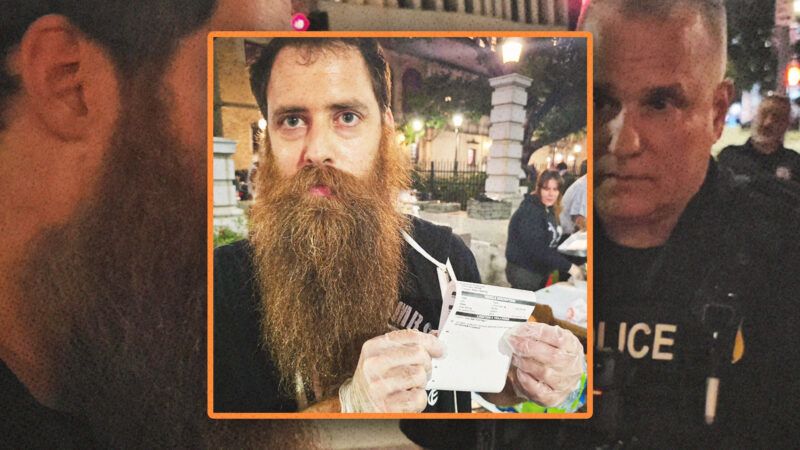
A federal judge ruled Tuesday that the city of Houston violated the First Amendment when it tried to stop activists from giving away free food outside a downtown library and issued more than 100 tickets to them.
U.S. District Judge for the Southern District of Texas Andrew S. Hanen found that Houston's enforcement of an ordinance prohibiting charitable food giveaways in public was unconstitutional as applied to the Houston chapter of Food Not Bombs (FNBH), a volunteer group that distributes free food in cities worldwide.
The ruling is the latest in a series of legal battles between Food Not Bombs chapters across the country—who argue that feeding the needy is expressive conduct under the First Amendment—and city officials, who say that unpermitted food distribution creates safety, liability, and litter problems.
"This week's ruling confirms what we have known all along: feeding our neighbors should not be a crime," Randy Hiroshige, a staff attorney at the Texas Civil Rights Project, said in a press release. "In the face of the City's cruel crackdown on charitable feeding, Food Not Bombs Houston had the courage to continue sharing its message and sharing meals, and we are proud to see that courage vindicated today."
The Texas Civil Rights Project filed a First Amendment lawsuit on behalf of the FNBH in 2024, a year after Houston police started issuing citations to FNBH members for violating a 2012 ordinance that outlaws providing free food to more than five people "in need" at outdoor locations without permission. The suit argued that Houston's anti–food sharing ordinance was unconstitutional both on its face and as applied to the FNBH by imposing an invalid prior restraint on the activists' First Amendment rights.
FNBH activists had operated at a downtown public park for more than a decade without incident—until 2023, when Houston officials wanted the FNBH to move to a city-approved parking lot for all homeless services. The activists insisted they had a First Amendment right to give out free food in public, with or without the city's permission. Houston police ultimately issued 111 citations for violating the ordinance.
However, attempts to enforce the ordinance did not go well. One activist was acquitted, and other cases were dismissed and delayed because prosecutors couldn't find jurors who were willing to fine people $500 for the crime of feeding the needy.
Hanen's ruling this week was not a surprise: He issued a preliminary injunction in 2024 blocking Houston from enforcing the ordinance after finding that the FNBH was likely to prevail on its First Amendment claims.
Hanen's ruling found that the Houston ordinance's requirement to obtain permission to distribute food was an invalid content-neutral regulation as applied to the FNBH. Hanen did not address the FNBH's facial challenge to the ordinance, citing circuit court precedent that required him to stop his analysis after determining the law was unconstitutional as applied.
Hanen ordered the FNBH and Houston to submit a proposal for a permanent injunction in 30 days that will allow the FNBH to continue operating while minimizing litter and other public nuisances.
Hanen's ruling drew on previous cases that have largely found that charitable activities can be forms of political and religious expression. The U.S. Court of Appeals for the 11th Circuit ruled in 2018 that distributing food was "expressive conduct" protected under the First Amendment. That decision was a response to a lawsuit by the Food Not Bombs chapter in Fort Lauderdale, Florida.
Nevertheless, similar cases keep popping up around the country. In May, police in Tulsa, Oklahoma, arrested four Food Not Bombs activists who insisted they had a First Amendment right to distribute food.
The Food Not Bombs chapter of Roswell, New Mexico, sued the city earlier this year, arguing that the city's permit and insurance requirements violated the group's constitutional rights. The city of Roswell eventually settled with the group.
Reason has also covered government suppression of food charities in Tampa, Florida; Orlando, Florida; Atlanta; Newark, New Jersey; Las Vegas; San Antonio, Texas; Philadelphia; and Kansas City, Missouri. In the latter case, health officials poured bleach on food meant for the homeless in 2018.
John Locke, a member of Food Not Bombs Houston, said in a press statement that the group's work has always been about more than just sharing food. "It's a form of protest against a system that allows people to go hungry while food and resources are all around us," he said. "We shouldn't have to fight for the right to feed people, but we did, and we won. And we're going to keep showing up."
The City of Houston did not immediately respond to a request for comment.