

The DSA's Coming-Out Party
Today begins the era when out-and-proud socialists will have real pull in Washington, D.C.
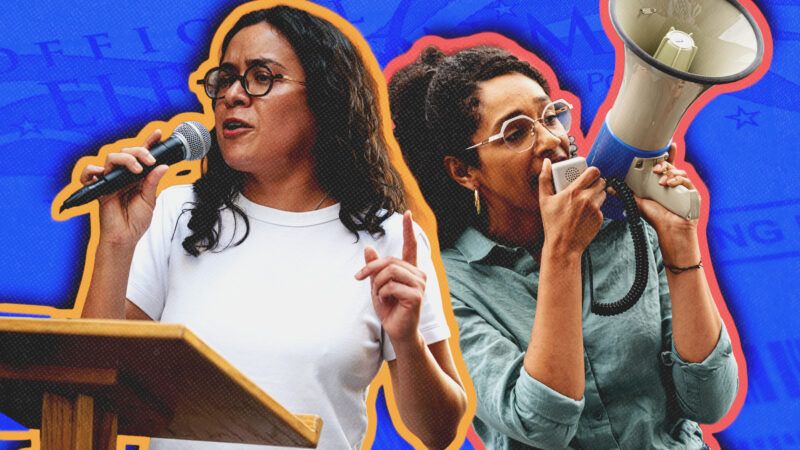
It's not hard to minimize today's national coming-out party for the Democratic Socialists of America. Yes, the DSA caucus in the House of Representatives is poised to quadruple in size. But growing from just two members (New York's Alexandria Ocasio-Cortez and Michigan's Rashida Tlaib) to around eight will only achieve the socialists' numerical parity with the Congressional Ski and Snowboard Caucus.
But that's an overly DSA-centric view of the socialistic left. Sen. Bernie Sanders (I—Vt.), the universally acknowledged godfather of the movement, is not technically a member of the DSA. Neither is the candidate who today is setting the most red hearts aflutter, Michigan's Abdul El-Sayed, a "socialist in all but name," as Reason's Robby Soave has pointed out. You will never run out of hairs to split when assessing who is or is not a member, or national endorsee, or local-only endorsee, or a former member who nonetheless got endorsed by New York Mayor and DSA kingmaker Zohran Mamdani, or a former endorsee who got excommunicated because he didn't sign onto the Boycott, Divestment and Sanctions movement.
The forest surrounding these trees is a rapidly growing bloc of elected officials who oppose American wars, softball the human rights crimes of American adversaries, and seek Medicare for All. They want to tax the rich, blunt the growth of data centers, abolish Immigration and Customs Enforcement (ICE), drive corporate money out of politics, and sever U.S. bonds with Israel.
"The DSA, the energy and the desire for bold change, not incremental change, is very much going to be…dominant," Gavin Newsom, the California governor and potential 2028 presidential candidate, predicted last month. "I mean, that is going to be the mainstream Democratic movement. Absolutely. No question in my mind."
With new Democratic majorities predicted for the House and increasingly the U.S. Senate, all eyes will be on the size of the socialistic rump and whether it exceeds the margins of partisan control.
"I would rather the Republicans keep the House by five [seats] than the Democrats win by five, because if that happens, they're hostage to the DSA," longtime Democratic strategist James Carville groused last month. "Like, [incoming House Speaker] Hakeem [Jefferies] cannot move. There's no place for him to go."
Such a scenario will be familiar to those who followed the rise and fall of the Tea Party movement within the GOP. After sweeping into office via a series of insurgent primary challenges against establishment opponents, the Tea Party bloc, which graduated into the House Freedom Caucus, leveraged its numbers to torture and eventually oust a series of speakers, from John Boehner to Paul Ryan to Kevin McCarthy. In the 2011–12 and 2013–14 sessions especially, the cantankerous caucus harassed the opposing-party president and shaped national politics in a material way, culminating in the sequestration budget cuts of 2013.
Being the loudest minority within a majority that stands in legislative opposition to an unpopular president means that DSA and DSA-adjacent members of Congress are going to be getting a lot of screen time over the next two-plus years, abetted by their comparative youth and good looks. Here are a few of the new specifically DSA faces to follow.
Darializa Avila Chevalier
New York's 13th Congressional District (Harlem/Bronx)
An anti-Israel activist at Columbia University who Mamdani boosted to a shock primary victory over a five-term incumbent who was chair of the Congressional Hispanic Caucus, the 32-year-old DAC is a prison abolitionist who last month was pushed to the ground by cops at an anti-ICE protest and then called on Mamdani's police commissioner, Jessica Tisch, to resign. She marched in solidarity with Palestinians on October 8, 2023, named Israeli Prime Minister Benjamin Netanyahu and President Donald Trump as the most detestable humans alive, and has a social media past that includes opposing interracial relationships, calling Joe Biden a "rapist," and supporting the nationalization of industry. The Washington Monthly, a decidedly left-of-center publication, named her as one of the "10 worst midterm candidates running for Congress" in 2026. Prediction markets put her odds of winning at north of 97 percent.
Claire Valdez
New York's 7th Congressional District (North Brooklyn/Queens)
Another establishment-smiting Mamdani pick, the 37-year-old Valdez is an artist-turned-union-activist-turned-state-lawmaker who last year was arrested outside the offices of Sens. Chuck Schumer and Kirsten Gillibrand during a protest against their opposition to halting arms sales to Israel. She believes in single-payer healthcare, universal rent control, nationalizing airlines, and a federal jobs guarantee. One of her campaign ads features her smacking a Starbucks coffee out of some stranger's hand, in protest of the company's policies toward unions. Prediction markets have Valdez at around 97 percent.
Melat Kiros
Colorado's 1st Congressional District (Denver)
The 29-year-old Ethiopian immigrant and budding lawyer defeated a 30-year incumbent in the shock primary, on a platform of Medicare for All, abolishing ICE, federalizing rent control, opposing data centers, and an arms embargo on Israel, which she accuses of being an ethnostate engaged in genocide. Kiros has "made Zionism a defining issue in Denver's congressional election," reports Denverite, by doing things like going on Hasan Piker's podcast in May to call the October 7, 2023, Hamas attacks "an inevitable consequence of apartheid, of occupation, decades of occupation," and refusing to characterize a deadly Boulder bombing attack on release-the-Israeli-hostages demonstrators as antisemitic. She is prediction-marketing at around 99 percent.
Donavan McKinney
Michigan's 13th Congressional District (Detroit)
A political organizer and state representative, the 34-year-old McKinney narrowly toppled in the Democratic primary a one-term, pro-Israel incumbent backed by House Leader Jeffries. McKinney has focused on affordability issues, such as insurance premiums and childcare, in addition to Medicare for All and abolishing ICE. His odds are at around 98 percent.
Angela Gonzalez-Torres
California's 34th Congressional District (Los Angeles)
California's top-two primary/runoff system means that the battles that otherwise get decided at the initial primary level can carry on into November. Such is the case with this 31-year-old DSA activist seeking to unseat a 51-year-old Democratic incumbent, on a platform of the usual DSA-pol positions, with an extra dab of affordability and anti-AIPAC. Gonzales-Torres cares so much about the Israeli-Palestinian conflict that she introduced a resolution supporting Gaza while serving as president of the Historic Highland Park Neighborhood Council, then derided her successor in that post as a "very Zionist gentrifier man, a white man" and a "threat to my community." AGT's prediction markets are closer to 80 percent.
Chris Rabb
Pennsylvania's 3rd Congressional District (Philadelphia)
The graybeard of the DSA group at age 56, Rabb is a politico, an academic, and an amateur comedian who focused on criminal justice reform, climate activism, and conscious capitalism before competing for this open congressional seat against some establishment-favored opponents. In addition to the usual Medicare for All/abolish ICE/data center moratorium/staunch criticism of Israel, Rabb has plumped for Mamdani-style government-run grocery stores. He's a 99 percenter.
There are plenty of more DSA-adjacent pols, such as my (odious) next representative, Brad Lander, who are poised to join the out-and-out DSAers in the 120th Congress. Whether their ranks will cohere enough without infighting, let alone outnumber the margin of Democrats over Republicans, is anyone's guess. The much tighter projected margin in the Senate means that even a DSA-friendly caucus of two (Sanders and El-Sayed), or even three (in case the much-less-ballyhooed Angie Nixon squeaks one out in Florida), could impose Carville's math over the neck of potential Majority Leader Chuck Schumer.
And even if the numbers don't add up yet to Tea Party–style influence, the DSA pulse-quickening among younger Democrats everywhere will exert at least some pull over the most centrist and establishmentarian of Dems. Almost 12 years since Donald Trump and Bernie Sanders upended American politics, the populist moment is far from over.



