

Why Are California's Governments So Lousy at Fighting Wildfires?
Bigger agencies, higher spending, and expanded workforces don't always make government more effective.
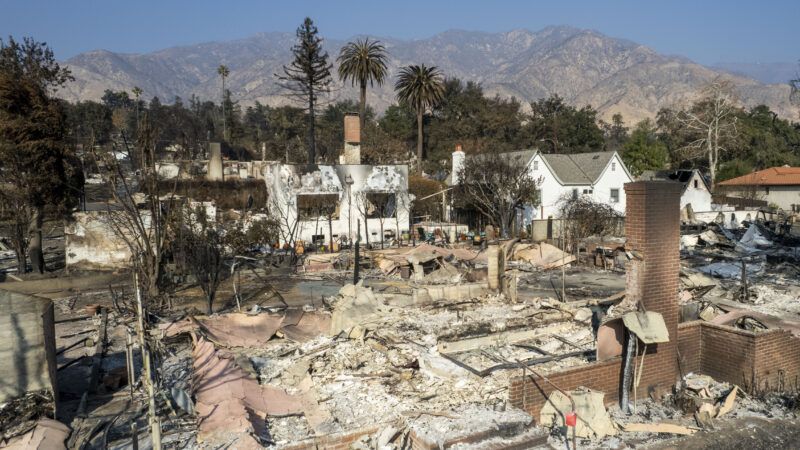
My recent trip to Malibu from Los Angeles was my first post-wildfire drive through the Pacific Palisades and, my goodness, there's nothing like seeing something with one's own eyes to grasp the enormity of the devastation. The obliterated hulks along Pacific Coast Highway 21 months after the tragedy raise multiple issues, including ones related to the excruciatingly slow rebuilding process.
This being California, the state has yet to grapple sufficiently with the reasons the wildfires started—and the failed response to them. But late is better than never, so I applaud a new report that Gov. Gavin Newsom commissioned from the nonprofit Fire Safety Research Institute. Released this month, it looked at the nitty-gritty of how the fires started and how multiple agencies reacted. The results aren't pretty.
The New York Times provided the best summary: "The comprehensive analysis found that while several state and local agencies fell fatally short in their preparation and response, the clearest lesson from the disaster was the extent to which climate-driven fires are outstripping modern firefighting." The report found LA officials failed to take the fires seriously enough at the outset. County officials handled the Altadena evacuations in a "chaotic" manner. They were unprepared for the intensity of the fire storms.
We've all read about some of the inexplicable stupidity. The Santa Ynez Reservoir was empty during the fires because of a repair to its protective cover, yet it's empty again (although it's in the process of being refilled). The California Coastal Commission allegedly delayed new permits for the Los Angeles Department of Water and Power to install fire-resistant utility poles because of concerns about an endangered weed. The commission disputes that report—and there's still heated debate involving multiple agencies.
If we can't get multiple agencies on the same page on one minor question about milkvetch, I'm skeptical California can deal with the basics. The report said the tragedy involved "multiple interlinked systems rather than any single factor or failure." In one example by Patch, the Los Angeles County Sheriff's Department remained at normal staffing levels. The Los Angeles Fire Department was reportedly so concerned about overtime costs that it reportedly responded slowly.
This epitomizes California's approach to everything: Bigger agencies, higher spending, and expanded workforces. The left hand never knows what the right hand is doing. Other priorities outside of public protection—budgeting, meeting union demands, turf battles—take precedence. This isn't malicious, but reflects the fundamental nature of government.
Even after the state suspended rebuilding regulations, the rebuilding process is still in a quagmire because of the number of involved agencies. How could California realistically streamline a wildfire-fighting process that involves an alphabet soup of local, county, regional, and state bureaucracies? Even the feds are involved because around 45 percent of the state's land area is owned by them. The wildfire issue is a statewide problem, so the conclusions should resonate beyond LA.
Furthermore, the report argues that California needs to change its overall approach toward wildfire resilience. Back to the Times analysis, which noted that climate-driven fires are becoming more intense and that's challenging the traditional ways that the state has battled wildfires. But how often have you seen governments respond efficiently to external economic or environmental changes? All governments are slow-moving freight trains.
Everything government does is mired in the past. As an unrelated example, the nation's education system isn't much different than the one created in the 1800s—despite all the technological changes that should have sparked a revolution. When COVID hit, private schools adapted and provided successful at-home learning, whereas the public schools watched students fall behind and truancy rates soar. It's not any different with any public service, including firefighting.
My fear: California policymakers will read that summary about "climate-driven" fire risks and do what they always do: blame the problem on climate change and double down on the state's counterproductive climate policies. They are designed to change the entire Earth's weather patterns (even though California is responsible for less than 1% of the world's greenhouse emissions), rather than adjust our regulatory system to make us more resilient in the face of warming trends.
California's union-controlled state and local governments aren't about to adjust firefighting budgets so they can further stretch their dollars. State firefighters generally earn more than $250,000 in annual total compensation, with some Los Angeles firefighting officials earning pay levels that boggle the mind. Instead of trimming costs, California has been ratcheting up pay levels.
California state officials haven't even been forthright about their approach toward brush clearance. For instance, four years ago Newsom touted an important wildfire-prevention program that at the time hadn't completed a single project. We hear promises, but little action.
That's government for you. It doesn't do anything well and is incapable of learning the right lessons even from the best reports. Driving along PCH was just my latest reminder of this sad truth.
This column was first published in The Orange County Register.




