
As Police Misuse Flock Cameras, 2 Senators From Opposite Parties Demand More Oversight
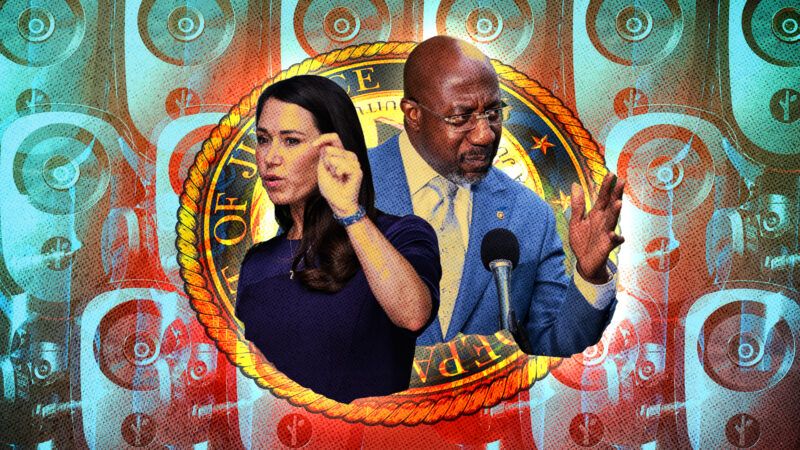
Sens. Raphael Warnock and Katie Britt would seem to have little in common, but they both feel people should have more protection from bad cops with surveillance tech.
It seems that automated license plate readers (ALPRs) are constantly in the news.
The roadside cameras—often called "Flock cameras" after Flock Safety, the company that manufactures most of them—capture images of license plates and store them in a database that can then be searched by police. While the technology is not new, it has come under intense scrutiny as numerous police officers across the country have been caught misusing the cameras.
Two U.S. senators from opposite sides of the aisle are now raising concerns about ALPRs and asking the government for more oversight of how the police use them.
"While law enforcement agencies around the country appropriately use ALPR for legitimate public safety purposes including the investigation of violent crime and the location and recovery of missing and abducted persons, misuse of these systems undermines the public's confidence in the technology," Sens. Raphael Warnock (D–Ga.) and Katie Britt (R–Ala.) wrote this week in a letter to Attorney General Todd Blanche. "We, therefore, write to request information about the Department of Justice's (DOJ) funding and oversight of such systems to prevent such misuse and ensure compliance with applicable federal statutes and regulations."
The senators seem to have little in common: For the current congressional term, conservative advocacy group Heritage Action scores Britt's voting record at 78 percent and Warnock's at zero percent, while the left-of-center ProgressivePunch gives Warnock an A and Britt an F.
But both senators feel the government must do more to protect people from ALPR abuse at the hands of police.
They're right to be concerned. "Reporting indicates that in dozens of cases across the country, police officers have improperly and, in some cases, illegally used ALPR technology to stalk and harass their current, former, or prospective romantic partners," the senators wrote.
Reason has documented numerous examples of officers across the country using Flock cameras improperly or illegally. Warnock cited a July report from Reason's Autumn Billings, finding that in Georgia alone, officials had caught "at least 20" officers misusing the Flock database by conducting searches for personal reasons unrelated to an investigation.
Britt's state is no different: Just in the past few weeks, multiple officers across Alabama have been caught misusing ALPR searches.
According to the website LPR Maps, Georgia has the fourth most ALPRs of any state but the highest number per capita, while Alabama has the sixth most per capita.
"In total, at least 50 law enforcement officers to date have been charged with, or accused of, using ALPR systems for unauthorized purposes," Warnock and Britt wrote. "These cases demonstrate the importance of strong guardrails and safeguards—such as appropriate access controls, auditing, supervisory review, and meaningful consequences of intentional misuse—to ensure that ALPRs' tracking capabilities cannot be utilized by rogue bad actors to threaten, manipulate, and inflict harm on unsuspecting victims."
"We also want to ensure that funding of these technologies is paired with appropriate oversight to ensure that the funding is not used to facilitate such abuse," they added. "We urge the DOJ to provide guidance to state and local law enforcement agencies on how they can best prevent the misuse of ALPR technology."
There are no federal laws governing ALPR use, and only a few states have adopted them. Among the states that have, the provisions vary greatly: Police in Colorado can store license plate images for up to three years after they're captured, while New Hampshire limits its storage to three minutes, unless it captures a plate that has been flagged. (The Institute for Justice, a public-interest law firm, drafted model legislation that would require the officer to get a warrant to access any images older than 24 hours.)
Warnock and Britt also asked about the DOJ's own use of ALPRs, whether it had conducted any audits, and what safeguards are in place to prevent abuse.
A 2024 Congressional Research Service report noted that multiple DOJ agencies use ALPRs, including the FBI, the Drug Enforcement Administration, and the U.S. Marshals Service. But this was not a complete accounting, it noted, because "there do not appear to be publicly available agency documents with comprehensive details on [ALPR] use."
In 2012, the FBI briefly paused ALPR purchases because, as one official wrote in an email, its Office of General Counsel was "wrestling with LPR privacy issues."
Again, Warnock and Britt are right to be concerned, especially given the sheer number of ALPRs—Flock Safety alone boasts of "more than 120,000 cameras across 49 states."
Flock cameras don't cause officers to behave badly, but without effective oversight, they certainly enable it.
Warnock and Britt are not alone. This week, cybersecurity experts and civil liberties advocates testified before the Senate and called for lawmakers to either ban ALPRs or require more oversight.