

Report: California's Proposed 'Billionaire Tax' Is Based on Bad Research
The planned wealth tax leads slightly in the polls and is already driving capital flight.
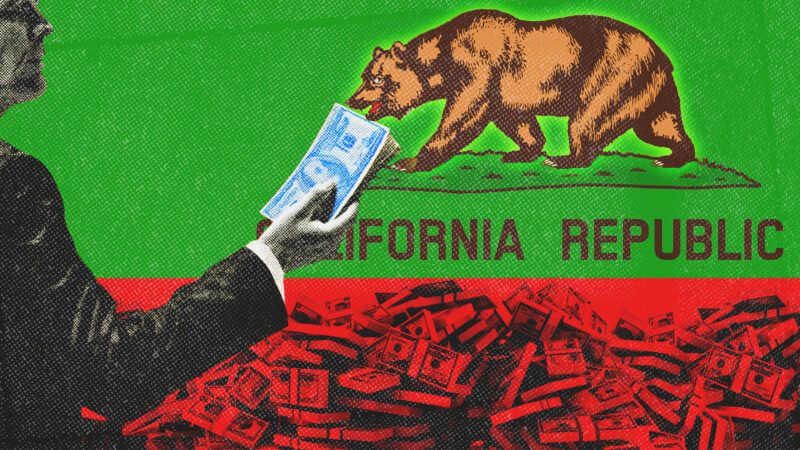
California's proposed "billionaire's tax" on the assets of wealthy state residents enjoys a slim lead in the polls leading up to the midterm elections, though so do two measures that, if they draw more votes, could render the scheme unenforceable. That makes for a high-stakes battle as many prosperous Californians are already fleeing to escape a tax that could force them to surrender ownership stakes in companies they've founded. Even if it doesn't pass, a new report warns that the proposal is based on faulty research and could do vast economic damage.
You are reading The Rattler from J.D. Tuccille and Reason. Get more of J.D.'s commentary on government overreach and threats to everyday liberty.
A Slight Polling Lead for the Wealth Tax—and for Opposing Measures
A survey conducted September 4–10 by the Public Policy Institute of California found 52 percent support for Proposition 40, which would impose a (supposedly) one-time 5 percent tax on the wealth of people with assets worth over $1 billion. Interestingly, 51 percent of respondents also support Proposition 41, which requires audits for new taxes and bars the way the wealth tax measure would allocate collected revenue, and 54 percent favor Proposition 42, which prohibits taxes on financial assets. Under California law, "if provisions of two or more measures approved at the same election conflict, those of the measure receiving the highest affirmative vote prevail."
Those conflicting measures could save Californians from themselves, since the proposed wealth tax is based on bad assumptions and would do enormous damage to the state's economy. Unfortunately, much self-inflicted harm is already locked in. In March, a Hoover Institution study found that wealthy individuals leaving the state in fear of Proposition 40's passage had already removed "$536 billion, or nearly 30 percent of aggregate billionaire wealth, from the tax base."
The Wealth Tax Scheme Is Based on Unusual Accounting
Now, a new report finds the proposed wealth tax is not only dangerous for California's economic prospects; it's also based on bad research. According to the report's author, Independent Institute research fellow Kristian Fors, "this proposal has been heavily influenced by the work of UC Berkeley professors Emmanuel Saez and Gabriel Zucman to justify the concept of wealth taxation." Saez and Zucman have generated news headlines with their claims that the wealthy are undertaxed in comparison to lower-income Americans. But as Fors points out, the estimate that drew so much news coverage claimed that "the overall tax rate for the top 400 richest households in the nation was 23 percent," while just a year earlier, Saez and Zucman "estimated that the top 1 percent paid an overall tax rate of approximately 36 percent; the authors found a share of 41 percent for the top 0.001 percent of earners in the most recent year of their survey, a category encompassing billionaires and high multimillionaires."
The discrepancy, according to Fors, comes from how the economists treat corporate income taxes. Conventional analysis assumes that corporate taxes burden shareholders, workers, and consumers as the tax gets passed on. That results in the earlier estimate of a 41 percent tax rate for the wealthiest. To reach their much lower 23 percent estimated rate, Saez and Zucman used a non-standard analysis—and while the results of that approach won news coverage, they weren't subject to peer review.
"Saez and Zucman's empirical work on the California billionaire tax proposal retains these same unconventional accounting practices from 2019 without addressing their conflict with the mainstream corporate tax incidence literature," cautions Fors.
The Independent Institute report observes that privacy laws prevented Saez and Zucman from drawing on personal income tax and other financial records. They relied on the Forbes 400 list, and "a 2010 study by a group of IRS statisticians found that the Forbes 400 dramatically overestimates the net worth of individuals in their lifetimes when compared to probate records of their estates after death." Adjusting for that discrepancy produces estimates of "an average effective tax rate of 38 percent between 2018 and 2020, as compared to the 24 percent claimed by Saez and Zucman for this period."
Other Economists Echo Criticism
It should be noted that Fors isn't the first critic to call out Saez and Zucman. In 2019, economic historian Phil Magness wrote that the duo's much-publicized data "produced a flashy chart that purported to show the top 400 earners' tax rate dipping below the bottom half, this pattern also broke sharply from their own previous published work including a 2018 article with Thomas Piketty." The earlier paper "showed a relatively flat pattern that only fluctuated year-to-year. For example, the top 0.001% average tax rate in 1962 was 44%. In 2014 it had only changed 3 percentage points, sitting at 41%." Magness agreed with Fors that Saez's and Zucman's work "contradicted decades of scholarly literature on how to handle corporate tax incidence."
Fors also criticizes claims by Saez and Zucman that the rich avoid income taxes with a "buy, borrow, die" strategy of borrowing against net worth to fund their lifestyles. "This strategy is not available only for those with an ultra-high net worth, but is also available to ordinary people," he notes, and it "only works if assets continue to appreciate." If assets lose value, lenders can call in loans, and selling assets to meet obligations "can also trigger a massive tax liability if massive, unrealized capital gains are involved." Strategies exist for reducing taxes, but they're not just for the super-rich and they're not risk-free.
Forced To Sell or Flee
Last month, in an exchange with Rep. Ro Khanna (D–Calif.), businessman Mark Cuban warned that the wealth tax could force entrepreneurs with high paper value to sell stakes in their companies because "they are the definition of cash poor, stock rich." Borrowing against shares to pay tax bills, as Khanna suggested, would be difficult for the founders of speculative start-ups.
Of course, one of the lowest-risk ways of minimizing exposure to high taxes is to leave jurisdictions that impose them. "Even the statistically improbable threat of a wealth tax is enough to provoke capital flight," notes Fors, who points to the high-profile departures of wealthy individuals who have brought vast amounts of capital with them to their new homes outside California. "Wealth is notoriously difficult to tax because of its mobility."
"Over the years, California has continually embraced policies that have driven people and capital out of the state," Fors concludes. "If enacted, the billionaire wealth tax, and the precedent it sets, may be the straw that breaks the camel's back."
Californians seem inclined to break their state's back with this ill-informed tax scheme. Fortunately, they also appear inclined to pass opposing measures that could prevent the tax from taking effect.




