

Trump's War in Iran Has Cost Americans Over $101 Billion at the Pump
Gasoline is up nearly 30 percent, and diesel prices are at a record high since the war began.
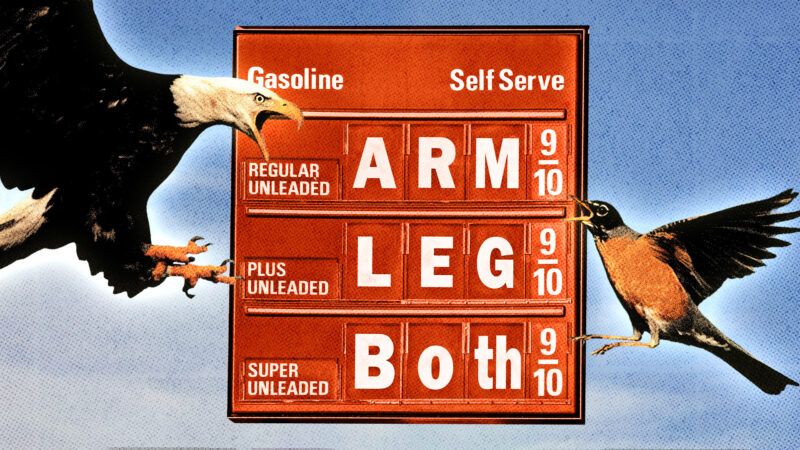
The cost of President Donald Trump's war in Iran continues to climb. On Wednesday, Brent Crude oil—the benchmark for global oil prices—traded above $100 per barrel for the first time since July, according to The Wall Street Journal. Since the war began, Brent prices have climbed nearly 40 percent.
Despite being waged thousands of miles away from the nearest U.S. city, Americans have felt the impacts of Trump's illegal war in Iran. A gallon of regular gasoline costs $4.22 as of Wednesday, a 32 percent increase from the previous year, according to AAA. Diesel costs are at a record high of $5.94 a gallon, up 60 percent from a year ago, per AAA. Through seven months of war, researchers at Brown University calculate that Americans have paid over $101 billion in extra fuel costs, or almost $777 per average U.S. household.
Unfortunately for consumers, the situation is likely to worsen before it improves. As the Journal reported last week, the Trump administration has extended troop deployments well into 2027—and the Iranians are seeking escalation—meaning Americans are unlikely to see any relief from higher gasoline prices soon.
Brown's tracker is one of several economic estimates that put the war's cost for the average U.S. household at well over $600. In June, Mark Zandi, the chief economist at Moody's Analytics, said the war had "cost the typical American household $1,000," and that the true cost to each household is "likely higher—meaningfully higher." Analyzing data from several federal agencies, the Institute on Taxation and Economic Policy found that, as of Wednesday, higher fuel prices in the U.S. have already cost the average household $663 since the start of the war, with the potential to rise to as much as $1,100 per household by the end of the year.
Americans are worried about these high prices—an issue with political ramifications for Trump and Republicans in November. An August Reuters/Ipsos poll found 47 percent of voters view the cost of living as the "single most important factor in deciding their 2026 midterm vote." Yet, the president has repeatedly dismissed concerns about the war's domestic economic impact.
In March, Trump described the rising costs for gasoline and diesel as short-term and claimed increased prices were a "very small price to pay for U.S.A., and World, Safety and Peace," adding "ONLY FOOLS WOULD THINK DIFFERENTLY!" The president has blamed higher gas prices on the "big Oil Companies," even as he contends any increase is temporary and worth the cost to American taxpayers for a nuclear-free Iran. Months later, he remains unfazed by the war's impact on American households, posting on Monday, "Oil prices will drop precipitously, like everything else is dropping (but more!), when we WIN the war with Iran."
Still, the president's bravado appears to be wearing thin with voters. The same Reuters/Ipsos poll found 71 percent of voters disapprove of the president's handling of the cost of living. When asked whether the war's benefits outweighed its costs so far, 54 percent of voters said no. Similarly, a RealClearPolitics average of the president's approval rating across polls found 61 percent of Americans disapprove of his handling of Iran, a tick lower than the 62 percent who disapprove of his handling of the economy.
It hasn't helped matters that the president and members of his administration often offer contradictory, unsubstantiated statements about the status of the war.
After claiming in April that gas prices had "likely peaked," Energy Secretary Chris Wright told CNN on Sunday he didn't "want to have an opinion" on gas prices—an odd position for someone tasked with overseeing the president's energy policies. Other members of the president's Cabinet don't believe the U.S. is even at war. Last Thursday, Vice President J.D. Vance told reporters he "wouldn't call it a war," even as the U.S. and Iran continue to trade strikes.
As the war drags on, the excuses have become less believable. In a recent appearance on Fox News, Treasury Secretary Scott Bessent found a new scapegoat in Ukraine, accusing the besieged nation of creating "upward price pressure on a global basis" by attacking Russian energy infrastructure. Of course, Bessent conveniently ignores the U.S.'s own attacks on energy infrastructure in Iran and the tit-for-tat strikes that have come to define the recent months of the conflict.
It's a matter of supply and demand. Higher gas prices are a direct consequence of Trump's war in Iran. As the president himself concedes, the sooner the war ends, the quicker prices will drop.




