

Planned New Battleships Come With a High Price Tag and an Uncertain Future
Large warships could prove to be expensive drone sponges without a clear mission.
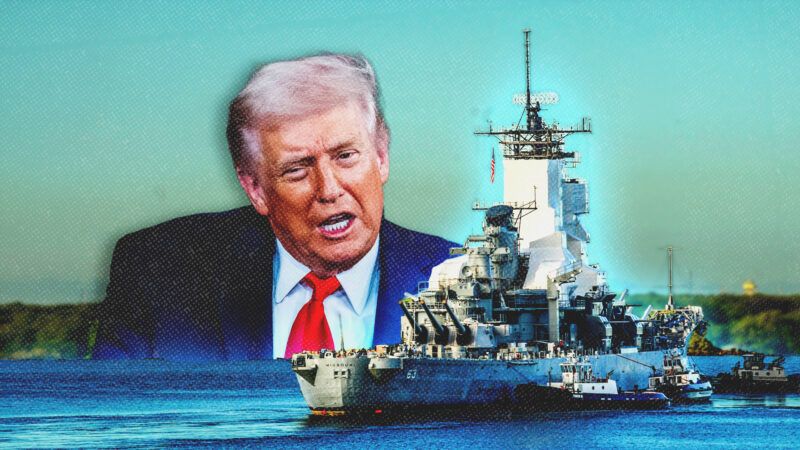
With control of the Strait of Hormuz up for grabs in the U.S. conflict with Iran, it's not surprising that President Donald Trump has naval matters on his mind. After all, patrolling sea lanes requires effective warships and the ability to keep them on station. The question is whether the president's ambitious plans for remaking the U.S. Navy with a new class of battleships and a return to older technology on aircraft carriers can live up to the hype. It's an important concern at a moment when U.S. federal debt has hit $40 trillion, because the Trump administration's plans are expensive.
New Battleships: High in Cool Factor and Expense
Last December, Trump, Secretary of Defense Pete Hegseth, and Secretary of the Navy John C. Phelan announced "their intent to construct a new class of American-designed battleships that will be the most lethal surface combatant ever constructed."
Technical specifications published by the U.S. Naval Institute put the ships at more than 35,000 tons displacement. "That's more than double the size of the 15,000-ton Zumwalt class of destroyers, which is the largest surface combatant currently in the fleet," according to Mallory Shelbourne and Sam LaGrone of USNI News. Aircraft carriers like the USS Gerald R. Ford are larger, at around 100,000 tons, as are amphibious warfare ships like the USS America, at about 45,000 tons. But the new class of battleships, starting with the proposed USS Defiant, are combatant vessels armed with cruise missiles, 5-inch guns, rail guns, and the possibility of advanced systems including directed energy weapons.
The planned ships have a high cool factor for those of us who spend a lot of time reading up on technology and military history. But they have equally high price tags.
"The total cost of the Navy's new nuclear-powered battleship program would be about $275 billion (in 2026 dollars) over the 2027–2056 period," the Congressional Budget Office (CBO) reported this month. "The first ship would cost about $23 billion. For the 15 ships that would be purchased through 2056, the cost would average slightly more than $18 billion per ship."
The CBO report added, "the average annual amount of funding needed to buy surface combatants would rise by slightly more than two-thirds, from about $11 billion to $19 billion." Constructing such large surface combatant vessels "could be a challenge for the shipbuilding industry."
That's expensive, especially for a government that's already keeping itself going by skating along on growing debt with no apparent plan for paying back creditors—so far, to the tune of over $40 trillion.
That still might be worthwhile if it prevents something even more expensive—say a lost military conflict with another power, like China. But the proposal for a new class of large surface warships comes at a time when navies are wondering whether such vessels are obsolete.
Large Vessels Are Especially Vulnerable in Modern Warfare
In the modern world, noted Harry J. Kazianis in June for national security publication 1945, "aircraft carriers, destroyers, frigates, amphibious ships, patrol vessels, and supply ships operate under a threat web built from satellites, long-range missiles, aerial drones, and explosive unmanned boats." In its war with Russia, Ukraine sank much of the aggressor nation's Black Sea fleet "with shore-launched missiles, aerial drones, and unmanned surface craft despite beginning the war without a major surface fleet." Drones, especially, are much cheaper than the missiles that warships commonly use to defend themselves. Swarms of drones can drain naval magazines of their armaments at relatively low cost.
In response, "defensive layers must become cheaper and more numerous," Kazianis added. Current thinking about naval warfare in the years to come is that "crewed ships will still fight on the surface. They will do it dispersed, connected to unmanned partners and far less willing to let one expensive hull carry every mission."
That raises questions about the wisdom of building what could prove to be $20 billion drone sponges.
Also of questionable wisdom is Trump's plan to replace modern Electromagnetic Aircraft Launch Systems (ELAM) on aircraft carriers with old-school steam catapults.
"The new mandate would likely cost billions of dollars and revert the Navy's most advanced ships to a system that takes more sailors to operate and is more difficult to maintain," according to the Associated Press' Konstantin Toropin.
There's certainly a school of thought in the navy that prefers the older technology. But the latest aircraft carriers were designed without the piping needed for the steam catapults and rebuilding them will cost time and money at a moment when an already-broke government plans a new class of battleships.
Do We Need Large Warships When We're Quitting the Job of Global Cop?
Then there's the question of mission. The U.S. Navy is currently the only real globe-roaming navy, and it's been slowly retreating from that role in a changing world. Geopolitical strategist Peter Zeihan commented in 2023 that after World War II, the U.S. was the only (relatively) free country left standing that hadn't been devastated by the conflict. To counter the Soviet Union, "the U.S. sent its Navy out to patrol the global oceans so that anyone could trade with anyone at any time" to build alliances based on commerce and access to the American market.
But this has been a massive commitment to maintaining freedom of navigation for the benefit of the entire planet. Zeihan added that "Americans have been moving away from maintaining this system" after concluding "the strategic case for globalization and keeping the sea lanes opened has weakened."
Yes, the U.S. is currently embroiled in an air and naval conflict with Iran in the Persian Gulf. But headlines have focused on the stresses of shipboard life during extended deployments, suggesting Americans are leery of what's required to patrol sea lanes mostly used by other countries. The U.S. hasn't formally withdrawn from the role of providing global maritime security, but we're ambivalent at best.
So, if the U.S. is slowly disengaging from the role of global ocean cop, should Americans really expend resources on a new class of battleships that may be vulnerable to relatively cheap modern weapons? Should we be expending more billions on even larger aircraft carriers to retrofit them with old technology?
The U.S. needs a navy. But it should be one suited to the country's requirements, which increasingly look oriented towards defending the homeland rather than projecting power around the world. And the government's military expenditures should acknowledge the constraints imposed by its debt burden.




