

A Year After the Wildfires, L.A. Homelessness Spikes
Plus: A new lawsuit challenges New York's rent freeze, a study affirms new supply helps everyone, and the battle between data centers and clouded leopards.
Happy Tuesday, and welcome to another edition of Rent Free. This week's newsletter includes stories on:
- A new lawsuit challenging New York's rent freeze
- A new study affirms that new supply helps everyone.
- Data centers, clouded leopards, and eminent domain, oh my!
But first, our lead story on the spike in Los Angeles' homeless population, and what it can tell us about the logic of moving chains.
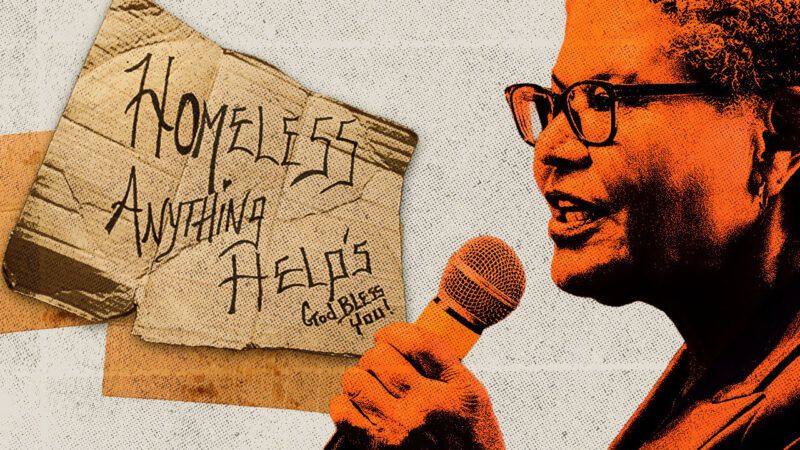
A Year After Wildfires Destroy Thousands of Homes, Los Angeles Posts Increase In Homelessness
After two years of declines, the city of Los Angeles is once again reporting that its homeless population is on the rise.
Rent Free Newsletter by Christian Britschgi. Get more of Christian's urban regulation, development, and zoning coverage.
According to the latest homeless census released by the Los Angeles County Homeless Services and Housing Department (LAHSA), which reports figures for the county as a whole, the city of Los Angeles posted an annual 3.4 percent increase in the homeless population.
There are a total of 45,194 people living on the streets or in shelters in the city. The countywide figures show a smaller annual increase of 1.2 percent, representing 73,040 people living on the streets or in shelters.
These figures come from LAHSA's point-in-time count, in which volunteers literally count all the people sleeping outside, in vehicles, or in shelters, during a single night in January. The federal government typically releases a national point-in-time count late in the year.
The posted increase in the city's numbers comes after two years of steady declines. Mayor Karen Bass heralded those declines as evidence of her administration's effective work to get people off the streets.
Her statement on the latest increase struck a defensive tone.
"Our efforts ultimately couldn't keep up with policies and funding cuts at the federal and state levels that pushed more people onto the streets," said Bass, blaming the increase on a lack of county services, cuts in federal funding, and unspecified Trump administration policies increasing the cost of "gas, groceries, and rent."
L.A. Councilmember Nithya Raman, Bass' opponent in the mayoral race, blamed the rising homeless population on the mayor's mismanagement.
The Trump administration has attempted a number of reforms to federal homeless spending, all generally geared toward shifting funds away from "housing first" programs and jurisdictions that rely on a housing first approach, and toward temporary shelter.
(The courts have blocked many of the administration's program reforms.)
In June, it suspended federal funding to LAHSA, the county agency, over what it described as "wanton mismanagement of public funds."
Even before that, Los Angeles' own city programs were frequently docked by government watchdogs for inefficient spending and long timelines for the delivery of permanent supportive housing for the homeless.
The increase in homelessness comes a year after the Los Angeles area experienced a major negative supply shock to its housing supply as a result of the 2025 wildfires. Some 12,900 households were displaced after their homes were either destroyed or severely damaged in the fires.
The Palisades fire primarily affected wealthy neighborhoods of Pacific Palisades and the city of Malibu. The Eaton fire destroyed more modestly priced homes in and around Pasadena.
One might think that a fire that destroys rich beachside property wouldn't ultimately impact the number of people living on the street. Odds are that everyone displaced by the fires had the means to find new housing for themselves. But that would ignore the logic of moving chains.
When a mansion burns down, its former occupants must find second-best housing somewhere else. Any home they occupy is one that someone else can't. That second person, who wasn't directly impacted by the fires, is then likely left looking for housing further down the market. The person who would have occupied that down-market home is now searching for an even more modest dwelling.
Play this out across multiple moves, and the loss of thousands of units at the top of the market translates to more demand on even the cheapest housing in the city. Ultimately, fewer units are available for those with the least means, who then end up on the streets.
This is essentially the reverse of the moving chains kicked off by the addition of new high-end supply. New luxury homes attract high-income residents, who vacate their former, slightly less luxurious homes, which are then occupied by people who move from more modest housing.
As our third story covers, the end result of new high-end supply is more available units and, presumably, lower prices at the bottom of the market.
For supply-side advocates, moving chains tell a story of how cities can overcome their housing shortages and related cost crises by building lots of expensive new construction.
The latest homeless numbers in L.A. highlight what happens when that housing isn't built (or in this case, destroyed). Like a game of musical chairs, more people crowd into the existing number of homes, and the ones with the lowest incomes move out of the region entirely or onto the streets.
Increasingly, it is looking like the fires will represent a negative supply shock that the city will not fully recover from for years.
Of the some 5,000 single-family homes destroyed in the Palisades Fire, only 28 have been completely rebuilt and issued with certificates of occupancy.
Bass and Gov. Gavin Newsom have at times moved to cut red tape on wildfire rebuilds and at others imposed new restrictions that make rebuilding harder.
A couple of weeks ago, this newsletter covered the criminal charges local prosecutors levied against allegedly unlicensed contractors offering to help with wildfire rebuilds.
Reduced federal funding and bad local administration could well have an impact on this year's posted increase in the city's homeless population.
But no amount of federal aid or more efficient local administration can overcome L.A.'s market-wide housing shortage that physically requires some people who live there to go without permanent shelter.
A New Lawsuit Alleges New York's Rent Board Ignored Data When Enacting Politicized Rent Freeze
Last week, a handful of landlords sued New York's Rent Guidelines Board in an effort to overturn the rent freeze it imposed on the city's nearly one million rent-stabilized apartments.
Every year, the nine-member RGB sets a percentage cap on how high property owners can raise rents on their rent-stabilized units. In making this decision, the board is required by law to consider both landlords' operating costs, tenants' cost of living, and the overall supply of housing.
This year, in the face of data showing owners' rising costs and strong growth in tenant income, the board voted to impose a 0 percent cap on rent increases.
The new lawsuit filed by petitioning landlords in Richmond County Supreme Court (which covers Staten Island) alleges that the board's freeze ignores the data on landlords' rising costs, or otherwise leans on its prejudiced data, to justify a rent freeze promised by New York Mayor Zohran Mamdani.
"To do the Mayor's bidding, this Board then made a mockery of its statutory mandate, resorting to multiple manipulations of its own data to try to justify this irrational result," reads the petition. "And this all comes amid unchecked inflation and rising costs that struggling landlords will have to bear to survive."
"That Mayor Mamdani preordained this outcome and then took affirmative steps to stack the deck is now undeniable," the petition continues, citing as evidence a statement of Christina Smyth, a member of the board appointed by Eric Adams who resigned hours before it voted to freeze rents.
"The Rent Guidelines Board has stopped being a fact-finding body. It has become a body that starts with an answer and vibe codes its way backward to justify it," Smyth said in her resignation letter.
Arpit Gupta, an associate professor of finance at New York University, was the sole member of the RGB to vote against the rent freeze.
Gupta told Reason in a recent interview that he believed the Mamdani administration didn't place any undue pressure on the board to vote a certain way.
Even so, he says, the independent board still voted for a freeze even after considering data showing landlords' expenses rising faster than incomes and increased financial distress of rent-stabilized buildings.
Christian Browne, an attorney at the firm McLaughlin & Stern, says the new challenge to the rent freeze might face a difficult time, given how reticent judges are to overturn the decisions of independent boards.
"The courts don't typically second-guess administrative bodies. You usually have to have a glaring [legal] error" on the body's part, Browne tells Reason.
In order to succeed, petitioners will need to make a strong showing that the board ignored the data it was required to consider and instead based its decision on arbitrary political concerns.
Mamdani's repeated promises of a rent freeze and the voluminous data showing landlords' spiking costs give landlords a "strong case" that the enacted rent freeze violates the law, says Browne.
Even if a court looks skeptically at the rent freeze, the question then becomes what kind of remedy it would provide, says Browne.
When decisions of an administrative body are tossed out because of some conflict of interest, a judge will typically send the case back to that same body with instructions to decide again without the votes of the conflicted board members.
That's not really possible in the RGB's case, given that the accusation is that a majority of the board has been compromised by Mamdani's political influence.
He says a court could theoretically dig through the data itself and set a new rent cap, although it's unlikely it'll want to do that. Another option would be that the court sends the case back to the RGB with instructions to make another decision that puts more weight on data that would justify some level of rent increase.
In addition to this latest challenge to the rent freeze, a constitutional case challenging New York's rent limits on vacant apartments, in which the RGB is a named defendant, is ongoing.
New Study Reaffirms That New Supply Helps Everyone
A new working paper on minimum lot size reforms in Adelaide, Australia, found that cutting the amount of land new homes are required to sit on increased the construction of smaller homes on smaller lots.
The paper, published last week by scholars at the e61 Institute, examined 2014 reforms made by the suburban community of Campbelltown in the Adelaide metro that cut minimum lot sizes from 350 square meters to as low as 150 square meters (3,767 square feet to 1,615 square feet).
The e61 researchers say that the reforms provided a natural experiment to compare Campbelltown with nearby suburbs that did not cut minimum lot sizes.
They found that builders eagerly exploited the new minimum lot sizes to subsidize large lots for townhome projects. Home construction increased 67 percent between 2014 and 2019, when the reforms were partially reversed.
Roughly 270 additional homes were built each year under the smaller minimum lot size regime, leading to a 6 percent increase in Campbelltown's housing stock during the life of the reforms, the paper found.
When the reforms were reversed, housing construction fell.
Researchers were also able to use census data to track the movement chains kicked off by the addition of new supply in Campbelltown. The homes produced by the community's reforms were generally bought by owner-occupiers, who vacated rental housing they'd previously occupied.
In other words, the new supply in one area of the city opened up more rental units for younger people across the Adelaide metro.
This adds to a growing body of evidence that new market-rate housing supply opens up housing for people of all incomes across a metro area.
Nashville Eminent Domain Fight Pits Clouded Leopards Against a Data Center
Last week, I covered the battle over a data center that's erupted in Nashville, Tennessee. There, Atlanta-based company DC BLOX is proposing to build a 69,000-square-foot facility on a property that's adjacent to the city's zoo.
The land is already zoned to allow data centers. Indeed, the industrial park where DC BLOX plans to build its facility already hosts a small data center.
Opposing the project is the zoo itself, which has expressed concern that the constant hum of the planned center's equipment will disturb its hearing-sensitive animals, particularly the clouded leopards that are bred at the zoo.
DC BLOX has promised that its facility will be quieter than what the zoning code allows and has committed to installing additional sound barriers to keep the noise down. It even offered to build a smaller project.
That's done little to mollify the zoo or city leaders. Last week, the Nashville Metro Council approved a temporary data center moratorium and advanced legislation that would allow the city to acquire DC BLOX's land via eminent domain.
Read the whole story here.
Quick Links
- The National Low Income Housing Coalition releases its annual Out of Reach report showing that housing is unaffordable to low-income earners everywhere. Read my criticism of past reports here.
- A Philadelphia resident has filed a first-of-its-kind lawsuit against a landlord for using rent-recommendation software to set rents, in violation of a new city law. Read more about the panic over this software here.
- A lawsuit alleges that a California law requiring landlords to accept Section 8 vouchers, and thus submit to inspections required by that program, violates the Fourth Amendment. Rent Free covered a similar lawsuit challenging Virginia's housing voucher law.
- Read my latest feature on how New York's rent law is bankrupting rent-stabilized housing.
- The Reason Foundation (which publishes this website) has a new policy brief on reducing barriers to manufactured housing.




