
A Supreme Court Decision Restricting Appeal Waivers Underlines the Injustice of Coercive Plea Bargaining
The Supreme Court ruled that "an agreement not to appeal a sentence is unenforceable when it would result in a miscarriage of justice."
When people plead guilty to crimes, they typically give up the right to appeal any aspect of the outcome, including the sentence they ultimately receive. On Thursday in Hunter v. United States, the Supreme Court imposed limits on such appeal waivers, which are improbably described as "knowing and voluntary" even when the defendant is acting under intense pressure and does not yet know what penalties and release conditions he will face.
"An agreement not to appeal a sentence is unenforceable when it would result in a miscarriage of justice," Justice Elena Kagan writes in the majority opinion, which was joined by seven of her colleagues. The decision defines "miscarriage of justice" as "the kind of egregious error that would bring the judicial system into disrepute." It offers some examples, including a sentence that exceeds the statutory maximum, a sentence "infected with a blatant constitutional error" such as racial bias, release conditions that violate basic rights, and a prison term imposed by a judge who "let an orangutan pick a sentence out of a hat."
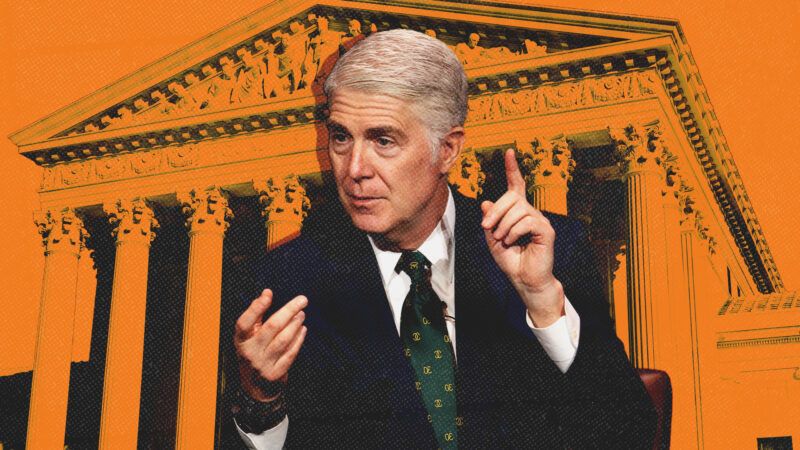
As Justice Neil Gorsuch explains in a concurring opinion joined by Justices Sonia Sotomayor and Ketanji Brown Jackson, the need for such intervention stems from a criminal justice system that resolves nearly all cases through plea deals. "In our times, the jury trial has given way to a conveyor belt of plea bargains," Gorsuch writes. "At least some responsibility for that development lies with this Court. When confronted with coercive prosecutorial tactics designed to induce defendants to take plea deals, the Court has often condoned those practices or let them pass in silence."
The case involves Munson P. Hunter III, who was charged with participating in "a years-long scheme costing various financial institutions about half a million dollars." In February 2024, Hunter pleaded guilty to one count of aiding and abetting wire fraud. It is not hard to see why: He was also facing nine other felony charges, which federal prosecutors dropped in exchange for his guilty plea. Had he been convicted of all 10 charges, Gorsuch notes, Hunter would have faced "up to 300 years in prison and a $10 million fine."
As part of the plea agreement, Hunter gave up the right to appeal his sentence. He later had cause to regret that decision.
The crime that Hunter admitted involved the theft of $38,649 in a single transaction. But at sentencing in the Southern District of Texas three months later, Judge Sim Lake took into account the dropped charges—a variation on a disturbing practice that imposes punishment for conduct that was never admitted by the defendant or proven beyond a reasonable doubt. For purposes of sentencing, Lake assumed that Hunter had helped steal $488,352 in 26 transactions.
"This made a significant difference for Mr. Hunter," Gorsuch notes. "Had the district court sentenced him based on the amount he had pleaded guilty to stealing, he would have faced an advisory sentencing guidelines range of 15 to 21 months in prison. Now, though, he faced a recommended prison term of 41 to 51 months. And based on that calculation, the district court chose a prison sentence of 51 months." In other words, "a guilty plea to a single charge enabled prosecutors to secure a punishment based on other charges they had agreed to drop or had not even brought."
That was not Hunter's only unpleasant surprise. As a condition of his supervised release after his prison term, Lake ordered him to "participate in a mental-health treatment program" and "take all mental health medications that are prescribed by [his] treating physician." Hunter objected to the latter condition, which he argued violated his "constitutionally protected liberty interest in avoiding the unwanted administration of antipsychotic drugs."
Confronted by that claim, the U.S. Court of Appeals for the 5th Circuit said Hunter could not raise it because he had waived his right to appeal his sentence. The Supreme Court disagreed, saying Hunter should have an opportunity to argue that his forced medication qualified as a "miscarriage of justice" because it was unconstitutional.
Gorsuch agreed with that result, as did all the justices except for Clarence Thomas. Under Hunter, Gorsuch notes, "prosecutors may not always leverage their plea-bargaining power to induce a defendant to forego the right to contest his sentence on appeal." But that issue, he emphasizes, is just one facet of the problems stemming from coercive plea deals.
"The most remarkable thing about Mr. Hunter's plea-bargaining journey may be how unremarkable it is," Gorsuch writes. "Our criminal justice system is no longer dominated by trials and sentences based on them, but plea bargains that work out in ways not unlike his own."
At the Founding, "the right to trial by jury was considered part of every American's 'birth-right and inheritance,'" Gorsuch notes. "Outraged by British efforts to deny that right in the colonies, those who fought the Revolution cited its suppression as one of their reasons for declaring independence. After the Revolution, too, the founding generation took care to secure the right to trial by jury in criminal cases not just once, but twice, in the Constitution and Bill of Rights they adopted."
Plea bargains "didn't begin to emerge as an alternative to trial in serious criminal cases until the mid-nineteenth century," Gorsuch writes. But today, around 95 percent of convictions are based on guilty pleas, making the right to trial more imaginary than real.
The Supreme Court was initially skeptical of that development, expressing concern about the power of prosecutors to coerce guilty pleas by threatening defendants with additional charges and penalties if they insisted on making the government prove its case. But by 1971, the Court was describing plea bargaining as "highly desirable," something "to be encouraged," and "an essential component of the administration of justice."
Why was it essential? "If every criminal charge were subjected to a full-scale trial," the Court worried in Santobello v. New York, "the States and the Federal Government would need to multiply by many times the number of judges and court facilities."
The Court reiterated that view six years later in Blackledge v. Allison. "Whatever might be the situation in an ideal world," it said, "the fact is that the guilty plea and the often concomitant plea bargain are important components of this country's criminal justice system. Properly administered, they can benefit all concerned."
What does a "properly administered" plea bargaining system look like? The Court provided a clue in the 1978 case Bordenkircher v. Hayes, which considered what happened after a Kentucky man was charged with forging a check for $88.30.
Based on that charge, Paul Hayes faced a sentence of two to 10 years in prison. If Hayes pleaded guilty, the prosecutor said, he would recommend a five-year sentence. But if Hayes insisted on going to trial, the prosecutor warned, he would be charged under Kentucky's "three strikes" law, which authorized a life sentence. Uncowed, Hayes said he wanted a trial. The prosecutor delivered on his threat, and Hayes was sentenced to life in prison. The Supreme Court saw no problem with the prosecutor's tactics.
Appeal waivers add another dimension to this situation, and now the Court has recognized that justice may require overriding them. In addition to the examples offered in the majority opinion, Gorsuch says the "miscarriage of justice" rule should also apply to "sentences imposing penalties the law reserves for offenses different [from] those of which the defendant stands convicted." Hunter's 51-month sentence fits that description, and there are many other examples.
Under the Court's decision in Hunter, "a defendant may be able to appeal a sentence imposing a condition of release that violates his right to be free from forced medication, or a condition that violates his right to speak or worship freely, or any other condition that violates one of his recognized constitutional rights," Gorsuch says. "I would think
a miscarriage of justice all but certain to arise whenever a sentence infringes a constitutional right that was 'firmly established at the time of sentencing.'"
The majority also said sentences "marred by serious procedural errors" should be appealable notwithstanding waivers, Gorsuch notes. In his view, that would include "not only a sentence chosen by an orangutan" but also penalties "reflecting a marked departure from mandatory sentencing procedures."
Even "aspects of sentencing that can require a degree of judicial discretion," such as "the application of the advisory sentencing guidelines," "the imposition of supervised release conditions within statutory and constitutional bounds," and the weighing of sentencing factors, could trigger the exception recognized by the Court, Gorsuch says. "A miscarriage of justice would seem to arise, as well, when a district court metes out punishment that is so substantively unreasonable that it would fail under the 'deferential abuse-of-discretion standard' that appellate courts already apply in sentencing challenges."
Gorsuch sees "deeper problems" with appeal waivers. "The Due Process Clause of the Fifth Amendment, this Court has held, tolerates only 'voluntary and knowing' guilty pleas," he notes. A guilty plea "must be made both 'voluntarily' and 'with full understanding of the consequences.'" But "how can a defendant 'know' and 'fully understand' at the time he signs a plea agreement that a court might later order punishment that defies the Constitution, a federal statute, or this Court's precedents?"
Gorsuch also notes that the Supreme Court "has found prospective waivers of
many other statutory rights invalid and unenforceable." He says the Trump administration, which urged the justices to uphold the 5th Circuit's decision in Hunter's case, "has offered no colorable explanation why a defendant's prospective waiver of his statutory right to appeal his sentence should be treated differently."
If a defendant "may prospectively waive the right to appeal his sentence," Gorsuch writes, "one might wonder what's to stop prosecutors from pushing their luck further yet. Might we eventually face plea agreements that include prospective waivers of the defendant's right to complain about future unreasonable searches and seizures of his home? Or prospective waivers of a defendant's right to seek a jury (rather than bench) trial in future proceedings if he ever is charged with another crime?"
Two centuries ago, "it was likely unimaginable that almost every federal criminal case would be resolved by plea bargain," Gorsuch says. "Forty years ago, it may have been no easier to foresee that plea bargaining defendants would be pressed to waive their statutory right to appeal sentences yet to be imposed. Let alone that the federal government would argue these waivers prevent defendants from appealing even
blatantly unlawful or unconstitutional sentences chosen by an orangutan."
Although the Supreme Court "is not responsible for all these developments," Gorsuch writes, "it has encouraged some of them and stood silent while others took hold. Today, the Court finally begins to correct course, taking an important step toward reining in appeal waivers. It is not a solution to all of plea bargaining's excesses, and perhaps not even those associated with appeal waivers. But it is a start."