
Medical Marijuana Rescheduling Is Legally Puzzling but a 'Huge Win' for Patients, Suppliers, and Scientists
Acting Attorney General Todd Blanche's distinction between medical and recreational cannabis is hard to reconcile with the relevant scientific and statutory criteria.
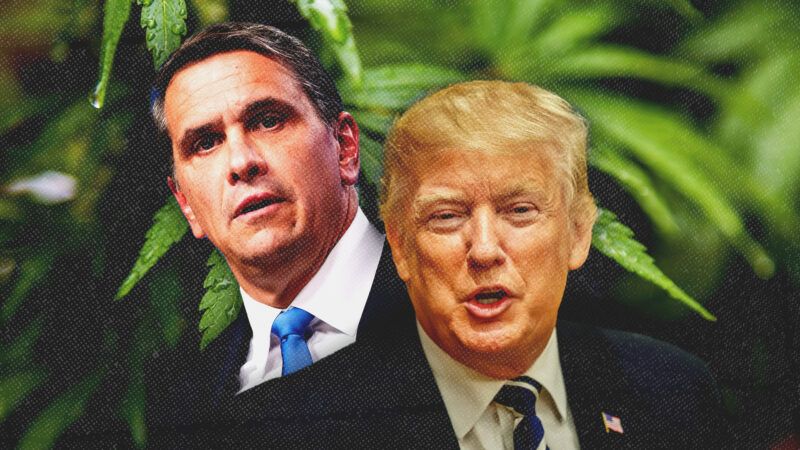
On Saturday, while signing an executive order aimed at facilitating regulatory review of psychedelics that have shown promise as psychotherapeutic catalysts, President Donald Trump complained that his underlings had not yet delivered on his promise to reclassify marijuana under the Controlled Substances Act (CSA). "Will you get the rescheduling done, please?" Trump said to Secretary of Health and Human Services Robert F. Kennedy Jr. "They're slow-walking me on rescheduling….You're gonna get it done, right?"
Although Kennedy's department has an advisory role in rescheduling decisions, the CSA authorizes the attorney general to make the final call. And on Thursday, Acting Attorney General Todd Blanche took a big step toward Trump's goal by signing an order that moves state-approved medical marijuana from Schedule I, the CSA's most restrictive category, to Schedule III, which includes prescription drugs such as ketamine, anabolic steroids, and Tylenol with codeine. If the Food and Drug Administration (FDA) approves new cannabis-based medications, they will likewise be listed in Schedule III under Blanche's order.
That change leaves federal marijuana prohibition essentially untouched. It does not legalize marijuana, even for medical use, which would require FDA approval of specific products. But it recognizes that marijuana's Schedule I status is not scientifically justified, as critics of the war on weed have been arguing for half a century, and it should facilitate medical research. It is also a financial boon to state-licensed suppliers of medical marijuana, allowing them to deduct standard business expenses when they file their federal income tax returns.
"The Department of Justice is delivering on President Trump's promise to expand Americans' access to medical treatment options," Blanche said. "This rescheduling action allows for research on the safety and efficacy of this substance, ultimately providing patients with better care and doctors with more reliable information."
Blanche's order is narrower than the change that Trump envisioned in December, when he instructed Pam Bondi, then the attorney general, to "complete the rulemaking process" required to move marijuana from Schedule I to Schedule II "in the most expeditious manner" allowed by federal law. Blanche said the broader change, which would reclassify marijuana in general, won't be completed until after the Drug Enforcement Administration (DEA) holds a hearing scheduled to begin on June 29. "Under the direction of President Trump and Acting Attorney General Blanche," DEA Administrator Terry Cole said, "DEA is expeditiously moving forward with the administrative hearing process—bringing consistency and oversight to an area that has lacked both."
Blanche's order encompasses marijuana sold by businesses with a "state medical marijuana license." Those businesses will be required to register with the DEA.
Forty states currently allow medical use of marijuana, and Blanche says "state regimes have developed robust infrastructure for preventing diversion, ensuring product safety, maintaining records, and conducting facility inspections functions that fulfill the objectives of federal registration and recordkeeping requirements." He therefore concludes that "incorporating state licensing systems into the federal registration framework represents the most effective and efficient means of achieving the CSA's objectives with respect to medical marijuana while promoting the medical benefits of marijuana and causing the least disruption for patients and existing state systems."
Blanche argues that limiting the reclassification to medical marijuana will help meet U.S. obligations under the Single Convention on Narcotic Drugs, which figures in scheduling decisions under the CSA. That treaty, he notes, exempts "medicinal cannabis" from a general requirement that signatory governments control the wholesale supply of marijuana. The order's selective scope nevertheless poses legal and scientific puzzles.
Cannabis products that patients use for symptom relief are pharmacologically identical to cannabis products purchased by recreational consumers. Since the criteria for classifying drugs under the CSA hinge on medical utility and abuse potential, it is not clear how the distinction drawn by Blanche can be justified within that scheme.
Schedule I supposedly is reserved for drugs with a "high potential for abuse" and no "accepted medical use"—drugs so dangerous that they cannot be used safely even under medical supervision. For reasons that the Department of Health and Human Services (HHS) explained after President Joe Biden started the rescheduling process that Trump is pursuing, marijuana plainly does not meet those criteria. Given marijuana's relative hazards and potential medical benefits, HHS recommended that it be placed in Schedule III. Blanche cites that August 2023 HHS recommendation in his order, although he notes that he is not legally bound to follow it.
Except for the drugs in Schedule I, all controlled substances are deemed to have "currently accepted" medical uses. Placement in the lower schedules therefore is supposed to hinge on abuse potential. Schedule II drugs, such as cocaine, methamphetamine, fentanyl, and oxycodone, are said to have "a high potential for abuse," including a risk of "severe psychological or physical dependence." Schedule III drugs are considered to have lower abuse potential than Schedule II drugs, posing a "moderate to low" risk of "physical and psychological dependence."
Given those criteria, it is hard to see how Blanche can say medical marijuana belongs in Schedule III but recreational marijuana, at least for now, does not. Those two categories consist of essentially the same products, distinguished only by their intended use, which may be legally relevant in determining whether a supplier or user is subject to criminal penalties but has not previously counted as a reason for placing a drug in a particular schedule. Cocaine, fentanyl, and methamphetamine, for example, are all Schedule II drugs, regardless of whether they are obtained legally by prescription or illegally from the black market.
The result of Blanche's order is "very silly," says Ryan Hunter, chief revenue officer at the marijuana vape company Spherex. Although medical and recreational marijuana are "the same plant," the former is now a Schedule III drug, while the latter is "still considered Schedule 1 (along with heroin)," Hunter notes. "My mind boggles at these arbitrary and artificial distinctions."
If Blanche's statutory reasoning is hazy, the benefits for state-licensed medical marijuana producers and distributors are clear. Under Section 280E of the Internal Revenue Code, illegal suppliers of Schedule I or Schedule II drugs are not allowed to deduct business expenses when they calculate their federal income taxes. The upshot for state-legal marijuana businesses has been staggeringly high effective tax rates.
The 280E restriction "often results in tax rates of more than 70% for marijuana retailers in particular," MJBizDaily noted in 2023. "I cannot emphasize enough that removal of § 280E would change the industry forever," cannabis lawyer Vince Sliwoski wrote around the same time. "Having worked with cannabis businesses for 13 years, I view taxation as the largest affront to marijuana businesses—more than banking access, intellectual property protection problems, lack of bankruptcy, you name it. This would be HUGE."
As a result of the rescheduling order, Blanche notes, "state licensees will no longer be subject to the deduction disallowance imposed by Section 280E." For now, that benefit is limited to state-licensed medical marijuana suppliers, which already receive special protection from federal prosecution under an annually renewed spending rider that Congress first approved in 2014. But after the broader rescheduling that Blanche says will eventually happen, businesses that serve recreational marijuana consumers, which two dozen states allow, likewise will be relieved of this crushing financial burden.
Marijuana's Schedule I status also imposed burdens on researchers interested in exploring the plant's medical potential. "The moment that a drug gets a Schedule I [designation], which is done in order to protect the public so that they don't get exposed to it, it makes research much harder," National Institute on Drug Abuse Director Nora Volkow noted during congressional testimony in 2019. That designation, she explained, requires researchers to complete a "lengthy and cumbersome" registration process. It also entails special storage requirements.
In addition to eliminating those obstacles, the Associated Press notes, Blanche's order "makes clear that cannabis researchers won't be penalized for obtaining state-licensed marijuana or marijuana-derived products for use in their work." Blanche says his order and the broader reclassification he intends to complete "will enable more targeted, rigorous research into marijuana's safety and efficacy, expanding patients' access to treatments and empowering doctors to make better-informed healthcare decisions."
Despite his skepticism of Blanche's legal logic, Spherex's Hunter welcomed the order. "We are thrilled that medical cannabis has been moved to Schedule 3," he says. "It's the most significant drug policy update since the introduction of the Controlled Substances Act, and overnight all state-legal medical marijuana businesses are more profitable as a result of the elimination of the 280E tax burden for legal medical marijuana producers. Rescheduling signals a recognition of legitimate medical use, which could make physicians more comfortable engaging with cannabis as a treatment option. It's a huge win for consumers, patients, businesses, and scientists alike."
Ricardo Baca, founder and CEO of the cannabis marketing company Grasslands, likewise acknowledges the significance of the rescheduling decision.* Although "it's not full legalization," he says, "that doesn't mean today's move isn't still historic. Once cannabis is moved to Schedule III [of] the Controlled Substances Act, we will have witnessed the single-biggest U.S. drug policy shift of our lifetimes. While rescheduling doesn't federally legalize cannabis, it's a massive boon for businesses, researchers and patients who have, up until now, been treated like second-class citizens."
*CORRECTION: The original version of this article misstated Baca's first name.