
Alabama Supreme Court to Cops: It's OK To Force a Pastor Watering Flowers To Show His ID
The court ruled that police can demand a physical ID under the state's stop-and-identify law.
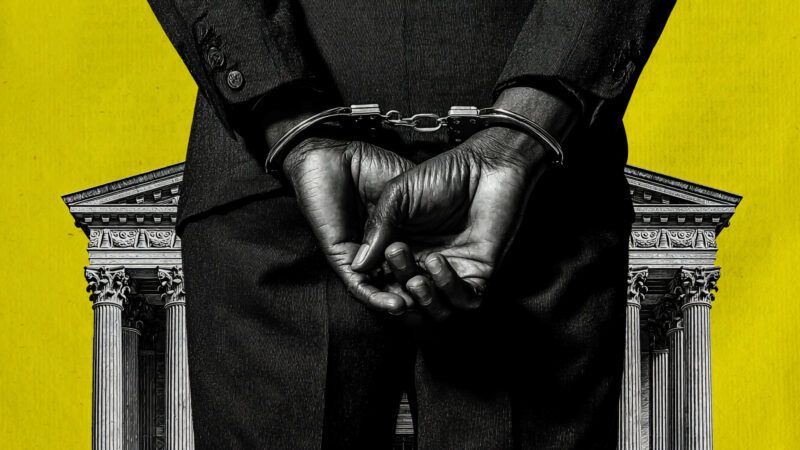
A recent Alabama Supreme Court ruling has vastly expanded police power in the state, holding that law enforcement can demand physical identification under the state's stop-and-identify law when someone provides "incomplete or unsatisfactory" answers to police questions about their name, address, and actions during a police stop.
Although Alabama's law clearly requires some individuals to carry ID, like drivers and voters, the state supreme court's ruling seems to imply a general requirement for individuals to carry identification at all times—even when watering flowers.
On May 22, 2022, Michael Jennings, a pastor who lives in Childersburg, Alabama, southeast of Birmingham, was approached by a police officer while watering flowers. Body cam footage shows an officer responding to a 911 call about a suspicious person and asking Jennings about the vehicle in the driveway and the house. "It's my neighbor's vehicle," Jennings answered. "Well, they're saying that this vehicle isn't supposed to be here, and you're not supposed to be here," continued the officer.
"I'm supposed to be here," Jennings replied. "I'm Pastor Jennings. I live across the street….I'm looking after their house while they're gone, watering their flowers.
Apparently unsatisfied with Jennings' forthcoming response, the officer then asks Jennings for "identification" while gesturing as if holding a card. "Oh no, man, I'm not going to give you no ID….I ain't did nothing wrong," Jennings responds. Agitated over the officers' continued requests to produce identification, Jennings begins walking away. A second officer places him in handcuffs as the men continue to argue and ultimately places him under arrest.
A few minutes later, the neighbor who had placed the initial 911 call speaks with the officers. Answering whether Jennings has permission to water the flowers, the neighbor replies, "He may, because they are friends, and they went out of town today. So he may be watering their flowers." "That would be completely normal," she continues. "This is probably my fault."
Under the Alabama law, an officer "may stop any person abroad in a public place whom he reasonably suspects is committing, has committed or is about to commit a felony or other public offense and may demand of him his name, address and an explanation of his actions." (emphasis added.) But despite Jennings volunteering much of this information from the start and later clarifying his full name when asked, the officers arrested Jennings because he refused to produce physical identification—an item not expressly articulated in the state's law.
Jennings was charged with obstructing a governmental function, a misdemeanor offense punishable by up to one year in jail and a $6,000 fine.
Although the charges against him were later dismissed, Jennings filed a civil federal lawsuit and accused the officers of violating his Fourth Amendment rights by, in part, arresting him without probable cause. And while the district court initially dismissed his suit, finding the officers were immune from civil liability, the 11th Circuit of Appeals disagreed. By reading the text of the Alabama code plainly, the appellate judges found that the officers lacked probable cause to arrest Jennings because they were only authorized to demand three things: his name, address, and an explanation of his actions.
"While it is always advisable to cooperate with law enforcement," wrote the appellate court, "Jennings was under no legal obligation to provide his ID." The 11th Circuit reversed the district court's decision to dismiss.
But rather than simply reopen the case as instructed, the district court turned to the Alabama Supreme Court to clarify whether officers are prohibited under state law from demanding physical identification if they receive an "incomplete or unsatisfactory oral response" under the state's stop-and-identify law. In answering that question, the Alabama Supreme Court effectively overruled the appellate court, deciding that "Alabama law is clear—once an officer has reasonable suspicion to believe that a suspect is committing, has committed, or is about to commit a felony or other public offence, [the law] empowers the officer to demand that the suspect disclose his or her name and address in a format that would allow the officer to affirmatively identify the suspect," and that "the suspect bears the burden to completely identify himself."
Although normal for a district court to ask for the state supreme court's input on legal questions, it is decidedly "not normal to circumvent an appellate court's ruling the district court didn't like," Matthew Cavedon, the director of the Project on Criminal Justice at the Cato Institute, told Reason in a recent interview. But now, under the state supreme court's binding decision, the officers who arrested Jennings may now attempt to avoid accountability by claiming the arrest was in line with the stop-and-identify law. "Courts don't like accountability for officers when rights are violated," Cavedon continued.
What's more is that the decision effectively gives a "ton of discretion to police officers," said Cavedon, leaving it up to officers and prosecutors to decide when and where a physical ID will be demanded and opening up "equal protection problems and concerns about discrimination."
After all, there is nothing in the Alabama law that requires pedestrians to carry ID, according to an amicus brief joined by the Cato Institute in this case. But now, it seems, Alabamians better have their physical identification handy, or else face the wrath of unaccountable law enforcement officers.