
Has the Iran War Ceasefire Already Ceased?
Both sides claim that they’ve agreed to stop fighting and open the Strait of Hormuz, but the fighting is still happening and Hormuz is still closed.
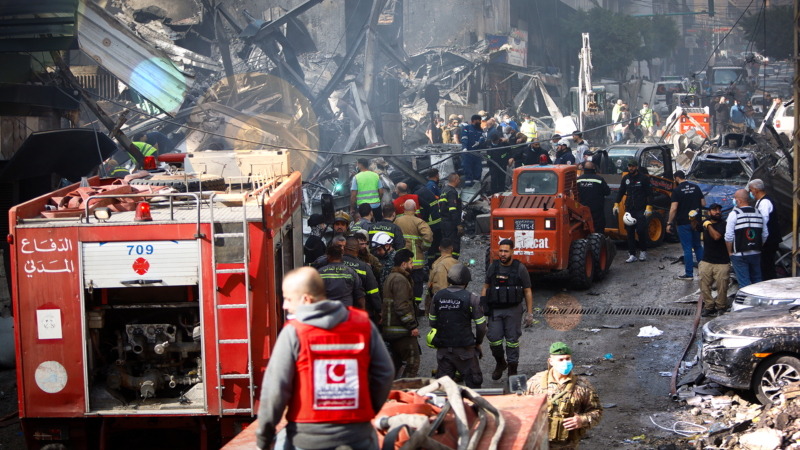
The United States and Iran claim to have achieved a ceasefire, but the firing hasn't ceased. On Wednesday morning, a few hours after the two sides announced that they had agreed to stop fighting for two weeks thanks to Pakistan's mediation, bombs were falling across the Middle East, killing hundreds of people.
In his initial Tuesday night announcement, Pakistani Prime Minister Shehbaz Sharif wrote that there would be an "immediate ceasefire everywhere including Lebanon and elsewhere, EFFECTIVE IMMEDIATELY." U.S. President Donald Trump claimed that the ceasefire would be subject to "the COMPLETE, IMMEDIATE, and SAFE OPENING of the Strait of Hormuz." Iranian Foreign Minister Abbas Araghchi agreed that "safe passage through the Strait of Hormuz will be possible via coordination with Iran's Armed Forces" for the two-week period.
None of these things are true. The biggest sticking point is Lebanon, where the pro-Iran militia Hezbollah had joined the war on Iran's side. On Wednesday morning, Israel declared that it "supports President Trump's decision to suspend strikes against Iran," but did not consider the ceasefire to apply to Lebanon, and launched Operational Eternal Darkness, a massive bombing campaign that killed 254 people in hours.
The Israeli military told the newspaper Yedioth Ahonroth that its "working assumption" is that the war with Iran will resume. "We still have some goals to accomplish, and we will achieve these goals, either from agreement and consensus, or from renewal of the war, because we are ready to do so whenever necessary. Our finger is on the trigger," Israeli Prime Minister Benjamin Netanyahu told reporters on Wednesday.
Despite Sharif's declaration, Trump agreed with Israel that Lebanon would not be part of the ceasefire. Araghchi, on the other hand, argued that the "terms are clear and explicit: the U.S. must choose—ceasefire or continued war via Israel." Iranian negotiators have told the mediators that they will not attend peace talks in Pakistan on Friday unless Lebanon is included, according to The Wall Street Journal, and Iranian state media publicly announced that the Strait of Hormuz will be closed again in response to the Israeli attacks.
Meanwhile, Iran and its Arab neighbors continued to fight a quieter energy war against each other. Early on Wednesday morning, Iranian authorities reported suffering "a cowardly attack by enemies" against the Lavan oil refinery, without pointing fingers at any particular enemy, and later reported shooting down an Israeli drone near the Persian Gulf coast. That afternoon, Saudi Arabia's east-west pipeline—the main alternative to Hormuz—was attacked by a drone, the Financial Times reports.
In addition to the pipeline bombing, the Saudi government and other Arab states reported several Iranian attacks against oil infrastructure, power plants, and water desalination stations on Wednesday. U.S. Secretary of War Pete Hegseth dismissed these attacks as the work of Iranian "troops out in remote locations" who didn't know about the ceasefire yet.
As for the planned Friday peace talks, the two sides don't seem to know what they have agreed to discuss. In his initial ceasefire announcement, Trump stated that Iran's ten-point plan "is a workable basis on which to negotiate." According to the version published by Iranian diplomats, that plan includes a full end to economic sanctions, a withdrawal of U.S. troops from the region, an end to the war against Hezbollah and other Iranian allies, and continued Iranian control over Hormuz.
At a Wednesday afternoon press conference, White House press secretary Karoline Leavitt claimed that Iran's public ten-point plan "was fundamentally unserious, unacceptable and completely discarded," and that Trump had actually agreed to negotiate on a separate, secret ten-point plan that the administration would not disclose to the public.
Trump administration officials have claimed that Iran "begged for this ceasefire" and that Trump's threats to kill the "whole civilization" of Iranians were what brought Iran to the table. But the Financial Times reports that the U.S. side was the one that initiated ceasefire talks—and that the Trump administration had spent weeks trying to convince Iran to negotiate. According to the Times' report, Araghchi's team had agreed in principle to a "ceasefire for Hormuz" deal several days before Trump's threat.
The current ceasefire has echoes of previous ceasefires in Gaza, where mediators presented each side with its own version of the truce, hoping to put off the real questions until later. And little surprise, peace has fallen apart multiple times in Gaza over the past few years. Even now, skirmishes have continued in Gaza between Israel, Hamas, and other Palestinian factions.
More important than what the two sides say is what they do. The Iranian navy has been radioing ships, telling them that anyone who "tries to transit without permission will be destroyed." (Lloyd's List, a shipping industry journal, reported Wednesday afternoon that only three ships had transited Hormuz since the ceasefire.) And U.S. military officials tell Reuters that thousands of Marines will continue moving from San Diego to the Middle East.
"Let us be clear, a ceasefire is a pause, and the joint force remains ready, if ordered or called upon," Gen. Dan Caine told reporters on Wednesday.
