

NASA's Artemis Program Is a Monument to Government Waste. It Can Only Go Up From Here.
Man is finally getting closer to the moon—long delayed by NASA, red tape, and political meddling.
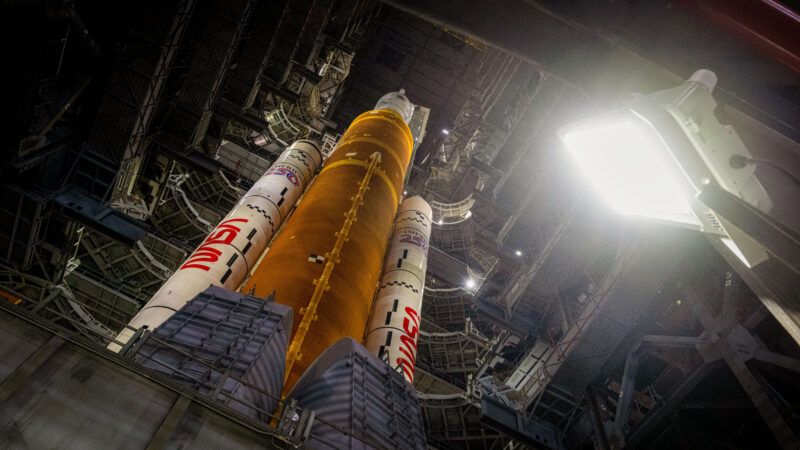
If the pending Artemis II mission is successful, it will not just send Americans around the moon and back for the first time in more than half a century—it will send them further than any human being has traveled into space. If the rest of the Artemis program proceeds on schedule, astronauts will return to the lunar surface by the end of the decade.
That's been a long time coming. The government has been working to get Americans back on the moon since the Bush administration created the Constellation program in the mid-2000s. Wondering why it's taking so long, given that the original moon mission required only seven years? The answer involves the familiar forces of government inefficiency and pork barrel congressional politics.
How We Got Here
After the space shuttle Columbia disintegrated while reentering the atmosphere in 2003, the Bush administration decided to shift the space program away from the Space Shuttle program. The result was the more targeted, purpose-driven Constellation program, which focused on completing the International Space Station and laying the groundwork for a "return to the Moon no later than 2020." This, officials hoped, would be a stepping stone toward a crewed mission to Mars not long afterward.
By the time President Barack Obama took office, the Constellation program was already on the way to cancellation; the new administration declared the program "over budget, behind schedule, and lacking in innovation." When the Shuttle program retired in 2011, no vehicle was set to take its place. So in 2010, Congress mandated that several legacy aerospace companies create the Space Launch System (SLS), both to take over the missions that the shuttle had been servicing and to provide for future space missions.
As development began on the rocket, the projected budget cost through 2017 was $18 billion, a number that would soon start growing. Early in development, each launch was projected to cost $500 million, a number very optimistic in hindsight: According to the White House's 2026 budget proposal, an SLS launch costs about $4 billion. Through last year, the total cost of the program has exceeded $60 billion.
The SLS program isn't just way over budget. It's way behind schedule too. Congress told it to fly by 2016, but the first launch didn't come until 2022. The second launch will be Artemis II.
When the first Trump administration started the Artemis program in 2017, the vision was to send Americans to the moon and then Mars. As the program developed, officials set a goal of having humans on the moon again by 2024. In April 2021, SpaceX won the bidding process to build the Human Landing System—the lunar lander that would deliver the astronauts to the moon's surface. Blue Origin then sued NASA over losing out to SpaceX, and NASA had to pause work until the lawsuit ended. The suit was resolved in November, at which point SpaceX and NASA returned to work.
Infrastructure issues plagued Artemis, with repairs spanning months. Rocket launches require good weather, and launch windows can be tight, so a few days of bad weather can postpone a launch by weeks or months.
After Jared Isaacman became NASA administrator last year, the Artemis mission schedule underwent substantial structural changes. Artemis III, which had been set to be the mission that would send astronauts to our satellite's surface, has now become Artemis IV, scheduled for 2028; the new Artemis III will test on-orbit capabilities but will stay in low Earth orbit. Further missions down the line are supposed to begin assembly of a U.S. lunar base. The current slate of missions run through Artemis X, projected to have a 2035 launch date.
Why the Delays?
Government programs are notorious for delays and for budget bloat, but the issues with Artemis have far exceeded the typical disruptions.
Like many spaceflight programs over the years, Artemis is a pork barrel project. Legislators with a NASA presence back home—or a large space company—have an incentive to put more money in the program to get a larger slice for their constituents. That's a recipe for spending money where it will make politically powerful people happy rather than where it's needed to get a job done.
This doesn't just affect governments. It affects private companies that contract with the government. Before SpaceX mastered reusability and high launch cadence, there was little incentive for businesses like Boeing even to launch at all. These companies' contracts with NASA were cost-plus contracts—that is, they'd get paid for the costs of development and other program necessities, not just to perform a service for the government. That encourages contractors to hire as much as possible and work as slowly as possible, so that every year Congress gives them additional money for their program costs. And as a contractor overhires, it devolves from a fast, lean operation to a slow and bloated one where the simplest decisions need approval from many departments.
The Artemis program has also seen bloat in unnecessary mission components. Consider the Lunar Gateway, which until its cancellation this month was a planned lunar space station that was supposed to support astronauts on the moon. Over $3 billion has been spent on this project so far, though it's not clear that a lunar space station is actually necessary to fulfill the Artemis program's stated goals. If anything, the Lunar Gateway felt like a solution in search of a problem: NASA officials keep speculating about possible uses for it (a propellant depot! a refueling station for Mars missions!), even though it is by no means necessary for either reaching the moon or building a base there.
Adding more missions to a program has meant upgrading the rocket with even more add-ons. The Space Launch System, unlike SpaceX's launch vehicles, is not a reusable vehicle, so the rocket needs to be rebuilt every mission. The authorities have announced plans to add further components for those future tasks, adding power to the rocket and allowing for much more cargo on each trip to the moon. These capabilities may be useful, but building out SLS this way requires even more money from American taxpayers and adds years in development time. The biggest beneficiaries are Boeing, Aerojet Rocketdyne, Northrop Grumman, and the United Launch Alliance.
Congressional interference has also played a role in mismanaging Artemis. Certain senators from key NASA states were adamant that SLS be chosen over SpaceX for the Artemis missions. Legislators could be forgiven for choosing a government rocket program over an upstart like SpaceX a decade ago, when the company had not yet actualized reusability or a strong flight cadence. But every year since has made it more astounding that legislators still put their hand on the scale in favor of SLS.
Consider the orbital propellant depot debacle of the mid-2010s. The United Launch Alliance was pioneering research into orbital propellant depots, which could be used to refuel spacecraft in orbit. These depots could enable trips to Mars and beyond, since those missions would no longer be limited by the amount of fuel a rocket can fill on Earth, nearly all of which is lost trying to escape our planet's gravitational pull. But SLS, being an expendable rocket, had no use for propellant depots, and Boeing pressured the government to cancel this research. Notoriously, then–Sen. Richard Shelby—a Republican from Alabama, where SLS development takes place—threatened to cancel NASA funding if he heard the agency mention "orbital propellant depots" ever again.
New Blood
The rise of China may eventually give those legislators, bureaucrats, and contractors a greater sense of urgency. Beijing has grand plans for the moon, some of them military and some scientific, and it's becoming more and more of a toss-up as to which nation will land people there next. After Congress passed the Wolf Amendment in 2011, barring the U.S. from cooperating with China in space, China built and launched its own space station. Washington is still dominant in the launch sector, thanks to SpaceX, but China has been quickly closing the gap with its own launch company ecosystem.
While China's space industry is hardly a free market, the government tends to spend its money more broadly than picking a handful of favorite contractors; instead of a singular entity akin to SpaceX, several robust competitors are approaching a regular launch cadence. Were it not for SpaceX, China would have surpassed the United States in space already.
One bright spot for Artemis fans is the new NASA administrator, Jared Isaacman. In the few months since the Senate confirmed him in December 2025, Isaacman has completely revamped many lagging programs that have been sluggish and has given the agency a morale boost. Many NASA chiefs have been afraid of upsetting Congress by limiting SLS flights or cancelling unnecessary projects, but Isaacman seems genuinely interested in cutting the waste. On February 26, NASA cancelled the development of the Block 1B, Exploration Upper Stage, and Block 2 configurations, looking to maintain a steady schedule for NASA programs. March 24 saw the cancellation of the Lunar Gateway, shifting those resources to the neglected Artemis lunar base.
With moves like that, Artemis might actually manage to get back on budget and on schedule—or as close to on-budget and on-schedule as NASA can manage.




