

ICE Insists Liberia Is the Only Place It Can Deport Kilmar Abrego Garcia
The administration insists it can only deport him to Africa. It's not clear why, other than to be vindictive.
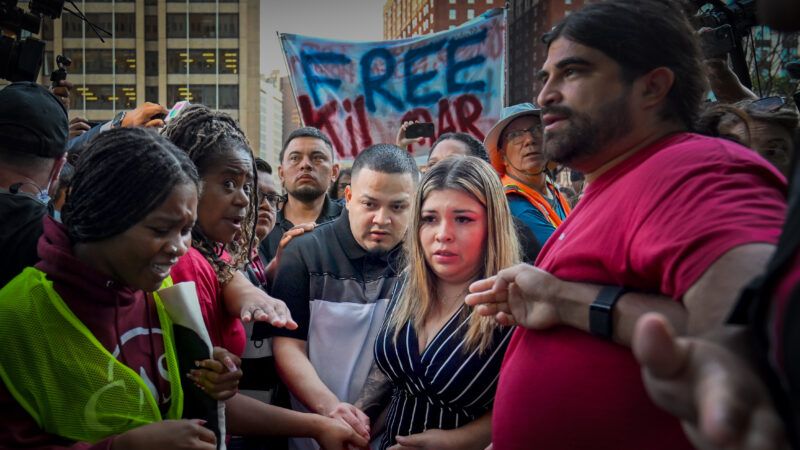
One year after it improperly arrested and deported a Salvadoran man, the Trump administration is in court trying to remove him again—not to his home country, this time, but to a completely separate continent. It's not clear why, other than simply to be vindictive.
In March 2025, Department of Homeland Security (DHS) agents arrested Kilmar Abrego Garcia and deported him back to El Salvador. The problem was that although he had entered the country illegally, an immigration judge had previously granted him "withholding of removal" to El Salvador, meaning that was the only country where he couldn't be sent.
In April, the U.S. Supreme Court unanimously affirmed a lower court's ruling that the government "facilitate" his release and return, "and to ensure that his case is handled as it would have been had he not been improperly sent to El Salvador." Instead, the administration ignored the ruling and falsely claimed the court had ruled in its favor.
"He is not coming back to our country," Attorney General Pam Bondi told Fox News. "That's the end of the story." DHS Acting General Counsel Joseph Mazzara agreed, claiming in an affidavit, "DHS does not have authority to forcibly extract an alien from the domestic custody of a foreign sovereign nation."
And yet just weeks later, the government apparently did just that, returning Abrego Garcia to the U.S. just to indict him on two federal counts of trafficking immigrants into the country. Last month, Judge Paula Xinis of the U.S. District Court for the District of Maryland issued an order barring Immigration and Customs Enforcement (ICE) from taking him into custody.
According to Abrego Garcia's attorneys, the government offered to send him to Costa Rica, but if he declined, he would instead be sent somewhere in Africa, like Uganda, Ghana, or Eswatini. As it turns out, none of those three African countries agreed to take him, but Costa Rica did, and he agreed to go.
But the Trump administration then refused, arguing he should instead be sent to Liberia. It reiterated this plan last week when asking the court to allow his removal.
"The United States government presently stands ready, willing, and able to remove Petitioner to Liberia, and the only impediment to Petitioner's removal is the Court's injunction barring Petitioner's removal," according to a motion filed Friday. "Removal to Liberia can be completed in a matter of days as soon as the injunctions currently preventing removal are dissolved." It asked Xinis to "dissolve the active injunctions" keeping them from deporting him.
Why Liberia? He has no connection to the country. The only explanation seems to be as a form of punishment. The administration had also suggested sending him to South Sudan, a country wracked by civil war and persistent instability. Last year, the U.S. deported eight people to South Sudan, including men from Cuba, Laos, and Mexico.
And yet the administration insists Liberia is the only viable option.
Again, the government allegedly offered Costa Rica as an alternative, which both Abrego Garcia and Costa Rica's government agreed to. But in a March 2 memo, Acting Director of ICE Todd Lyons says that would be "prejudicial to the United States," using a term in federal law that allows the government to deny a deportee's request.
Lyons' evidence for this claim is laughable. "To date, significant U.S. Government resources and political capital have been expended negotiating with the Republic of Liberia for its acceptance of third country nationals, and specifically for its acceptance of Mr. Abrego Garcia," he wrote. "Abandoning agreements negotiated at the highest levels of government could cast doubt on the diplomatic reliability of the United States in relation not only to the Republic of Liberia but also other nations with whom it negotiates on these and other matters. Accordingly, after careful consideration, I have decided that Mr. Abrego Garcia's removal to Costa Rica at this time would be 'prejudicial to the United States.'"
Lyons argues that after negotiating this arrangement with Liberia, it would simply be embarrassing not to send people there—whether or not it makes any sense to do so.
Of course, nobody asked the administration to negotiate with Liberia as a location for the U.S.'s deportees in the first place. What purpose would it serve, other than to be vindictive?
After all, as the government argues that it must send Abrego Garcia to Liberia, it simultaneously warns Americans to "exercise increased caution" when traveling there. "Violent crime, such as armed robbery are common in urban areas, crowded markets, and public beaches," per a travel advisory from the U.S. State Department. "Local police lack the resources to respond effectively to serious crimes."
It's also a bit ironic for the Trump administration, which seems to pride itself on the number of international agreements it has withdrawn from, to be concerned that our "diplomatic reliability" is at stake if we don't send non-African migrants to Africa.
"[The government's] persistent refusal to acknowledge Costa Rica as a viable removal option, their threats to send Abrego Garcia to African countries that never agreed to take him, and their misrepresentation to the Court that Liberia is now the only country available to Abrego Garcia, all reflect that whatever purpose was behind his detention, it was not for the 'basic purpose' of timely third-country removal," Xinis wrote in December when ordering his release from custody.




