

What Is Life Like Beneath the Bombs of the Iran War?
Reason speaks with civilians about wartime life in Iran, Israel, Kuwait, and Bahrain.
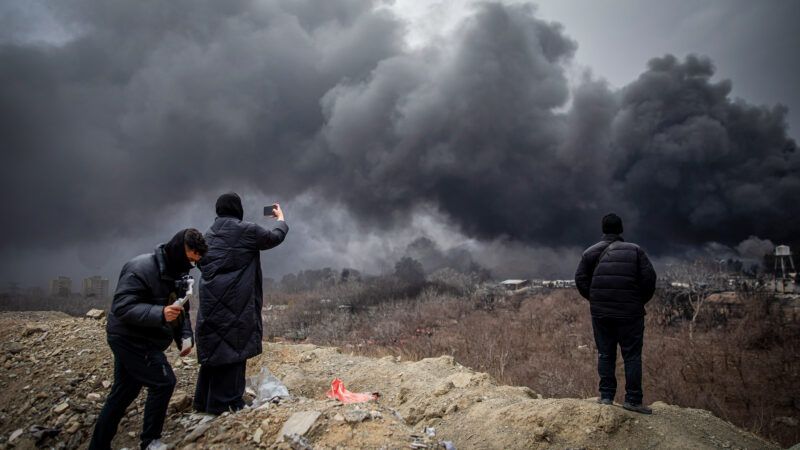
Since the U.S.-Israeli air raids on Iran last week, every single country in the region has seen some level of bombing or even ground skirmishes. While most Americans are experiencing the war mostly through higher prices at the gas pump—though a few families have made the ultimate sacrifice—Middle Easterners are going about their lives to a constant rhythm of air raid sirens and deadly projectiles.
The war has killed at least 1,698 people throughout the Middle East, the vast majority of them in Iran. Here are a few stories from people around the region who spoke to Reason. On both sides of the front line, there is widespread fear, uncertainty about the future, and mistrust in the government. Because all of these countries are under some degree of wartime censorship, Reason has changed the names of everyone involved.
Iran
Hossein had been expecting war for weeks, but it was still a shock when it happened. He woke up to his family discussing the news of the U.S. attack and arguing about whether to leave the house or not. "I decided to tag along given that I would rather die with my family than stay home," he wrote in his diary.
The family got in the car and drove to the countryside outside of Isfahan, their home city. Hossein saw long lines at gas stations. Along the highway, Hossein heard a loud boom and the music on the car radio suddenly cut out. Warplanes had attacked the radio station. The family turned around and headed straight home.
Although Isfahan has not borne the brunt of the air raids, there was a deadly series of attacks on the fourth day of the war. "Every time there is a sound, I have to listen carefully to distinguish whether it's a missile being fired at the enemy (the whooshing of the booster) or the constant airflow of a jet or plane," Hossein wrote. "Sometimes I pretend to the family that I didn't hear a sound or attribute it to something else."
Hossein is constantly trying to get in touch with friends in other parts of the country that have been bombed much harder, including Tehran, Tabriz, and the port of Bandar Abbas. "My friend in Bandar Abbas is especially distraught due to the constant bombing of the south by the U.S.; my friend in Tehran doesn't really have options to leave given that she has two pets that make things hard," he tells Reason via text.
On Saturday, the Israeli air force bombed fuel depots in Tehran, blanketing the city with smoke and oil. Authorities have warned residents to stay inside for fear of toxic fallout and acid rain. Hossein's friend fortunately lives far away from the fuel depots, though she told him that the air smells of gunpowder from so many bombings.
Just before the war, Iranians held a nationwide uprising against the government, which violently cracked down, killing thousands of people. Many Iranians hoped that this war could lead the way to a swift revolution. Others abhor a foreign war on their country. Hossein heard people shouting in support of the old monarchy and honking in celebration when news broke of Supreme Leader Ali Khamenei's death; he says government supporters are holding nightly rallies to keep protesters off the street.
He also forwarded messages from his friend Mehdi, who lives in another provincial city. When Mehdi's parents heard news of the airstrike on the elementary school in Minab, which killed 165 people, they called it an inside job by the Iranian government. (U.S. officials briefed Congress that it was likely a U.S. strike, and video evidence shows the school was hit by an American missile during a raid on a nearby Iranian naval base.) Mehdi wrote that it made his "blood boil" to see his parents "brainwashed" like this. Even families are polarized.
"I am expecting this war to go on for months, and go on for longer than anyone in the government planned for," Hossein adds. "Both Iran and U.S."
Kuwait
Some of the most intense Iranian counterfire has targeted Kuwait, home of one of the largest U.S. military bases in the region. On the first day of the war, an Iranian drone killed six American soldiers at a makeshift operations center at the Port of Shuaiba. The Kuwaiti army has itself lost two soldiers—and shrapnel from an intercepted drone killed an 11-year-old girl. Kuwait is also where three U.S. fighter jets were shot down in a bizarre friendly-fire incident.
"People thought Iran [is] gonna rain missiles on all of Kuwait" on the first day, says Anas, a Kuwaiti man. Since then, he says things have calmed down from "hysteria" to a "general anxiety" about how long the war is going to last. Anas calls it "annoying" that the air raid sirens go off every day around the morning prayer, when the Ramadan fast begins.
"Most people are scared because they think they're going to be hit by missiles or shrapnel, but I would say only half of those people are being reasonable about the actual threats," says Jasim, another Kuwaiti man. "Random migrant workers who pointedly avoid talking politics…ask for reassurance and explanations for what's happening."
Although the bulk of the Iranian fire has been directed at military bases outside the city, Anas and Jasim are both very worried about Kuwait's desalination plants, which provide 90 percent of the country's water. On Saturday, Iran accused the U.S. of bombing an Iranian desalination plant, which the U.S. military denies. On Sunday, Bahrain claimed that an Iranian drone hit a Bahraini desalination plant. Kuwait could easily be next.
Jasim has heard a variety of different political reactions from Kuwaitis. Some blame America for starting the war, others blame Iran for "going crazy," and a few believe that the war is actually a conspiracy between Iran and "the Jews" to destroy Arab countries. And there is a mistrust of the Kuwaiti government, which is "going back to familiar routines as if they guarantee safety," Jasim says. "It feels maddening that everyone thinks that things will go back to normal after this."
Bahrain
Bahrain is the most tense country in the Gulf. Many Bahrainis feel doubly occupied—the monarchy is not native to the country, and it has always relied on foreign military protectors, from the British Empire to the U.S. Navy's Fifth Fleet. In 2011, Saudi tanks crushed a Bahraini popular uprising. The war has uncorked built-up anger; the Bahraini authorities have arrested at least 65 people for protesting the U.S. military presence and at least 11 people simply for posting footage of air raids online.
"The feeling of danger is very individual to people's personalities. You have people who can have their properties wrecked and they're cracking jokes, whereas a lot of people, nowhere near any danger, can get really psychologically affected/panicky," says Abbas, a Bahraini now outside the country. He hears sirens and explosions in the background when he calls his family in Bahrain, yet "no one seems bothered by them at all."
On the other hand, Abbas says, there is a real fear of the Bahraini government "violently cracking down" on the Shiite majority to preempt an uprising. Fatima, another Bahraini outside the country, says some supporters of the opposition were initially "euphoric" to see U.S. bases getting bombed. But "once the civilian buildings got hit, it is more nervousness and very little celebration," she says.
Some people could understand Iranian attacks on hotels because U.S. troops were billeted there. (Two U.S. personnel were injured in one such attack.) However, the mood really soured when Iranian drones bombed Bahrain's main oil refinery, a major source of livelihood for the country. "It is the feeling that you are stuck in a war that you didn't ask for because of [a] government alliance with the U.S. you never asked for," Fatima says.
On Friday, Abbas told Reason he was "actually surprised" that shrapnel from air defense hadn't killed anyone in Bahrain, given how densely populated the island nation is. Two days later, his fear appeared to come true. A viral video from Sunday night shows an air defense missile fired from Bahrain flying off course and hitting the ground. The Bahraini government then announced that 32 civilians were wounded by "an egregious Iranian drone attack" on a village.
"Latest handiwork of the kachra [garbage] American interceptors: a Shia village wrecked," Abbas texted Reason along with a video of the aftermath. "There is extreme frustration at what is perceived as the intentional dispersing of American military assets next to Shia villages, people feel (and historical evidence validates them) that the government treats them as disposable, that they in particular are being used as human shields, etc."
Of course, some Bahrainis support their government and straightforwardly blame Iran for causing the damage. And even beyond government supporters, "some will get angry at people who minimize the hitting of civilian infrastructure, angry at Iran for hitting civilian buildings," Fatima says. "But most are just like shit is hitting the fan and we never asked for this."
Israel
It's quite a different story in Israel, which has been at war continuously since the Hamas attacks of October 7, 2023, and had fought Iran directly during the Twelve-Day War of June 2025. "Psychologically speaking it's intense but nothing compared to the early Gaza War, especially immediately following 10/7," says David, an Israeli man. "I think this time everyone saw it coming on some level."
In the weeks leading up to war, the media ran numerous stories about Israel preparing to attack Iran—and Israeli Prime Minister Benjamin Netanyahu ordered civil defense institutions to go on high alert two weeks before the war began. David is surprised by the level of "general compliance" and "wall to wall support" that Israelis have shown for the war so far. "I think also the notion that this time we're doing it 'once and for all' (whatever that means) plays a part," he says.
The situation now reminds David of the 2020 pandemic, where "everyone needs to hunker down." Schools are closed, public gatherings are banned, reservists are being called up, and every so often air raid sirens warn of an incoming missile or drone. "I don't think people are really scrambling to shelters anymore. That was only the first couple of days. Some of the alarms hit at like 3 AM, so nobody's gonna bother," David says, adding that "a lot of people have kids so it's a whole pain in the ass to manage them in the shelter."
On the second day of the war, an Iranian missile broke through a bomb shelter in Beit Shemesh, killing four people inside. "It was unsettling at first. But was handwaved a bit since it was a Haredi [Orthodox Jewish] community and the shelter was kinda improvised and shoddy (per reports)," David says.
Israelis tend to be worried less about direct Iranian attacks and more about Lebanon, where the Hezbollah militia has joined the war on Iran's side. Israel officials were not expecting Hezbollah, which had lost a war to Israel in 2024, to act as aggressively as it is now. "There have been some casualties in Lebanon and it doesn't appear to be wrapping up soon," David says ominously.




