
Withholding $260 Million From Minnesota Won't Win the War on Medicaid Fraud
The legal exploitation of Medicaid's federal matching system is a much bigger problem than criminal fraud.
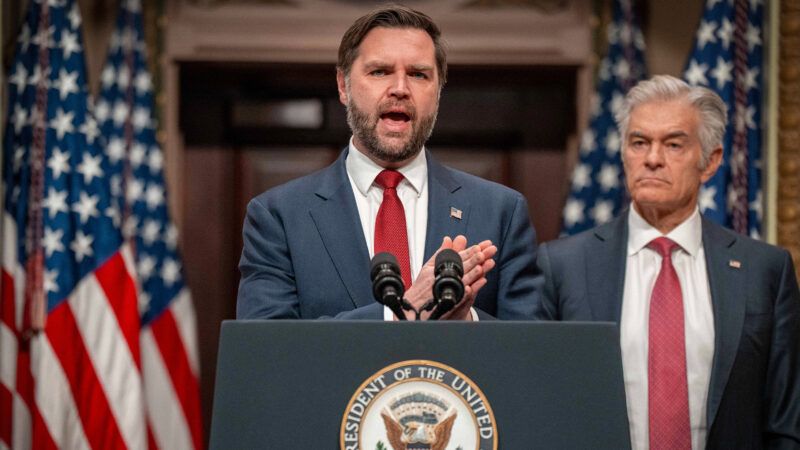
The Wall Street Journal reported on Wednesday that Vice President J.D. Vance and Administrator for the Centers for Medicare & Medicaid Services (CMS) Mehmet Oz are withholding "$259.5 million in funds…until [Gov. Tim] Walz can show that the state has investigated whether the money is going to the intended recipients."
This announcement marks the first battle in the "war on fraud," which President Donald Trump declared during his State of the Union address on Tuesday. Unless Trump wants this war to be as big a failure as the war on drugs and the war on poverty, Vance will have to do more than temporarily withhold $260 million in Medicaid subsidies to Minnesota.
Minnesotan fraud has been in the administration's crosshairs since City Journal's viral November 2025 reporting on the exploitation of three Medicaid-funded programs, almost entirely by members of the Somali community. Following public outrage, CMS notified the state in January "of its intent to withhold federal funds until it was satisfied with the state's corrective action plan to address its program integrity shortcomings."
Of the $259.5 million in federal matching funds being withheld, $243.8 million target "unsupported or potentially fraudulent Medicaid claims" emanating from personal care, practitioner, and home services. At the State of the Union, Trump cited the "stunning example [of] Minnesota, where members of the Somali community have pillaged an estimated $19 billion" from such Medicaid-funded programs. There are two major problems with this claim.
First, Assistant U.S. Attorney Joe Thompson estimates that about $9 billion of Medicaid dollars spent by Minnesota since 2018 may be fraudulent ($19 billion was the total cost of the program in Minnesota in 2023). Second, while Minnesotans of Somali descent disproportionately committed around $1.5 billion of this fraud, Trump's claim that this community—less than 2 percent of which were involved in the aforementioned fraud—is responsible for the remainder is merely speculation.
Republicans aren't the only ones making sensationalist claims. Walz described the temporary withholding as "cuts [that] will be devastating for veterans, families with young kids, folks with disabilities, and working people across our state." They're conditional withholdings, not permanent cuts, and only about 1.3 percent of Minnesota's nearly $20 billion Medicaid budget for this year.
Meaningfully reducing Medicaid fraud will require Trump and other politicians to wrestle with the problems inherent to the program's federal matching system. Then again, doing so would require Trump to meaningfully reduce the scope of the federal government and walk back his State of the Union promise to "always protect Social Security, Medicare, [and] Medicaid."
The Cato Institute's Romina Boccia and Tyler Turman describe how states have long exploited legal gimmicks to shift 70 percent of Medicaid costs from the state to the federal level. Instead of actually spending money on health care, states effectively tax health care providers, "use [this] revenue to claim federal matching funds, and rebate the tax money back to providers through Medicaid payments before pocketing the rest," they explain. Similarly, states borrow money from their city and county governments to increase federal Medicaid funding and then return a portion of these federal dollars to local governments.
These schemes, which Michael Cannon, the Cato Institute's director of health policy studies, refers to as "perfectly legal" fraud, were responsible for over $173 billion (20 percent) of the $866 billion the federal government and states spent on Medicaid in 2022. By contrast, the Department of Health and Human Services (HHS) recovered only $416 million from criminal fraud in 2022. In 2025, the HHS Office of Inspector General charged 324 defendants with $14.6 billion in health care fraud, which is still much lower than the federal dollars lost to provider tax abuse and intergovernmental transfers.
Temporarily withholding hundreds of millions of dollars from one state that does an egregious job of policing outright fraud makes for good politics. But it does not reduce federal spending on entitlements, nor solve the actual fiscal problem of states legally fleecing the federal taxpayer for nearly $200 billion every year.
