
The Supreme Court Just Struck Down Trump's 'Emergency' Tariffs
"There is no exception to the major questions doctrine for emergency statutes," wrote Chief Justice John Roberts.
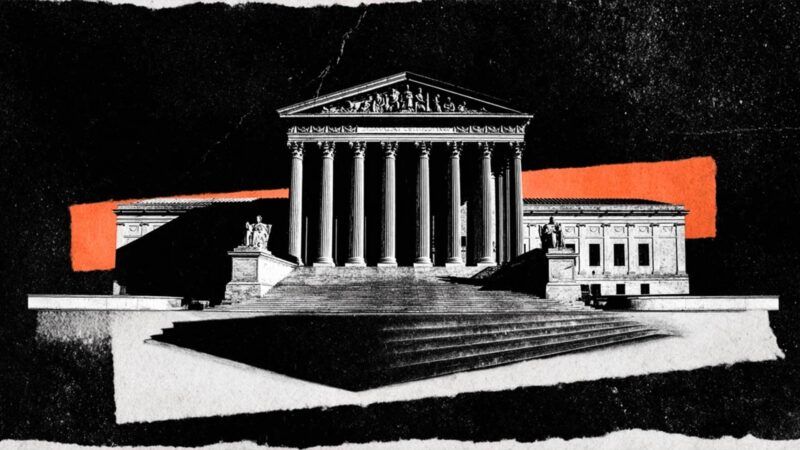
President Donald Trump's use of sweeping "emergency" powers to impose tariffs is unlawful, the U.S. Supreme Court has ruled.
In an opinion released Friday, Chief Justice John Roberts said that Trump's unprecedented use of the International Emergency Economic Powers Act (IEEPA) to place tariffs on many U.S. imports extended beyond the president's "legitimate" powers. The ruling affects tariffs imposed in February 2025 against goods from Canada, China, and Mexico, as well as the larger set of tariffs Trump announced in April.
The final decision was effectively a 6–3 ruling that said the IEEPA statute did not authorize the president to impose tariffs. However, the majority appears to be split on its reasoning for reaching that conclusion. Roberts was joined in his opinion by Justice Neil Gorsuch and Justice Amy Coney Barrett. Justices Elena Kagan, Sonia Sotomayor, and Ketanji Brown Jackson filed a concurring opinion.
Both Roberts and Gorsuch (who filed a concurring opinion of his own) leaned strongly into the so-called major questions doctrine, which says that significant policy matters must be settled by Congress.
"There is no exception to the major questions doctrine for emergency statutes," Roberts wrote. "Nor does the fact that tariffs implicate foreign affairs render the doctrine inapplicable."
The Learning Resources v. Trump case rolled together multiple lawsuits filed by a group of small businesses and some state attorneys general. It has been widely seen as an important test case not only for presidential tariff powers but also for the Supreme Court's willingness to defend the separation of powers against Trump's expansive executive actions.
Friday's much-anticipated ruling caps a monthslong legal saga that saw the Trump administration lose at the Court of International Trade, a federal appeals court, and now at the Supreme Court. On each occasion, the legal system has balked at the idea that a president may use IEEPA to impose tariffs when the text of the 1977 law plainly does not authorize tariffs.
At oral arguments in November, the Trump administration faced tough questions from the Supreme Court's liberal and conservative wings over its reading of IEEPA. The administration argued that the law allows presidents to "regulate" trade and that, therefore, tariffs were permissible.
The Supreme Court did not buy that argument.
"While taxes may accomplish regulatory ends, it does not follow that the power to regulate includes the power to tax as a means of regulation," Roberts wrote. "Indeed, when Congress addresses both the power to regulate and the power to tax, it does so separately and expressly. That it did not do so here is strong evidence that 'regulate' in IEEPA does not include taxation."
In a dissenting opinion, Justice Brett Kavanaugh argued that "this case presents one straightforward question of statutory interpretation: Does Congress's explicit grant of authority in IEEPA for the President to 'regulate…importation' of foreign goods in declared national emergencies authorize the President to impose tariffs? The answer is a clear yes."
The ruling will likely kick off a number of new legal and political fights. The Trump administration could move to reimpose the tariffs under a different statute (there are several options, though none allow such broad action as IEEPA), or could ask Congress to amend the IEEPA law to give presidents the powers that Trump seeks.
Meanwhile, importers that paid the IEEPA tariffs will seek to be reimbursed for those costs. That will cost the federal government hundreds of billions of dollars and could start more legal fights, as the White House has signaled that refunds may not be given.
Those are issues to be settled another day. The most important part of Friday's ruling is the Supreme Court's recognition that executive powers have limits and that congressional authority over trade policy remains intact. A victory for the administration would have dealt a death blow to that constitutional arrangement.
"We claim no special competence in matters of economics or foreign affairs," Roberts wrote. "We claim only, as we must, the limited role assigned to us by Article III of the Constitution. Fulfilling that role, we hold that IEEPA does not authorize the President to impose tariffs."