
Trump's FTC Chairman Sends a Threatening Letter to Apple for Not Promoting Enough Conservative Media
Chairman Andrew Ferguson continues the Federal Trade Commission’s crusade against free speech with an official letter to Apple CEO Tim Cook.
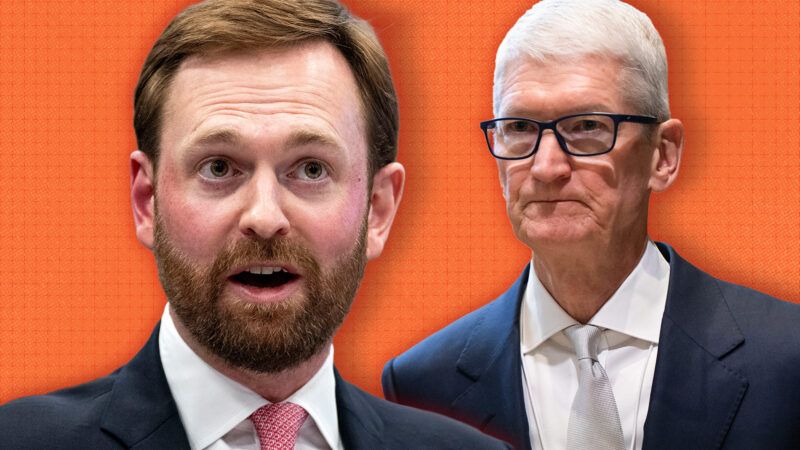
The Federal Trade Commission's (FTC) campaign on Big Tech reached a new chapter on Thursday when FTC Chairman Andrew Ferguson sent a letter to Apple CEO Tim Cook, accusing the company of suppressing conservative content. In it, Ferguson ironically insists that "the FTC is not the speech police" after lecturing Apple for its speech.
Ferguson accuses Apple News, the No. 1 news app in the United States, of "systematically promot[ing] news articles from left-wing news outlets and suppressed news articles from more conservative publications." To substantiate his accusation against Apple, Ferguson cites "multiple studies [that] have found that in recent months Apple News has chosen not to feature a single article from an American conservative-leaning news source." These studies are those conducted by the Media Research Center (MRC), a conservative media watchdog.
The MRC found that only one of the 560 "top 20 AllSides-rated news stories featured on Apple News…at approximately 10:00 AM ET" from November 3 to November 30, 2025, was "right-leaning," as defined by AllSides, a nonpartisan firm that evaluates media bias. In January, not a single one of the top 620 stories featured that month was right-leaning, according to the MRC. Of the 620 top stories featured, nearly 71 percent (440) were from left-leaning sources, with the remaining coming from center sources, per MRC.
Although AllSides did not participate in the MRC studies referenced by Ferguson, Julie Mastrine, the company's director of communications, told the New York Post that "Americans that are relying on these Big Tech companies to provide them with news are not getting a balanced view and they're not getting the full scope of perspectives available."
Deliberately withholding certain perspectives from the public may not be especially ethical, but the First Amendment allows Apple to platform whatever it pleases.
Ferguson gives lip service to this fact, but emphasizes that the First Amendment does not protect "material misrepresentations made to consumers," which violate the FTC Act's prohibition of "unfair or deceptive acts or practices in or affecting commerce." He says that Apple News may be guilty of just this if the politically motivated suppression and promotion of articles or publications is "inconsistent with the terms and conditions of service."
If that's the criterion, it appears that Apple is on solid legal ground. Joe Coniglio, director of antitrust and innovation at the Information Technology and Innovation Foundation, says there is nothing in Apple News' terms and conditions "that says there will be a certain amount of news of a certain political slant.…In fact, they have a big disclaimer that basically says the opposite—no promise of specific results." Indeed, Apple News' Terms of Use explicitly state that it "does not promise that the site or any [of its] content…will be error-free…or that your use of the site will provide specific results."
Ferguson's missive to Apple is meritless, but it's eerily reminiscent of an August email he sent to Alphabet CEO Sundar Pichai. In it, he warned Pichai that "Alphabet may be engaging in unfair or deceptive acts or practices" if claims about Gmail discriminating against Republican campaign emails were true. (Last month, the 9th Circuit Court of Appeals threw out the Republican National Committee's lawsuit against Alphabet, which accused the company of doing just this.)
But this wasn't the only time the FTC has gone after parties that the agency perceived to be hostile to its agenda.
Three months before Ferguson's letter to Pichai, FTC Commissioner Mark Meador reposted a video of him suggesting that "nonprofit employees and academics who advocate 'for the interests of certain corporations or mergers in their white papers and their op-eds without ever disclosing that they're being paid to do so' may also be guilty of deceptive practices," as Reason reported at the time. Then, in May, the FTC launched an investigation into progressive nonprofit media watchdog Media Matters for its role in organizing an advertising boycott against X—an exercise of political speech that is protected by the First Amendment.
Ferguson's letter is just the latest episode in the FTC's campaign against free speech. While it's unclear what effect, if any, Ferguson's letter will have on Apple News' editorial decisions, this probably won't be the last time the FTC attacks private institutions for constitutionally protected speech.
