
Special Immigrant Visa Program Needs Resuscitation, but It's Not Dead Yet
Our Afghan allies deserve better treatment from the Trump administration as many live under uncertainty during a visa pause.
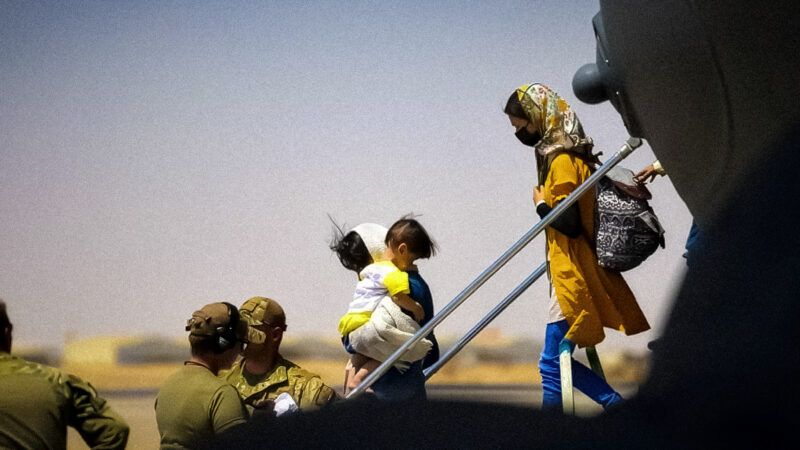
On February 5, The New York Times reported on the supposed death knells of the Afghan Special Immigrant Visa (SIV) program, explaining that "on Tuesday, Congress quietly closed the door to the program altogether when it cleared a spending package that authorized no new visas for it."
Fortunately for the more than 125,000 Afghan SIV applicants still awaiting various stages of processing as of the last State Department's April 2025 quarterly report, the situation is not necessarily so dire.
Though the deadline for submitting new SIVs passed on December 31, 2025, there is no strict deadline on when the U.S. government can stop doling out visas to the Afghans already in process with their applications and who meet the program's prerequisites of having provided more than a year of faithful and valuable service to our government during the course of the nearly 20-year war in Afghanistan.
The number of remaining visas available is a serious concern, however. The April 2025 quarterly report shows 10,216 remaining SIVs for the 115,258 Afghans with a pending application for Chief of Mission (COM) approval, the first step of the SIV process. While that is the latest official figure, far fewer visas are likely available now.
The main impediment to SIV processing is a halt on all Afghan immigrant visa processing, one of numerous punishments leveled against the entire Afghan community shortly after an Afghan national shot two West Virginia National Guardsmen, and killed one, on November 26.
The SIV program hasn't always lived up to its promise. The International Refugee Assistance Project (IRAP) forced the U.S. government via a class-action lawsuit to adhere to the nine-month SIV adjudication timeline that the program mandates in recognition of the dangers facing applicants. In December, IRAP filed a motion to enforce this class action lawsuit. Last week, a judge ruled with IRAP that the State Department must recommence issuing COM approvals to qualified applicants in their class action suit.
Pedro Sepulveda Jr., an IRAP litigation fellow, told Reason that "Secretary Rubio violated the will of Congress and the court's orders when he unilaterally suspended the Afghan SIV program. While Afghan nationals are still not able to enter the U.S. as a result of President [Donald] Trump's travel ban, the court ruled that other steps of the Afghan SIV program must resume."
"On February 24, the U.S. government will explain to the court what steps they are taking to meaningfully comply with the court's orders to speed up processing for SIV applications that have been pending for nearly half a decade," Sepulveda Jr. added. "Compliance with the law is long overdue, and IRAP will continue to hold the government accountable to our Afghan allies who are still at risk from the Taliban."
Support From Congress
Andrew Sullivan, executive director of the nonprofit No One Left Behind, is optimistic that the SIV program will survive. He told Reason in an email that "the President has previously expressed strong support for Afghan allies, as has Congress, and we remain optimistic that this critical program will resume."
"Congress has repeatedly affirmed the importance of the program in a strong bipartisan way," Sullivan says, "and although no new visas were authorized in the FY2026 appropriations packages, the salience of the issue and Congressional support for our SIVs remain high."
Evidence shows continued support for the progress, including among Republicans, Sullivan notes. "In 2025, a bipartisan Congressional letter calling for the authorization of 20,000 additional Afghan SIVs received 106 signatures." That constitutes "a 25% increase in total signatures and a 33% increase in Republican signatures from the prior year."
Pakistan Is Not a Safe Place
Still, the pause in issuing visas and the dwindling quantities of available SIVs has had serious impacts on SIV applicants. Geeta Bakshi, founder of the nonprofit FAMIL USA (which provides humanitarian support for Afghans resettling in the U.S.), supports members of the National Strike Unit (NSU) trained by the CIA. NSU members worked shoulder-to-shoulder with U.S. special operations forces and intelligence personnel over almost 20 years, and were evacuated to the U.S. after playing an instrumental role in securing Hamid Karzai International Airport during the August 2021 U.S. withdrawal.
Unfortunately, a substantial number of NSU members in the U.S. continue to await SIV processing. "FAMIL has made real progress with the Trump administration in addressing the SIV backlog that left thousands of NSU veterans in limbo for years after their relocation under the Biden administration," Bakshi told Reason in an email.* She explained that "while the current immigration pause puts some of these families at risk of losing jobs, homes, and the ability to provide for their loved ones due to expired documentation, we remain engaged with the administration and key Congressional partners and are hopeful processing will resume with the highest vetting standards in place."
No One Left Behind continues to assist SIV applicants overseas who are impacted by the processing pause, who Sullivan says are now "facing crushing uncertainty." He explained that our allies "worked by or on behalf of America, many of them in highly sensitive roles supporting intelligence, defense, and diplomatic missions." As a result, "SIV-eligible Afghans face a credible fear of being abused, tortured, or killed should they be returned to Afghanistan…for Afghans seeking refuge in Pakistan, the risk is further elevated given Pakistan's deportation campaign."
Indeed, Pakistan sent back nearly one million Afghan refugees to their homeland between March and December 2025. These numbers include U.S. allies who once received letters of protection from the U.S. government to bar their deportation. With those letters now expired and no further protections granted, Afghans who worked with the U.S. government now worry daily that they will be sent back to the Taliban, whose reprisal campaign continues.
Sullivan's organization is continuing to help applicants in Pakistan "through life support, housing, Pakistani visa assistance, and other general sustainment services." He added that "although SIV-eligible Afghans have earned their place in America, given the pause to U.S. visa processing, a brutal Pakistani crackdown on Afghans, and the extreme risk of reprisal from the Taliban, moving some of the most at-risk Afghan allies to third countries makes sense at this time." Given these circumstances, "No One Left Behind will support evacuation and resettlement to other third countries."
The Personal Toll of the SIV Pause
Four Afghan SIV applicants who were awaiting SIV processing in Pakistan spoke to Reason on condition of anonymity about the toll that the pause and fear of deportation have taken on their lives.
"Farhan" worked as an interpreter and administrative assistant for five years, ending his employment only when the Taliban took control of the country. After two of his colleagues were killed, Farhan went into hiding, burning all his equipment and uniforms to remain safe during the Taliban's house-to-house searches. He moved to Pakistan after achieving COM approval, and had been waiting for his final SIV interview for nine months when processing paused.
With his Pakistan visa expired, the deportation campaign targeting Afghans in Pakistan escalating, and no hope of being processed, he fears for the future of his family, who are "prisoners in [their] own home."
For five years, "Parwiz" worked as a transportation officer around construction project sites in areas of Taliban influence. After waiting four "long, agonizing years" to receive COM approval, he sold all his belongings to move to Pakistan to await SIV processing with his family. With expired visas, an "overwhelming" financial burden, and an "immense" psychological toll on his anxious family, Parwiz said that the pause has "devastated [his] spirit."
"Samad" worked for 10 years on U.S. contracts that gave him authority to personally vet employees to protect Americans from insider threats. As a member of two Afghan minorities and the father of three daughters "who have no future if forced back to Afghanistan," Samad fears for his family's future.
Samad was particularly far into the SIV program, stuck in "ready" status with his visa approved and the U.S. Embassy holding his physical passports until the time his visa would be issued. Samad's final hope is a national interest exemption his lawyer is filing, arguing that Samad's cybersecurity and vetting skills would make him an asset to the United States.
With two of his SIV colleagues deported from Pakistan in the first week of February, Samad feels his family is "running out of time" as the system "suddenly turned its back on us." Samad says that his wife and four children "are the reason [he is] living," and that he will "do anything to protect them."
"Aziz," a former interpreter who worked with the United States for five years over two different periods, was medically cleared and interviewed in Pakistan for his SIV in 2022. After being asked to update his forms three years later, he was interviewed and medically cleared a second time in 2025. Aziz said that following the pause on processing, his case has nonetheless been put in "Refused" status. After spending years "stranded in Pakistan" and unable to safely return to his homeland, Aziz says that there is "no explanation, timeline, or resolution" to the uncertainty he faces.
A source familiar with SIV processing told Reason that Aziz's refusal is likely linked with the processing pause, as all SIV applicants are now receiving refusals as their visas are being adjudicated. If processing were to commence once more, the source believes, Aziz's and other applicants' processing would likely resume with no prejudice.
The Wider Impact
SIV applicants are not the only Afghans impacted by the administration's recent actions targeting Afghan allies. About 85,000 Afghans in the U.S. Refugee Admissions Program (USRAP) continue to be impacted by a suspension of the USRAP mandated by executive order on January 20, 2025. The removal of temporary protected status for Afghans has put Afghans in the U.S. in precarious legal standing, as has the revocation of parole for those who crossed the border using the CBP One App under the Biden administration.
Following November 26, the Trump administration expanded its previous travel ban and announced its intention to reexamine the cases of Afghans who had been resettled under the Biden administration. In early January, the State Department announced that by March 31 it would close Camp As-Sayliyah (CAS), a facility in Qatar where about 1,100 Afghans have been waiting to be processed for the USRAP and SIV program. Though the State Department says it will relocate resident Afghans to a third country, it has yet to announce what country they will be sent to.
The State Department did not respond to questions about SIV program adjudication or plans for relocating Afghans at CAS.
*CORRECTION: Bakshi was misgendered in the article as originally posted.
