

Bureau of Land Management Says Bison Are Not Livestock, Obstructing Plans for a Huge Private Prairie Reserve
The American Prairie nonprofit seeks to create a 5,000-square-mile prairie reserve in Montana where buffalo may roam and antelope play.
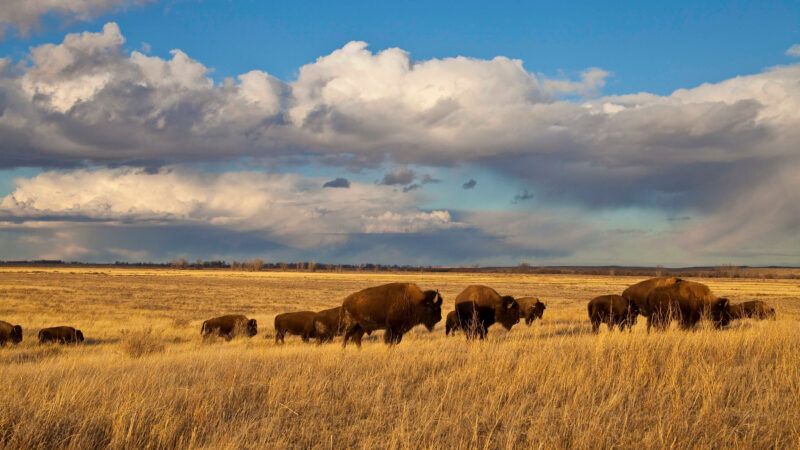
An ambitious and privately funded project to create a 5,000-square-mile prairie reserve where buffalo may roam and antelope play in eastern Montana is being stymied by an obtuse new ruling by the Bureau of Land Management (BLM). The goal of the American Prairie nonprofit is to re-create a prairie ecosystem one-and-a-half times the size of Yellowstone National Park that can eventually support a free-ranging herd of 5,000 bison. Such a reserve would also greatly benefit other prairie species, including elk, pronghorn antelope, sage grouse, prairie dogs, and perhaps one day, predators like mountain lions and bears.
Reason reported on this remarkable private conservation project 10 years ago.
American Prairie uses a variety of techniques to assemble the land needed to create an ecologically self-sustaining reserve. For example, the nonprofit forms voluntary partnerships with local ranchers, making direct payments to them as an incentive to adopt wildlife-friendly management practices on their private lands. In addition, the group also connects the landscape by purchasing private land.
Like much of the western United States, the federal government owns huge swathes of land in Montana with the BLM owning and managing over 8 million acres in the state. The BLM leases out a lot of the range to private operators such as cattle ranchers. In fact, Montana has the most BLM grazing permits of any state. The BLM authorizes 1.1 million animal unit months (AUM) of grazing across the land it manages in Montana and the Dakotas. Those AUMs would support about 90,000 cows and their calves for a year.
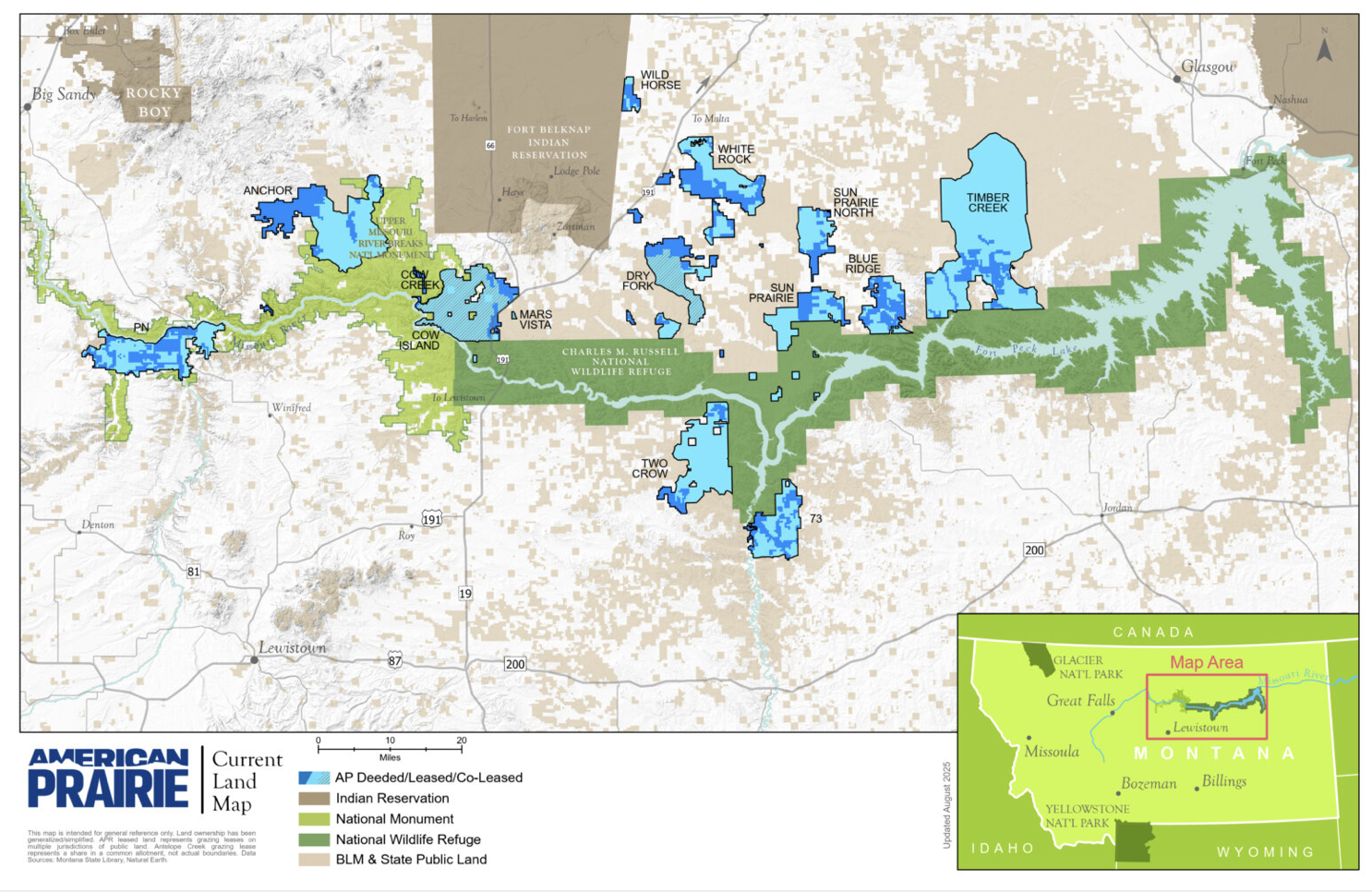
Often, private ranches have preferences to lease adjacent BLM lands to graze their livestock. American Prairie assumes those BLM lease allotment preferences from the ranches it purchases. Since 2004, American Prairie has assembled its current habitat base by combining the purchase of 167,070 acres with 436,587 acres of leased public lands for a total of 603,657 acres.
Since bison, like cows, are ruminants, it shouldn't matter whether one or the other species is grazing on the landscape. In fact, this was the conclusion that the BLM reached back in 2022 when it approved American Prairie's proposal to "manage their base properties and associated grazing allotments to allow for a change in class of livestock from cattle to domestic indigenous livestock (bison)." The 2022 BLM decision also noted that "no scientifically and/or resource management-based reason was identified for why bison should not be permitted to graze BLM land as long as the owner of the animals qualifies as an applicant under the requirements of the grazing regulations."
The BLM's decision to treat grazing bison like grazing cows has, however, been opposed by the Montana Stockgrowers Association, with the organization arguing that bison are not livestock under the relevant federal regulations. This view has long been supported by Montana Gov. Greg Gianforte and Attorney General Austin Knudsen, both Republicans.
The new Secretary of the Interior Doug Burgum ordered in December 2025 that the BLM reconsider its 2022 decision that bison may graze on BLM allotments. The new BLM decision issued last week now finds that bison are not cows, sheep, horses, burros, or goats and therefore are not domestic livestock according to federal regulations. In its new decision, the BLM may only "issue permits where the animals to be grazed will be used for production-oriented purposes. That would include their being used for their meat, milk, fiber, or other animal products."
Amusingly the Congressional Research Service has just issued a new report on federal grazing regulations that cites a 1976 Department of the Interior's Office of Hearings and Appeals holding "that bison may be considered 'livestock' under the TGA [Taylor Grazing Act], where the bison are treated in substantial respects as livestock and have characteristics in common with livestock." As it happens, American Prairie arguably meets the "production-oriented purposes" requirement since it actively manages its bison and authorizes annual harvests from its herd.
In a statement hailing the new BLM ruling against American Prairie's grazing permits, Knudsen says, "I'm pleased to see this proposed decision from the Trump Administration's Bureau of Land Management today. Canceling the American Prairie Reserve's bison grazing permit will help to protect the livestock industry and ranching communities in Northeastern Montana from the elitists trying to push them out."
Since American Prairie's private agreements and purchases are entirely voluntary, it is hard to see how its project is pushing out ranchers and rural residents. In an emailed statement, American Prairie CEO Alison Fox noted, "We've had permission to graze bison on some of these allotments for 20 years and have followed the law, complied with every requirement, and prioritized transparency at every step." She added, "This creates uncertainty for livestock owners across Montana who depend on public lands for grazing." Indeed it does.
It would, of course, be better if the BLM would just sell its land to private owners like American Prairie. In the meantime, the 2021 public comment by policy director Hannah Downey at the free market environmental policy think tank, the Property Environment Research Center, remains apt:
"Montana's ranchers and agricultural producers are important conservationists, and I appreciate their concerns over the future of their industry. People can disagree with the goals of APR [American Prairie], but there is no reason for believers in individual liberty, property rights, and free markets to abandon those values when a conversation group's rights are at stake. Allowing APR to graze privately-owned bison on its federal allotments respects APR's rights and, ultimately, honors all landowners' rights to exercise their grazing privileges while promoting the health of federal lands."
The BLM should get out of the way and let buffalo roam and antelope play once again across the American prairies.




