
Greenlanders Don't Consent To Becoming Americans
Residents of the chilly island coveted by President Trump favor independence—and subsidies.
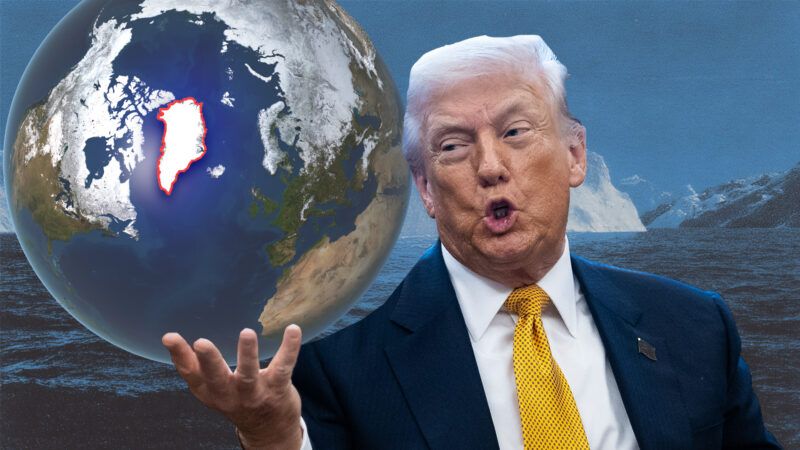
According to President Donald Trump, taking possession of Greenland is a national security necessity. It's so critical, he claims, that he's willing to take the chilly island the "easy way" or the "hard way." Denmark, which governs Greenland, isn't eager to surrender the territory. Even more important, the residents of Greenland, most of whom don't especially want to be Danish, have even less interest in becoming American. The leader of a country founded on high-minded sentiments about the "consent of the governed" should consider taking that into account.
You are reading The Rattler from J.D. Tuccille and Reason. Get more of J.D.'s commentary on government overreach and threats to everyday liberty.
Acquiring Greenland 'the Easy Way' or 'the Hard Way'
"The United States needs Greenland for the purpose of National Security. It is vital for the Golden Dome that we are building," the president posted January 14 on Truth Social. "NATO should be leading the way for us to get it. IF WE DON'T, RUSSIA OR CHINA WILL, AND THAT IS NOT GOING TO HAPPEN!"
At the White House days earlier, Trump had commented, "We are going to do something in Greenland, whether they like it or not, because if we don't do it, Russia or China will take over Greenland, and we're not going to have Russia or China as a neighbor." He then added, "If we don't do it the easy way, we're going to do it the hard way."
"The president has made his view clear, and we have a different position," Danish Foreign Minister (and former prime minister) Lars Løkke Rasmussen politely responded.
More firmly, Jens-Frederik Nielsen, the prime minister of Greenland, which enjoys autonomous status within Denmark, snapped, "If we have to choose between the US and Denmark here and now, then we choose Denmark. We choose NATO, the Kingdom of Denmark and the EU."
That was actually a remarkable response given that Nielsen leads a political party—the Democrats—which came in first in the island's last general election, in March 2025, on a platform of free markets and independence for Greenland. He leads a coalition that favors independence and governs people who voice majority support for Greenland to stand alone as a sovereign nation.
Greenlanders Want To Be American Even Less Than They Want to Be Danish
"56% of Greenlanders answer that they would vote yes to Greenlandic independence if a referendum were held today, 28% would vote no, and 17% do not know what they would vote for," The Verian Group announced a year ago about a survey it conducted in Greenland.
With regard to Trump's long-voiced desire to acquire Greenland for the United States, Verian's Camilla Kann Fjeldsøe added, "the results show that 85% of Greenlanders do not want to leave the Realm and become part of the United States, while 6% want to leave the Danish Realm and become part of the United States, whereas the remaining 9% are undecided."
Greenland's 57,000 people don't want to be Danish, but they really don't want to be American. If forced to choose between remaining an appendage of one country or joining another, they'll likely take the devil they know over the one they don't.
What About the Consent of the Governed?
That's a problem for Trump's imperial ambitions—annexing Greenland would have to happen over the objections of the people who live there. The U.S. could get away with that sort of thing when it didn't even pretend to give a damn about what the Sioux and the Cheyenne wanted, and when it bought the Louisiana Territory and Alaska from autocratic regimes. It's not as if Napoleon Bonaparte or Czar Alexander II were going to offer their subjects a say in the matter anyway. But Denmark is a relatively inoffensive liberal democracy that holds regular elections. Greenlanders are accustomed to picking their own political leaders and having input into their fate. If asked, they'll almost certainly reject the offer.
So, is Trump really going to opt for doing it "the hard way" and just grab the island?
When the United States decided its own fate 250 years ago, the Declaration of Independence set out grievances with the British crown, as well as some basic principles for the new nation. Among them:
We hold these truths to be self-evident, that all men are created equal, that they are endowed by their Creator with certain unalienable Rights, that among these are Life, Liberty and the pursuit of Happiness.--That to secure these rights, Governments are instituted among Men, deriving their just powers from the consent of the governed.
Most Americans no longer consented to be governed by King George III or the British Parliament and so set up a new country with a government of its own. What excuse would we have for foisting American governance and laws on Greenlanders if—as seems likely—they reject political affiliation with the U.S.?
We Could Invoke Existing Agreements (and Spare Ourselves Some Welfare Costs)
If Trump is worried about Greenland's security from Russian or Chinese incursions—a concern shared by Denmark, which has a tiny military and is ill-prepared to defend a large area—there are other options. For instance, the U.S. could build on its existing alliance with Denmark.
For starters, the U.S. first stationed troops in Greenland during World War II and then signed a defense treaty regarding the island in 1951. Pituffik (formerly Thule) Space Base currently houses around 150 U.S. military personnel on the island. That's a small presence, but it numbered in the thousands during the Cold War and might be increased again—if we asked nicely under the terms of the existing agreement.
Building on the existing military relationship would help the U.S. escape one of the pitfalls of acquiring Greenland: The island is a welfare case that's subsidized by Denmark. Last year, the governments of Denmark and Greenland signed yet another agreement for "initiatives and investments" in Greenland that will cost Danish taxpayers DKK1.6 billion ($249 million). That's above and beyond the existing very generous and expensive Danish welfare state. To pay for those goodies, Denmark's tax to GDP ratio was 45.2 percent in 2024, compared to 25.6 percent for the U.S.
Greenlanders like it that way. The Verian pollsters mentioned above found that "a small majority agree or mostly agree that Denmark should continue to support Greenland financially, even if the country becomes independent." Why should the U.S. take on that burden—or, more likely, further disappoint Greenlanders, again without the consent of the governed—when we could just build on existing defense relationships?
The president may want Greenland, but the people who live there don't want to be American. That should be the end of the matter. If he's worried about securing the island against aggression by foreign powers that aren't him, Trump could build on existing agreements and avoid violating Greenlanders' right to choose their own government—and simultaneously avoid the cost of subsidizing them.
