
19 States That Legalized Marijuana Use Nevertheless Say It Should Disqualify People From Owning Guns
They are joining the Trump administration in urging the Supreme Court to uphold a federal law that disarms "unlawful" drug consumers.
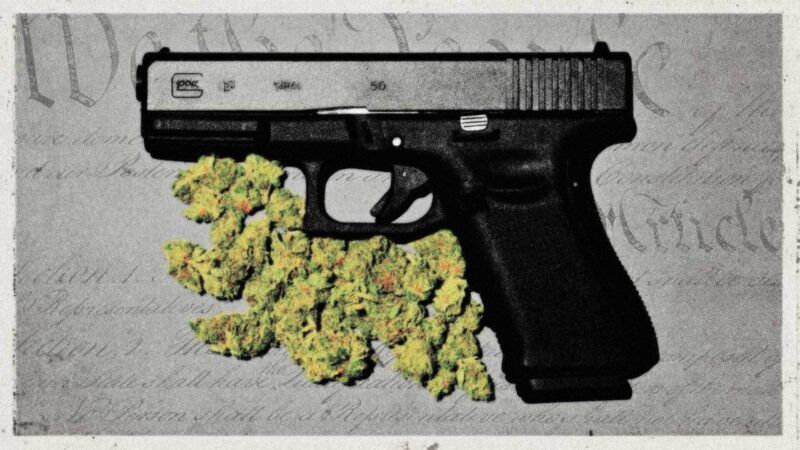
If you are a cannabis consumer who owns a gun, you are committing a federal felony right now, even if you live in one of the 40 states that have legalized marijuana for medical or recreational use. That perplexing situation is perfectly reasonable and constitutional, according to 19 of those states, which are urging the Supreme Court to uphold the federal ban on gun possession by "unlawful" users of "any controlled substance."
That law is at the center of a case that the Court is scheduled to hear on March 2, which involves a Texas man, Ali Hemani, who was charged with illegal gun possession after an FBI search of his home discovered a Glock 19 pistol, two ounces of marijuana, and less than a gram of cocaine. The potential implications extend far beyond Hemani because this ban applies to millions of peaceful Americans who pose no plausible threat to public safety.
As I explain in my new book, Beyond Control, that policy authorizes severe criminal penalties for drug users who try to exercise their Second Amendment rights. Under the law that Hemani violated, it does not matter whether someone handles guns while intoxicated or otherwise endangers the public.
Last year, the U.S. Court of Appeals for the 5th Circuit upheld a federal judge's dismissal of the gun charge against Hemani. That outcome was dictated by a 2024 ruling in which the 5th Circuit held that the Second Amendment barred the government from prosecuting a gun-owning cannabis consumer "based solely on her 'habitual or occasional drug use.'"
Such prosecutions, the 5th Circuit said, are not "consistent with this Nation's historical tradition of firearm regulation"—the Second Amendment test that the Supreme Court established in 2022. While "our history and tradition may support some limits on a presently intoxicated person's right to carry a weapon," the appeals court said, "they do not support disarming a sober person based solely on past substance usage."
The Trump administration wants the Supreme Court to reject that conclusion and reinstate the charge against Hemani. Solicitor General D. John Sauer implausibly argues that all "unlawful" drug users, including occasional cannabis consumers and state-registered patients who use marijuana for symptom relief, pose a danger that justifies disarming them.
Sauer likens drug users to "habitual drunkards," who historically could be confined to workhouses as "vagrants." But the law he is defending is more analogous to a categorical ban on gun possession by alcohol consumers, which would be clearly unconstitutional.
The Trump administration's position, which echoes the Biden administration's, seems inconsistent with the president's avowed commitment to the Second Amendment. The states that have joined Sauer in asking the Supreme Court to overrule the 5th Circuit likewise seem to be contradicting their own policies.
Illinois and a bunch of other states that allow recreational use of marijuana complain that the 5th Circuit's understanding of the Second Amendment constrains their ability to impose restrictions aimed at "preventing firearms from coming into the hands of people likely to misuse them." Those people, they imply, include everyone who buys and consumes marijuana in compliance with state law.
That position is puzzling, since all these states have decided that marijuana should be treated like alcohol. If drinkers are not categorically forbidden to possess firearms, why should cannabis consumers be disarmed simply because they use a different intoxicant?
In their attempt to justify that arbitrary distinction, Illinois et al. warn that drug users may suffer "lasting mental disturbances," commit crimes to support their habits, or "interact with" violent "drug dealers and traffickers." Those concerns make little sense as applied to the typical cannabis consumer, especially when he is buying marijuana from state-licensed stores.
These states are so eager to justify gun control that they are willing to throw those businesses and their customers under the bus. The Trump administration, meanwhile, is so eager to reinforce hoary anti-drug stereotypes that it is willing to sacrifice a constitutional right it supposedly is determined to defend.
© Copyright 2026 by Creators Syndicate Inc.