
The Trump Administration Owns Responsibility for Whatever Comes Next in Venezuela
By deposing Maduro but keeping his brutal regime in power, the U.S. implicitly endorses its crimes.
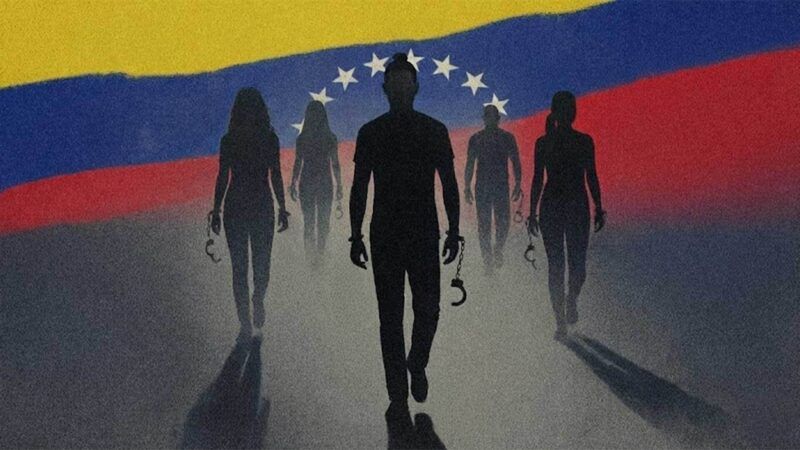
Regarding the 2002 invasion and occupation of Iraq, former U.S. Secretary of State Colin Powell warned then-President George W. Bush, "if you break it, you own it." He elaborated, "if we take out another country's government by force, we instantly become the new government, responsible for governing the country and for the security of its people until we can turn all that over to a new, stable, and functioning government."
You are reading The Rattler from J.D. Tuccille and Reason. Get more of J.D.'s commentary on government overreach and threats to everyday liberty.
Trump: 'We Will Run the Country'
The U.S. hasn't occupied Venezuela, but Nicolás Maduro, the country's former dictator, now languishes in a Brooklyn jail. Importantly, President Donald Trump claims, "we will run the country until such time as we can do a safe, proper and judicious transition"—a process, he says, that could last years. So far, the country's decapitated but still in-place socialist regime seems inclined to work with the U.S. government. Under pressure, it has begun releasing political prisoners including prominent leaders of the opposition. Of particular interest to the Trump administration, the state-owned oil company, PDVSA, is negotiating with U.S. officials over the future sale of oil, with the terms effectively set by Americans.
Left out in the cold is the large and popular political opposition, including leaders such as Nobel Peace Prize winner María Corina Machado and Edmundo González Urrutia, the presidential candidate who, by all accounts, actually won the last election. "I think it would be very tough for her to be the leader," Trump claimed of Machado, the most prominent opposition figure. "She doesn't have the support within or the respect within the country."
Presumably, Trump meant Machado doesn't have support among rank and file government workers since the 2024 opposition ticket—Machado was barred by the state from running herself—won around two-thirds of the vote, according to independent counts. The public would very likely support an opposition-led government, but maybe the ranks of socialist loyalists who, after a quarter-century of rule, infest state institutions including the oil industry and the military, would not.
The U.S. Chooses a Thug Over the Democratic Opposition
So, the Trump administration has decided to place its bets on Venezuela's second-ranking thug, hardline socialist Delcy Rodriguez. After taking the oath of office, she seemingly accepted U.S. control of her country's oil, saying Venezuela is "open to energy relations where all parties benefit."
For its part, the Department of Energy says the U.S. has taken over the marketing of Venezuelan crude oil: "These oil sales begin immediately with the anticipated sale of approximately 30 – 50 million barrels. They will continue indefinitely."
Simultaneously, Rodriguez is consolidating what remains of her government's power in the hands of loyalists. "For those at home, the message from the new presidency is that nothing has changed and the revolution continues its march, 'firmer than ever,' which includes a purge in search of accomplices of the embarrassing U.S. incursion into the heart of Caracas," writes Jacobo García of Spain's El Pais. Rodriguez's approach, adds García, "accentuates the repressive model."
The Opposition Could End Up Battling the U.S.
Venezuelan opposition leader Machado has been courting the Trump administration including, reportedly, an offer to give her Nobel Peace Prize to the U.S. president. "I certainly would love to be able to personally tell him that we believe—the Venezuelan people, because this is a prize of the Venezuelan people—certainly want to, to give it to him and share it with him," Machado told Fox News.
But if the olive branch is rejected and the popular opposition remains sidelined, Machado, González, and their many supporters will find themselves fighting a regime as oppressive as ever but now backed by the United States.
It will be very difficult for the Trump administration to argue that the ensuing mess, including the consequences of steps taken to keep Delcy Rodriguez in office and her colectivos paramilitary gangs, police, and troops terrorizing anybody who complains, isn't their responsibility. After all, every protester shot by a soldier, every skull cracked by the colectivos, will be in the name of propping up a national leader anointed by the U.S. government.
Looking back on America's fumbled occupation of Iraq, former Secretary of State Powell commented, "We broke it, we owned it, but we didn't take charge—at least until 2006, when President Bush ordered his now famous surge, and our troops, working with new Iraqi military and police forces, reversed the slide toward chaos." Well, reversed the slide toward chaos to some extent, perhaps—Iraq remains shaky.
Owning the consequences was a risk as soon as the U.S. moved to depose Maduro. Whatever the outcome, it would have been set in motion by American actions. By supporting the continuation of Maduro's regime under new management, the Trump administration is implicitly endorsing the censorship, fixed elections, corruption, and brutality that have kept that government in power since it took office under Hugo Chavez.
Given the guarantees the Trump administration is making to lure American oil companies to reinvest in Venezuela, that could mean boots on the ground, or at least U.S.-employed security forces facing off against Venezuelans.
"We're dealing with the country, so we're empowered to make that deal, and you have total safety, total security," Trump claimed of his offer to oil firms. "One of the reasons you couldn't go in is you had no guarantees, you had no security. But now you have total security."
Far from being a liberator that saved the Venezuelan people from an entrenched socialist regime, the U.S. could become an enabler that turns the regime into a local subsidiary to get a piece of the action.
The Trump Administration Is Keeping Venezuela Broken
In truth, Venezuela was broken long before Americans raided Caracas and snatched Maduro away to a fate to be determined by the U.S. courts. But it was a brokenness of Venezuelans' own making. They voted themselves into a disastrous situation and have been trying to extricate themselves through a variety of channels ever since. Making Venezuela's problem an American problem was always going to be dangerous, because it meant assuming responsibility for an already fraught situation with the tough task of trying to fix things while potentially making them worse.
The Trump administration seems committed to ensuring that the outcome the U.S. is responsible for is terrible from day one. America didn't break Venezuela to begin with, but the Trump administration is working to keep it broken.
