
The Most Overlooked Holiday Miracle: Abundance
History shows clearly that the societies most capable of generosity and liberalism are not those trapped in poverty but those that have escaped it.
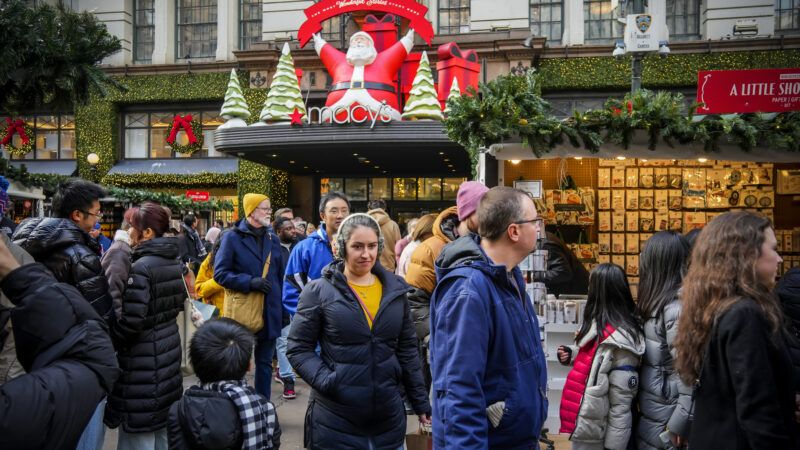
The Christmas season is a time to reflect on what we have, which includes the kind of society that has made countless blessings possible. The warmth, security, and generosity that many Americans experience during the holidays are not accidents or pure gifts of nature. In their tangible sense, they are the products of a long and extraordinary period of economic growth—one that has expanded opportunity, reduced hardship, and given moral ideals room to breathe.
History shows quite clearly that the societies most capable of generosity and liberalism are not those trapped in poverty but those that have escaped it. An abundance of wealth does not corrupt moral life; it enables it. Economic growth is not a rival to our highest values. It's a precondition to their most vigorous pursuit.
This truth is easy to forget precisely because modern growth has been so successful. We take for granted the material abundance that allows us to debate its spiritual costs. For most of human existence, life was defined by constant vulnerability. Hunger, disease, and early death were ever-present. The idea that ordinary people could expect anything different—let alone genuine comfort or opportunity—would sound fantastical to our preindustrial ancestors.
As economic historians like Deirdre McCloskey have shown, the dramatic acceleration of growth beginning in the 19th century—the "Great Enrichment"—transformed human prospects on a scale unmatched by any previous moral or political revolution. Living standards rose exponentially. Poverty declined. Education spread. And with this abundance came a greater capacity for tolerance, pluralism, and peaceful coexistence.
This connection is not accidental. In The Moral Consequences of Economic Growth, Harvard economist Benjamin Friedman shows that societies experiencing sustained growth tend to be more generous and more committed to liberal values than others. When people believe the future can be better than the past, politics becomes less of a zero-sum fight over seemingly fixed resources. And cooperation becomes easier.
The reverse is also true. When growth slows, even affluent societies begin to fray. Zero-sum thinking returns—not necessarily because people are poor or because they have changed, but because progress no longer feels assured. In a different economic environment, politics turns inward and resentful. Scapegoats are sought, historically including immigrants, Jews and other minorities, trade, big businesses, and rich people. Illiberal ideas gain traction.
Seen in this light, today's anxieties are less mysterious. After decades of slowed productivity growth, many Americans—especially younger ones—no longer feel confident their work will be rewarded or that the future will be more abundant than the past. Nostalgia on the right and a constant sense of oppression on the left are responses to a perceived closing of opportunity.
To reverse these destructive reactions, we must rebuild the conditions for abundance. It requires no massive new spending, protectionism, or industrial strategies. It only requires removing government obstacles to work, building, and innovation.
Take labor markets, where occupational licensing has spread far beyond any plausible public safety rationale. It's barring entry into modest, safe jobs, protecting established workers at the expense of younger, lower-income workers, and raising consumer costs. Scope-of-practice rules limit competition and access to health care by preventing nurse practitioners and physician assistants from providing affordable services they are fully capable of delivering. Labor markets grow when access to work is governed by competence and demand, not by layers of permission requirements.
No less essential is energy abundance. Modern economies run on energy, yet the United States increasingly constrains supply through permitting delays and regulatory uncertainty. Cheap, reliable energy—whether from fossil fuels, nuclear, or renewables—is a prerequisite for housing, manufacturing, transportation, and medical care.
Regulatory sclerosis afflicts housing and infrastructure in other ways. We generously subsidize buying while relentlessly constraining supply, guaranteeing higher prices and rising frustrations. Zoning rules and endless permitting requirements have turned productive cities into closed clubs, locking out families and workers who could thrive there.
Trade policy, too, has moved in the wrong direction. Tariffs—effectively taxes on consumers and input costs for producers—have hit us hard during the last three presidential administrations. They raise prices, create uncertainty, and slow growth.
Across these areas, the pattern is the same. So is the answer: Freeing supply would create tremendous growth. Consider this my Christmas wish.
As an economist, this holiday season reminds me that generosity requires capacity—not just money but time. It's easier to help the vulnerable and sustain a pluralistic society when the economy is expanding rather than stagnating. Growth, in short, makes us more capable of being good to one another. Among the most important gifts we can pass on is a society that is confident enough in its future to be generous in the present.
COPYRIGHT 2025 CREATORS.COM