
Trump Blames Illegal Immigrants for High Housing Prices. Blame Zoning Instead.
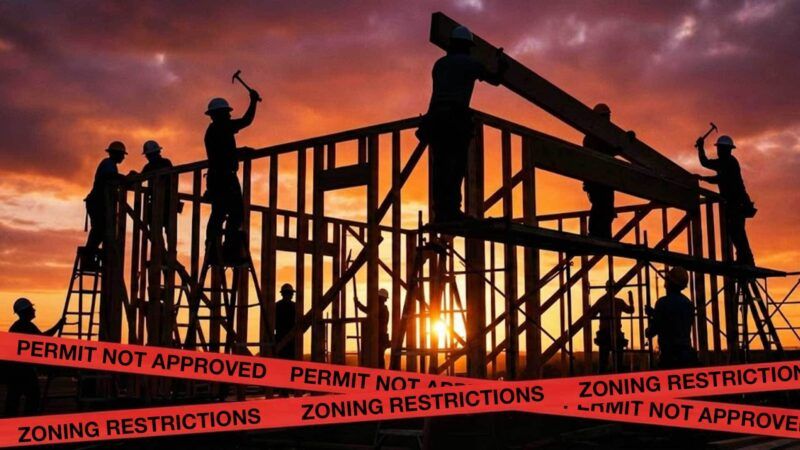
Low-skilled immigrants would expand the supply of housing more than they increase demand, if local governments would just allow new construction.
President Donald Trump delivered an end-of-year address Wednesday night to tout economic accomplishments of dubious veracity and attribute hardships to anything other than his own policies.
On historically high housing costs, Trump blamed "the last administration [for bringing] in millions and millions of migrants and [giving] them taxpayer funded housing while your rent and housing costs skyrocketed." While deceptively intuitive, Trump's explanation is more xenophobic rhetoric than sound economics.
Alex Nowrasteh, senior vice president for policy at the Cato Institute, estimates "a net increase in the illegal immigrant population of 5.5 to 6 million during Biden's administration." The Pew Research Center calculates a net increase of roughly 4 million undocumented immigrants between 2020 and 2023. So, it is in fact the case that millions of illegal immigrants were let into the country during the Biden administration.
It is also true that many immigrants are eligible for taxpayer-funded housing.
The Housing and Community Development Act of 1980 makes "federal rental assistance programs…including the Public Housing, Housing Choice Voucher, [and] Section 8 project-based rental assistance programs" available to "most categories of immigrants," explains the Congressional Research Service. While illegal immigrants are excluded from these benefits, they may avail themselves of them if a single member of their household—a native-born child, for instance—is eligible, according to the National Low Income Housing Coalition. Although immigrants can access these social services, they don't do so at higher rates than American citizens. As the Center for Immigration Studies points out, only about 5 percent of households headed by legal immigrants, illegal immigrants, and native-born Americans access these housing programs.
However, just because immigrants put pressure on public housing programs does not mean that they drive prices up in the private housing market. While increased demand drives up the cost of any good, all else being equal, prices are brought back down as producers enter the market and expand supply. This is exactly what we see in the housing market.
Immigration restrictionists often reference the 2007 finding of Albert Saiz, the director of Massachusetts Institute of Technology's Urban Economics Labs, that "an immigration inflow equal to 1% of a city's population is associated with increases in average rents and housing values of about 1%." However, new research finds that immigration's effect on shelter prices is a function of the ease with which building permits are issued.
In a study for the European Economic Review, James Cabral and Walter Steingress investigated the impact of immigration on local housing prices in the United States, and found that, "in the county with the least restrictive issuance of building permits and the lowest level of education of immigrants, an immigrant inflow of 1 percent of the county's population would reduce shelter prices by 0 to 2 percent relative to a county that did not experience an immigrant inflow." Conversely, "in the county with the most restrictive issuance of building permits receiving immigrants with the highest level of education, an immigrant inflow of 1 percent of the county's population would increase shelter prices by 6 to 8 percent."
Where zoning laws are lax and building permits readily issued, low-skilled immigration to a place lowers housing prices for native-born Americans (and everyone else), contrary to the claims of Trump and immigration restrictionists. Clearly, the solution to the housing crisis is not to reduce the number of productive immigrants who are welcomed into the country—nearly 15 percent of whom work in the construction industry, more than twice the proportion of native-born construction workers—but for local governments to allow the construction of new homes.
