

Thanksgiving Traffic Shows the Highway Trust Fund Is Running on Empty
Federal gas taxes no longer cover the cost of highways, leaving taxpayers to fill a growing multibillion-dollar gap.
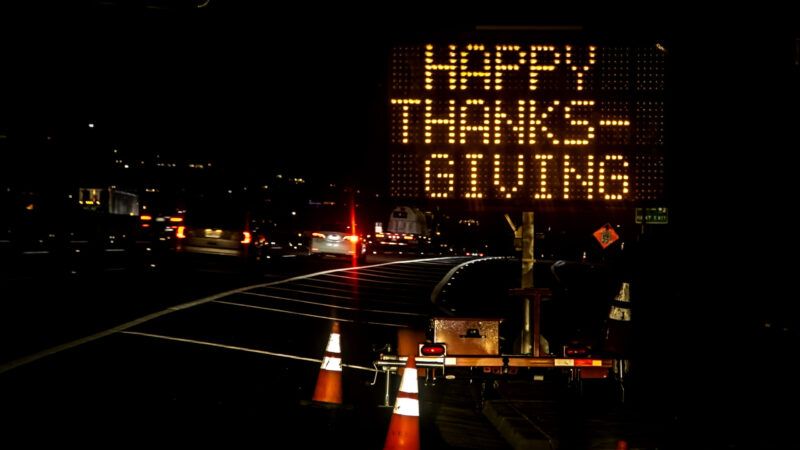
The American Automobile Association predicts that nearly 82 million Americans will travel more than 50 miles from home over Thanksgiving—a new record if it pans out. Almost all the travel increase, it projects, will be by car.
Whether you take a train, plane, or automobile to your holiday festivities, your income tax dollars are subsidizing drivers on the road. Most Americans assume that gas taxes and tolls fund highways. That used to be the case, but it's no longer true.
Gas taxes and user fees haven't fully funded the federal highway system since 2007. In 2021, Congress authorized roughly $181 billion in transfers to the highway account—money paid for by debt and general revenues.
Even with that added cash, the federal Highway Trust Fund (HTF) will run out of money again in 2027. By 2033, it will need an extra $250 billion from taxpayers. That's nearly $2,000 per American household over the next eight years.
The increased popularity of electric vehicles (E.V.s) contributes to the shortfall, as E.V. drivers don't pay gas taxes. But the biggest reason highways are costing taxpayers is a decrepit financing system that needs an overhaul.
User fees are the best way to fund the highway system, because they come closest to approximating market prices. Gas taxes scale with how much people drive, while also pricing in some of the air and noise pollution they create. Heavy trucks rightly pay more in registration fees because of the damage they do to the roads. Meanwhile, freight railroads don't benefit from subsidies the way that freight trucks do. Private freight railroads pay for over 90 percent of their own capital investment.
Congress can't impose tolls to fund the HTF; state governments are responsible for maintaining federal and state highways, however, and they can levy tolls to fund them. As E.V.s gain a larger share of the car market, tolls will become increasingly important, as they are the main way for E.V. drivers to pay for their road use.
Many think it's fine to exempt E.V.s from paying for the highways because of their environmental benefits. But E.V.s have their own pollution problem. Their extra weight means they often produce more particulate matter pollution from tires, brakes, and road surfaces. They also do more damage to the roads than equivalent gas-powered cars. Also, considering how their batteries are produced, recharged, and disposed of, E.V.s aren't such an unambiguous win for human health that we should let them use the roads free of charge.
Charging all vehicles for their use of the highways through tolls or other user fees makes economic and environmental sense. When users have to pay their own way, they have an incentive to conserve. When they're exempt from paying, they will have an incentive to overuse a resource.
Another benefit of tolling is the option for surge pricing. Variable tolling can balance traffic and allocate scarce highway space to those drivers who need it most—and are willing to pay for it—at peak times.
Ideally, Congress should transfer ownership of federal highways to states and let states fund them through variable tolling as well as their own gas taxes and registration fees. So long as Washington can't use tolls to fund highway construction, it makes more sense to put the responsibility for that funding in the hands of governments that can.
Otherwise, if Congress is unwilling to get out of the highway game, it needs to raise the gas tax to cover the full cost of the HTF.
No libertarian wants to advocate raising a tax, but the federal gas tax is closer to a user fee than most other taxes. Right now, the federal government uses income taxes, tariffs, and other distorting levies to subsidize inefficient highway use. Opposing an increase to the federal gas tax in the current environment effectively endorses higher income taxes instead.

Editor's Note: As of February 29, 2024, commenting privileges on reason.com posts are limited to Reason Plus subscribers. Past commenters are grandfathered in for a temporary period. Subscribe here to preserve your ability to comment. Your Reason Plus subscription also gives you an ad-free version of reason.com, along with full access to the digital edition and archives of Reason magazine. We request that comments be civil and on-topic. We do not moderate or assume any responsibility for comments, which are owned by the readers who post them. Comments do not represent the views of reason.com or Reason Foundation. We reserve the right to delete any comment and ban commenters for any reason at any time. Comments may only be edited within 5 minutes of posting. Report abuses.
Please to post comments
Just let the states collect all the gas taxes and cut out the middle man. We all know the more hands the money goes through the less there is for the stated purpose, And the feds usually add strings on what it can be used for.
One of my Chartertopia features is it requires all budgets be independent. No transfers from a popular over-funded department to an unpopular one. Feds can't bribe states with extra funds. If bicycle paths and buses are separate budgets from roads, they have to stand on their own.
What are the 'Feds' doing in State Roads?
A State Co-op would be far better.
I oppose tolling because it necessitates everyone putting what is essentially a tracker in their vehicle.
Pre-paid transponders which can be topped up with cash solve that problem. Just keep it in a Faraday bag while not in use.
Besides which, tolling also tracks by license plate. Forgot to take your transponder out of its bag? No problem, they use your license plate and send a bill.
Well, if we get the Feds out of the highway game, everyone will pretty much need a permanent transponder and thus be tracked everywhere. Saying you can just put it in a bag is missing the point. It's like saying, "Oh, you can have a gun, you just can't carry it (list of half the places you might go)."
Last I checked, heavy trucks don't pay proportionally to the wear they do on the roads. They pay a lot, but in the USA and elsewhere, truckers revolt at paying in true proportion.
In recent years, though, I've started to think the efficiency gains wouldn't be worth the trouble in trying to figure out the positive and negative externalities of shipping and other transportation. Does the frontage of an urban building really scale to right-of-way maintenance? Should vehicle battery recharging be taxed differently from other electricity? Etc. I get the idea we wouldn't adjust technology use and behavior to gain much in the way of efficiencies if the answers were known and applied.
Big trucks pay many multiples of taxes and fees compared to 4 wheelers. But it's all smoke and mirrors because consumers pay all truck taxes when they buy shit.
I was thinking - who pays gas taxes if not tax payers?
Don't Tax You. Don't Tax Me. Tax That Fellow Behind the Tree. -- Russell B. Long
People in government aren’t capable of running a lemonade stand.
You mean giving people money to buy cars that will not contribute to the fund AT ALL and damage the roads more than normal cars due to EV being heavy was not a good idea?
Because Climate Colonialism- Gavin Newsom strategically and reluctantly endorsed 2028 POTUS
Womt somebody think of all the graft?
You know what might fill the gap? A $1.2 TRILLION infrastructure bill supported by both parties. Any waste, fraud or theft on that baby? If so, how much? 10%? 30%? I know a certain hopey-changey president who passed a similar bill, laundered it through his cronies, and claimed the jobs weren't as shovel-ready as he thought. (Cue press pool polite laughter.)
Toll roads are the most obvious market solution, but they have to be managed by private companies where people can lose their livelihoods and go to jail if they defraud the public. Because nobody in government ever, ever, ever faces consequences for their theft and corruption.
Sell them to U.S. citizen private companies with a clause for military easement ownership during war.
You pay a "gas guzzler" tax when you buy a car that uses "too much" gas. Such cars do not cause more wear and tear on roads.
It's long past time when those who buy electric vehicles should pay a "electricity sucking" tax, instead of getting a tax incentive.
If Congress would repeal Reagan’s Surface Transportation Assistance Act of 1982, that alone would be equivalent to an 18 percent increase in money available for highways, plus, it would return trust to the Highway Trust (sic) Fund, plus, it would require transit to be funded by its own user fees.
Win, win, win!


