
Reason.com - Free Minds and Free Markets
Reason logo Reason logo
  • Latest
  • Magazine
    • Current Issue
    • Archives
    • Subscribe
    • Crossword
  • Video
    • Reason TV
    • The Reason Roundtable
    • Just Asking Questions
    • Free Media
    • The Reason Interview
  • Podcasts
    • All Shows
    • The Reason Roundtable
    • The Reason Interview With Nick Gillespie
    • The Soho Forum Debates
    • Just Asking Questions
  • Volokh
  • Newsletters
  • Donate
    • Donate Online
    • Donate Crypto
    • Ways To Give To Reason Foundation
    • Torchbearer Society
    • Planned Giving
  • Subscribe
    • Reason Plus Subscription
    • Gift Subscriptions
    • Print Subscription
    • Subscriber Support

Login Form

Create new account
Forgot password
Reason logo

Reason's Annual Webathon is underway! Donate today to see your name here.

Reason is supported by:
A. Tuchman

Donate

Debt

Don't Let the Government-Shutdown Charade Distract You From the Debt Crisis

America’s biggest fiscal challenge lies in the unchecked growth of federal health care and old-age entitlement programs.
Romina Boccia | 9.14.2023 11:20 AM

Share on FacebookShare on XShare on RedditShare by emailPrint friendly versionCopy page URL Add Reason to Google
Media Contact & Reprint Requests
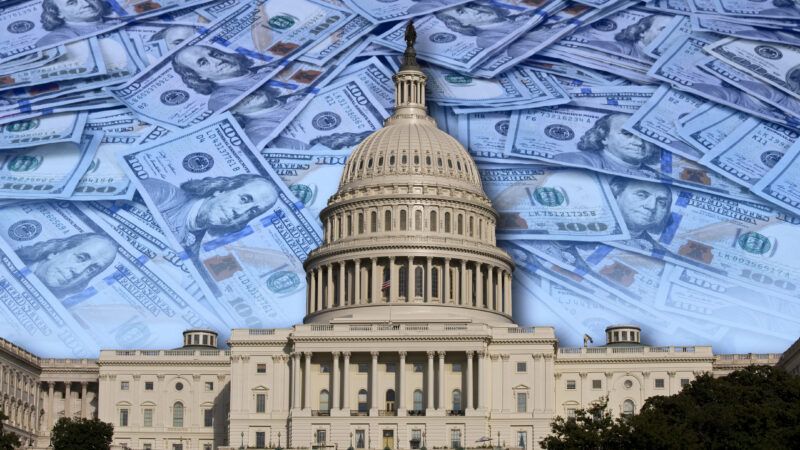
An illustration of the U.S. Capitol with money covering the sky behind it | U.S. government spending is projected to consume nearly 30 percent of the economy by 2053—almost 40 percent more than the historical average
(U.S. government spending is projected to consume nearly 30 percent of the economy by 2053—almost 40 percent more than the historical average)

With the Senate and now the House reopening for business, Congress is resuming its negotiations over annual spending on so-called discretionary programs. As Washington tinkers around the edges of the behemoth federal budget, members are steering clear of the biggest budget items—the ones sending U.S. debt to unprecedented heights.

Discretionary means that Congress hasn't put these programs on autopilot, unlike so-called mandatory programs. Instead, Congress must vote each year (and sometimes more often) to either continue, or alter the spending. Otherwise, discretionary program funding expires on September 30, or whichever date Congress picks as the end date for a continuing resolution (a bill to continue spending at current levels).

While controlling discretionary spending is important for fiscal responsibility, for reducing government waste, and for negotiating the proper size and scope of federal activities, the current shutdown debate is largely symbolic. America's biggest fiscal challenge lies in the unchecked growth of federal health care and old-age entitlement programs. Repeated shutdown fights and a slew of temporary continuing resolutions have gotten us no closer to reforming Social Security and Medicare.

Those paying attention to the debt limit debate that ended in early June may be wondering what all the shutdown fuss is about, given that Congress and the White House agreed to new spending limits just a few months ago. Those limits, specified in the Fiscal Responsibility Act, were a sham from the beginning. Secretive side deals undermined the stated goals of the bipartisan agreement before the ink was dry. Now President Joe Biden has requested $40 billion in additional emergency supplemental spending, with the Senate adding several more billion to its appropriations bills, a glaring attempt to evade even modest fiscal restraints.

The debt limit deal did succeed in allowing both Democrats and Republicans to claim political victory while suspending the debt limit for more than 18 months. The losers are the American people, as excessive federal spending and unchecked entitlement growth drive up inflation and interest rates and undermine stronger economic growth. A more responsible way to raise the U.S. debt limit would have paired such an increase with a credible fiscal plan to stabilize the growth in the debt. Alas: With federal elections looming next year and the White House dug in against entitlement reform, Congress chose to punt instead.

The longer Washington waits to fix autopilot spending, the more damage they'll do. The Congressional Budget Office's latest long-term budget outlook projects that U.S government spending will consume nearly 30 percent of the economy by 2053—almost 40 percent higher than the historical average. Congress is expected to rack up more than $100 trillion in additional deficits over those 30 years—more than four times what the U.S. government has borrowed over its entire history. Who will lend the U.S. government such vast sums?

The main drivers of this increase are heightened interest costs and the growth in health care and Social Security spending. With Medicare and Social Security responsible for 95 percent of long-term unfunded obligations, according to the Treasury Financial Report, there's simply no way any serious fiscal reform effort can leave these programs untouched. Every other part of the budget will either stay steady or decline slightly. Other so-called mandatory programs, including various welfare programs, retirement benefits for federal employees, and some veterans' benefits, are projected to decline as a share of the economy. Discretionary spending depends on what Congress decides to spend each year; if historical trends hold, this part of the budget will decline by one-sixth. And yet this is the part of the budget that all this shutdown fuss is about.

The most likely outcome from the current standoff is a continuing resolution into December, followed by a spending-laden Christmas tree bill before year's end. This shutdown debate matters only so much, considering the huge fiscal challenge confronting the United States.

Start your day with Reason. Get a daily brief of the most important stories and trends every weekday morning when you subscribe to Reason Roundup.

This field is for validation purposes and should be left unchanged.

NEXT: Despite the Doomsday Narrative, Global Inequality Has Significantly Declined

Romina Boccia is the director of budget and entitlement policy at the Cato Institute. Follow her writing on Substack at The Debt Dispatch. 

DebtDebt CeilingGovernment ShutdownFiscal policySocial SecurityMedicareDefense SpendingBudget
Share on FacebookShare on XShare on RedditShare by emailPrint friendly versionCopy page URL Add Reason to Google
Media Contact & Reprint Requests

Show Comments (102)

Webathon 2025: Dec. 2 - Dec. 9 Thanks to 826 donors, we've reached $544,234 of our $400,000 $600,000 goal!

Reason Webathon 2023

All Donations NOW Being Matched! Donate Now

Latest

What Is Syria Like 1 Year After Its Revolution?

Matthew Petti | 12.8.2025 8:00 AM

Bill of Rights Day: How Your Rights Keep Authoritarianism in Check

J.D. Tuccille | 12.8.2025 7:00 AM

Trump's Tariffs Were Supposed To Cut the Trade Deficit and Boost U.S. Manufacturing. They're Not Working.

Eric Boehm | From the January 2026 issue

Brickbat: No Jury of Your Peers

Charles Oliver | 12.8.2025 4:00 AM

Why I Support Reason with a Tax-Deductible Donation (and You Should Too!)

Nick Gillespie | 12.7.2025 8:00 AM

Recommended

  • About
  • Browse Topics
  • Events
  • Staff
  • Jobs
  • Donate
  • Advertise
  • Subscribe
  • Contact
  • Media
  • Shop
  • Amazon
Reason Facebook@reason on XReason InstagramReason TikTokReason YoutubeApple PodcastsReason on FlipboardReason RSS Add Reason to Google

© 2025 Reason Foundation | Accessibility | Privacy Policy | Terms Of Use

This site is protected by reCAPTCHA and the Google Privacy Policy and Terms of Service apply.

r

HELP EXPAND REASON’S JOURNALISM

Reason is an independent, audience-supported media organization. Your investment helps us reach millions of people every month.

Yes, I’ll invest in Reason’s growth! No thanks
r

I WANT TO FUND FREE MINDS AND FREE MARKETS

Every dollar I give helps to fund more journalists, more videos, and more amazing stories that celebrate liberty.

Yes! I want to put my money where your mouth is! Not interested
r

SUPPORT HONEST JOURNALISM

So much of the media tries telling you what to think. Support journalism that helps you to think for yourself.

I’ll donate to Reason right now! No thanks
r

PUSH BACK

Push back against misleading media lies and bad ideas. Support Reason’s journalism today.

My donation today will help Reason push back! Not today
r

HELP KEEP MEDIA FREE & FEARLESS

Back journalism committed to transparency, independence, and intellectual honesty.

Yes, I’ll donate to Reason today! No thanks
r

STAND FOR FREE MINDS

Support journalism that challenges central planning, big government overreach, and creeping socialism.

Yes, I’ll support Reason today! No thanks
r

PUSH BACK AGAINST SOCIALIST IDEAS

Support journalism that exposes bad economics, failed policies, and threats to open markets.

Yes, I’ll donate to Reason today! No thanks
r

FIGHT BAD IDEAS WITH FACTS

Back independent media that examines the real-world consequences of socialist policies.

Yes, I’ll donate to Reason today! No thanks
r

BAD ECONOMIC IDEAS ARE EVERYWHERE. LET’S FIGHT BACK.

Support journalism that challenges government overreach with rational analysis and clear reasoning.

Yes, I’ll donate to Reason today! No thanks
r

JOIN THE FIGHT FOR FREEDOM

Support journalism that challenges centralized power and defends individual liberty.

Yes, I’ll donate to Reason today! No thanks
r

BACK JOURNALISM THAT PUSHES BACK AGAINST SOCIALISM

Your support helps expose the real-world costs of socialist policy proposals—and highlight better alternatives.

Yes, I’ll donate to Reason today! No thanks
r

STAND FOR FREEDOM

Your donation supports the journalism that questions big-government promises and exposes failed ideas.

Yes, I’ll donate to Reason today! No thanks
r

FIGHT BACK AGAINST BAD ECONOMICS.

Donate today to fuel reporting that exposes the real costs of heavy-handed government.

Yes, I’ll donate to Reason today! No thanks