
Supreme Court Term to Start Hot
OT 2026 leads off with climate litigation.
Suncor Energy (USA), Inc. v. County Commissioners of Boulder County, the dispute over whether federal law preempts claims against fossil fuel companies for alleged harms from climate changes exacerbated by the companies' alleged conduct, will be the very first case heard by the Supreme Court this October.
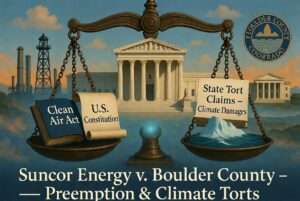
Suncor is obviously an important environmental case, but its significance is far broader. If the claims are allowed to proceed--and if the plaintiffs are able to overcome the other hurdles to making their case (a significant if)--quite a bit of money could be at stake. In addition, if the justices reach the merits, the case could dramatically alter the law of federal preemption.
Given the significance of the case, it should be no surprise that waves of amici filed briefs. By my count, there are forty top-side briefs supporting the fossil-fuel companies' preemption claims, including a brief by the Solicitor General. There are also twenty-eight bottom-side briefs arguing against preemption (including mine).
Most discussion of the case--and, indeed, many of the amicus briefs--focus on the policy context. Accordingly, folks who want urgent action to address climate change tend to support the respondents, and those who are skeptical of such policies (or who are concerned about energy prices), support the petitioners. This is understandable, but threatens to obscure the underlying legal issues, as does conspiratorial talk about what shadowy interests are supporting one side or the other.
As I try to show in my brief, there is no statute or precedent that supports wholly preempting these cases. This does not mean the claims should succeed, nor does it mean there are no constitutional or other grounds to force a narrowing of the claims. But those other grounds are not encompassed by the question presented and are not being advanced by the petitioners. What is before the Court is whether federal law or the constitution wholly precludes bringing claims under state-law for interstate harms of the sort alleged here. It is a narrow question. It is also one that I think is relatively easy and straightforward. We will see if a majority of the Court agrees.
For those interested, here are my prior posts on this subject:
- Why State Common Law Nuisance Claims Against Fossil Fuel Companies Are Not Preempted, Oct. 27, 2021;
- Third Circuit Rejects Oil Company Efforts to Remove Climate Claims to Federal Court, Aug. 17, 2022;
- Oil Companies Fail to Convince the Eighth Circuit Climate Cases Should Be Removed to Federal Court (Updated), Mar. 25, 2023;
- Is Climate Change Going Back to the Supreme Court? (Minnesota Edition) [UPDATED], Dec. 11, 2023;
- D.C. Circuit Rejects Oil Company Attempt to Remove District's Climate Suit to Federal Court, Dec. 19, 2023;
- William Barr Responds on American Petroleum Institute v. Minnesota, Dec. 26, 2023;
- Supreme Court Takes a Pass on Minnesota Climate Change Case, Jan. 8, 2024;
- Are State Law Climate Change Tort Suits Preempted by Federal Law?, May 3, 2024;
- Supreme Court Denies Certiorari in Climate Tort Suits, Jan. 13, 2025;
- Supreme Court Rejects Red State Attempt to Sue Blue States Over Climate Suits, Mar. 10, 2025;
- William Barr Discovers the Economics of Tort Law (and Misrepresents the Law Governing Interstate Pollution), Nov. 3, 2025;
- Placing Climate Tort Litigation in Context (Updated), Nov. 7, 2025;
- A Second Round with William Barr on Litigation Over Interstate Pollution, Dec. 2, 2025;
- Court Dismisses Trump Administration Effort to Block Michigan Climate Lawsuit, Feb. 4, 2026
- Climate Change Goes Back to the Supreme Court -- Colorado Edition, Feb. 23, 2026.
- Previewing Suncor Energy v. Boulder County, Mar. 6, 2026.
- Amicus Brief in Suncor Energy v. County Commissioners of Boulder County, Aug. 3, 2026.