
Amicus Brief in Suncor Energy v. County Commissioners of Boulder County
In the upcoming climate change case the Supreme Court should reject the industry and Trump Administration arguments for preemption-by-penumbra.
This morning I filed an amicus brief in Suncor Energy (U.S.A.) Inc. v. County Commissioners of Boulder County. In this case, likely to be argued in October, the Supreme Court will consider, among other things, whether the Clean Air Act or the Constitution preempt state-law claims seeking relief for injuries allegedly caused by climate change.
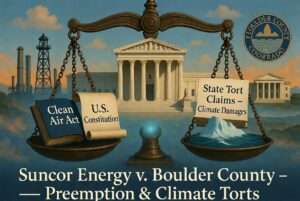
As my prior blogging on the subject has indicated, I find the preemption claims to be without merit. (I have no opinion on the procedural jurisdictional issue, but recommend the briefs by Profs. Derek Muller and Ben Johnson for an idea of the issues there.) Accordingly, my amicus brief focuses on the preemption claims. Here is the summary of my argument:
Global climate change presents many complex and intractable legal and policy questions. Assuming this Court has jurisdiction, the legal questions in this case are comparatively simple and straightforward. Nothing in federal law, let alone the Constitution, preempts state-law claims seeking relief from injuries allegedly caused or exacerbated by petitioners' conduct.
At issue in this case is whether allegedly aggrieved parties, including subnational governments, may seek redress under state law from defendants otherwise subject to state court jurisdiction for harms allegedly caused or contributed to by petitioners' conduct. In order to succeed, plaintiffs will ultimately need to show that the damages they allege were caused by actions taken by defend-ants, that such actions are within the jurisdiction of state courts, and that such actions may be the subject of tort liability under state law. Allowing this case to proceed does not allow any State to impose a universal rule on all fossil fuel producers, let alone on all greenhouse gas emissions around the globe. The fact that emissions "can-not be unmixed and traced," Pet'rs' Br. 28, may complicate plaintiffs' ability to prove their case, but it does not justify—let alone require—preemption of their claims.
Petitioners charge that respondents' claims are barred because both the Clean Air Act and the Constitution categorically preclude any claims seeking redress for harms caused by interstate pollution. Yet neither the Clean Air Act nor the Constitution imposes such a rule. To the contrary, as this Court has long understood, such suits may proceed, subject to certain limitations, even if they are viewed as efforts to seek redress for interstate pollution subject to federal regulation.
That the Clean Air Act may constitute a broad, "comprehensive" regulatory scheme does not mean that it preempts state-law efforts to seek remedies for the alleged harms caused by the accumulation of greenhouse gases in the atmosphere. Like other federal environmen-tal statutes, the Clean Air Act was enacted against a back-ground of extensive and essential state-law environmen-tal protections, including those provided by common law causes of action. That the Clean Air Act was meant to supplement, enhance, and encourage state-level efforts, rather than supplant or preempt them, is evident from the text, history, and structure of the Act. It is also what this Court has recognized.
The Constitution's structure provides no more basis for closing the courthouse doors on respondents' efforts to seek redress for the harms they allege. Federal common law may once have preempted state attempts to control interstate air pollution under state law, but federal common law has been displaced, and no longer serves that function. Nor does any constitutional provision or doctrine identified by petitioners provide a basis for wholly preempting state-law claims seeking redress for harms such as those alleged here. Petitioners' attempt to cobble together an argument for constitutional preemption rests upon penumbras and emanations from various constitutional provisions that cannot hold the weight of their pro-posed rule. That is insufficient. "There is no federal pre-emption in vacuo, without a constitutional text or a federal statute to assert it." Hencely v. Fluor Corp., 146 S. Ct. 1086, 1093 (2026) (quoting Puerto Rico Dep't of Consumer Affairs v. ISLA Petroleum Corp., 485 U.S. 495, 503 (1988)). And "[i]nvoking some brooding federal interest or appealing to a judicial policy preference should never be enough to win preemption of a state law." Virginia Uranium, Inc. v. Warren, 587 U.S. 761, 767 (2019) (lead opinion).
State law—statutes, regulations, and common law court decisions—has played an essential role in this nation's history of environmental protection. Resort to state law should not be foreclosed merely because such claims threaten economically important interests or rely upon expansive theories of liability or attenuated chains of causation. If such suits are to be preempted, that is a job for Congress, not the courts.
And from later in the brief:
The Court should decline petitioners' invitation to craft a new constitutional rule that would categorically preclude States from seeking to use state law to address environmental problems that relate to interstate pollution. Environmental problems rarely respect jurisdictional lines. Yet this has never barred the application of state law to environmental concerns, nor foreclosed efforts by state policymakers and affected parties to utilize state law to redress environmental harms.
The Constitution provides the federal government with ample power to direct climate change policy and limit or preempt inconsistent, ineffective, or ill-advised state laws. Such power may be exercised by the political branches, through the process of bicameralism and presentment. The power to adopt an unheralded, unprecedented, and unbounded rule concerning interstate environmental problems does not lie in this Court, and this is reason alone to reject petitioners' arguments.
While I do not address the foreign affairs preemption argument, I find it even less persuasive than the arguments I address, largely because it is an argument without limit. The United States is not currently party to any treaty--or even an international negotiation--that even threatens to conflict with a potential damage award. The idea that such suits could nonetheless be preempted because the defendants are engaged in multinational conduct or because the atmosphere (like, say, the internet) is global does not change the analysis. Congress could certainly preempt this litigation on foreign affairs grounds and (at least under current precedent, i.e. Garamendi) executive branch action might also be relevant, but there is no action here by the political branches that could or should have such effect.
I also do not address the First Amendment arguments raised in some of the top-side amicus briefs, largely because those questions are not before the Court. As I say in my brief, there may well be constitutional constraints on tort liability for marketing claims of the sort at issue here, but that's not an argument for preemption of these suits at the outset.
I expect to blog more on some of the issues in this litigation (and perhaps some of the many amicus briefs filed). In the meantime, for those interested, here are my prior posts on this subject:
- Why State Common Law Nuisance Claims Against Fossil Fuel Companies Are Not Preempted, Oct. 27, 2021;
- Third Circuit Rejects Oil Company Efforts to Remove Climate Claims to Federal Court, Aug. 17, 2022;
- Oil Companies Fail to Convince the Eighth Circuit Climate Cases Should Be Removed to Federal Court (Updated), Mar. 25, 2023;
- Is Climate Change Going Back to the Supreme Court? (Minnesota Edition) [UPDATED], Dec. 11, 2023;
- D.C. Circuit Rejects Oil Company Attempt to Remove District's Climate Suit to Federal Court, Dec. 19, 2023;
- William Barr Responds on American Petroleum Institute v. Minnesota, Dec. 26, 2023;
- Supreme Court Takes a Pass on Minnesota Climate Change Case, Jan. 8, 2024;
- Are State Law Climate Change Tort Suits Preempted by Federal Law?, May 3, 2024;
- Supreme Court Denies Certiorari in Climate Tort Suits, Jan. 13, 2025;
- Supreme Court Rejects Red State Attempt to Sue Blue States Over Climate Suits, Mar. 10, 2025;
- William Barr Discovers the Economics of Tort Law (and Misrepresents the Law Governing Interstate Pollution), Nov. 3, 2025;
- Placing Climate Tort Litigation in Context (Updated), Nov. 7, 2025;
- A Second Round with William Barr on Litigation Over Interstate Pollution, Dec. 2, 2025;
- Court Dismisses Trump Administration Effort to Block Michigan Climate Lawsuit, Feb. 4, 2026
- Climate Change Goes Back to the Supreme Court -- Colorado Edition, Feb. 23, 2026.
- Previewing Suncor Energy v. Boulder County, Mar. 6, 2026.