
A Modest Uptick in Supreme Court Popularity
A recent YouGov poll shows the Court is likely less unpopular than before. The tariff ruling may have given it a boost. The poll has several other notable findings, as well.

A recent YouGov poll, conducted in early May, finds that 38% of Americans approve of the job the Supreme Court is doing, while 45% disapprove. That -7 net disapproval may not seem very impressive. But it's way better than the other two branches of government. In recent surveys, an average of 58% disapprove of Donald Trump, compared to 38% who disapprove. Congress' approval rating is much lower, still.
The Court's current numbers are also a modest improvement from polls conducted in mid to late 2025. At that time, an Economist/YouGov poll found a net -16 disapproval (51-35), Gallup found a -10 (52-42), and Quinnipiac a -13 (53-40). In fairness, a June 2025 YouGov poll found almost identical results to their most recent one (45% disapprove, 40% approve). But that appears to have been an outlier at the time.
To the extent that the Court has become less unpopular, it may be in part because of the recent decision in the tariff case (which I helped litigate). The May YouGov poll found 58% approving of the result, while only 25% disapprove. An earlier YouGov poll, conducted right after the ruling, found 60% approve and 23% disapprove. Thus, I may have helped make the Supreme Court a little more popular (or, rather, less unpopular). I'm sure I will get invited to all the cool SCOTUS holiday parties this year (OK, almost certainly not….).
Before going further, I should emphasize that public opinion is a poor barometer of the quality of the Court's decisions. Survey data shows most Americans know very little about the Constitution and the Court's work, and a majority cannot even name one Supreme Court justice. Similarly, I do not claim that broad public support for the tariff decision proves that the justices go it right (though I do in fact believe they got it right, for other reasons). Ideally, the justices should not be guided by public opinion. Insulating them from it is one of the reasons why they have life tenure.
But, as I have noted in the past, public opinion about the Court does matter in some ways. A highly unpopular Court is more vulnerable to measures to curb or even destroy its authority, such as court-packing. And the Court can more easily strike down major policy initiatives of the president and other political leaders if it knows doing so will enjoy substantial public support. If the Court becomes sufficiently unpopular, politicians could potentially defy its rulings with little fear of political consequences. Thus, while it is unlikely the Court decided the tariff case as it did merely because the tariffs are unpopular, that unpopularity may have made it easier for the justices to strike down one of Donald Trump's signature policy initiatives.
For these and other reasons, the Court's degree of public approval can matter. That's true even though the public's assessment of the Court's work says little about whether the justices are actually doing a good job or not. Indeed, if the Court were to become immensely popular, I would worry they weren't doing enough to protect the rights of unpopular minorities.
In addition to the Court's overall approval rating and the question about tariffs, the YouGov survey has several other interesting results. They also did approval ratings for all the individual justices:
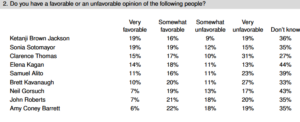
Interestingly, the three liberal justices seem to have the highest approval ratings. All three have net positive ratings, while all six conservatives are net negative. But I would not give too much credence to these numbers. As noted above, most Americans cannot even name a Supreme Court justice, and many of those giving opinions in the YouGov survey probably know little or nothing about the justices in question. Even as it stands, for each of the justices 33% or more said they had no opinion, except Clarence Thomas (about whom only 27% had no opinion).
In addition to the tariff case, YouGov also asked respondents whether the Court should overturn Obergefell v. Hodges (the 2015 ruling striking down state laws banning same-sex marriage); 51% of respondents said "no" and only 24% said "yes." They similarly asked about the birthright citizenship case currently before the Court, on which issue 53% said the Court could ruled that "[a]ll children born in the U.S. should automatically become citizens," while 39% wanted it to rule that "[o]nly those children born in the U.S. whose parents are citizens or lawful permanent residents should automatically become citizens."
As with the tariff case, I agree with majority public opinion on both of these issues. I have argued the Court should rule against Trump in the birthright citizenship case, and that Obergefell v. Hodges is a landmark civil rights decision, even though its reasoning should have been better. It all goes to show I am a true Man of the People! OK, maybe not… In reality, I hold all kinds of unpopular views. And I think majority public opinion is often highly ignorant and influenced by bias.
On a slightly more serious note, Obergefell's strong popularity is one of the reasons why I think it is unlikely to be overruled. And the unpopularity of Trump's position on birthright citizenship is one reason why the Court probably won't hesitate to rule against him on this issue if a majority of justices believe he's wrong (as seemed likely, though not certain, to be the case after oral argument).
There are several other interesting questions in the survey, which I may post about it in the future, if time allows. For example, the poll confirms that term limits for Supreme Court justices are popular, while court-packing is not; this despite the fact that the question on the latter was favorably worded for the pro-packing side, inasmuch as it asked about "expanding the size of the Supreme Court" without mentioning that the reason for doing so was to change the ideological composition of the Court to one more favorable to one side of the political spectrum.
In sum, the public's view of the Court is only modestly negative, and much less so than its view of the president and Congress. That's hardly a rousing endorsement. But it's a lot better than the other two branches of government, and that difference may provide some protection against political attacks on judicial independence.