
He Served 22 Years of a 60-Year Prison Sentence and Rebuilt His Life. Now the Supreme Court Says He Must Go Back.
Richard Daniel rebuilt his life after being freed from a 60-year prison sentence. Now the Supreme Court says he must go back.
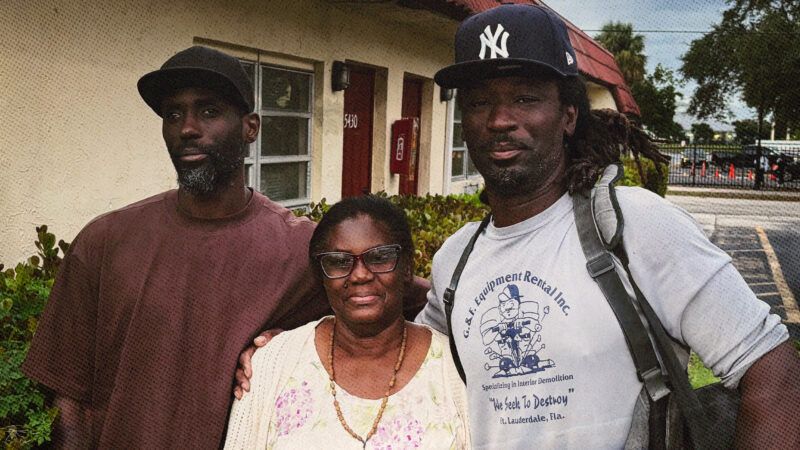
When you speak with him, Richard Daniel keeps using the words "grateful" and "blessing."
A judge freed the 44-year-old Miami man from federal prison in 2024 after Daniel served 22 years of a 60-year mandatory minimum sentence. Since then, Daniel has seen divine providence everywhere in his life, from the mundane to the extraordinary. He says it's a blessing to run errands for his elderly mother on Saturdays and that it was a blessing when he hit two jackpots on the same slot machine last winter, winning roughly $40,000. The money allowed him to buy a car and rent an apartment of his own, a short walk from his mom's place in the same complex.
His other blessings include a steady construction job, a good probation officer, and a strong work ethic, all of which have helped him overcome the daunting challenges of rebuilding a life after prison—something that tens of thousands of formerly incarcerated people every year fail to do.
By any metric of rehabilitation, Daniel has succeeded. But for all his effort and whatever one calls the string of events that got him to this point—chance, fate, the hand of God—he stands to lose it all.
This May, the Supreme Court ruled that federal judges didn't have authority to reduce long mandatory minimum sentences like Daniel's. The ruling reversed judges' orders shortening the sentences of a handful of federal offenders who'd managed to get relief in the brief period after the First Step Act was passed in 2018 and before the Court's decision shut that legal avenue down.
Now federal appeals courts are beginning to send some of those men back to prison. On Monday, the U.S. Court of Appeals for the 11th Circuit ordered a lower district court to reinstate the life sentence of Rodney Taylor, who benefited from the First Step Act and was released in 2025 after a judge granted his motion for relief. Taylor served 21 years of a mandatory life sentence for being a felon in possession of a firearm.
The Court's order in Taylor's case is dire news for Daniel. Federal prosecutors' appeal of his resentencing was paused pending the outcome of Taylor's case, but the clock is ticking again.
Daniel got the freedom he prayed so long for, but with an unexpected and suddenly looming expiration date.
"I knew that God was with me the whole time," Daniel says. "He's been with me my whole entire incarceration, so I knew that as long as I work hard, do right by people, be honest, be righteous, I'm going to get what I'm asking for, which is independence, stability, and everything that comes with it. That's why it's just so difficult to have this big, heavy cloud hanging over my head. I'm doing all that I can to just maintain focus and control what I can control."
Shanna Rifkin, general counsel for the criminal justice reform group FAMM, says her organization has identified 13 people, including Daniel and Taylor, who were released from federal prison but now face the prospect of returning to serve out sentences that both Congress and federal judges found excessively long.
Rifkin says these men have reconnected with their families and started new jobs. Some bought their own homes. One man was elected a deacon at his church.
"What's so unjust about these cases is that they are doing everything that we would hope that people would do when they come home from prison," Rifkin says. "They are living proof of their rehabilitation, and yet they are facing the unimaginable prospect of having to go back to prison after doing all of that hard work."
'Never Look Back'
I met Daniel on an October evening at his mother's apartment in Fort Lauderdale, Florida. He was stuck in traffic coming back from his construction job, where he does demolition work and cuts concrete.
While I waited, I chatted with his mother, Anne Daniel. Anne, 71, immigrated from Haiti in the 1970s and has seven children. She is a devout Catholic and wears a wooden rosary. Despite her age, she still works as a caretaker, looking after other senior citizens, but she hopes to retire soon.
Daniel helps support his mother both physically and financially. One of her knees is visibly swollen, and she has trouble walking. She says she needs surgery to fix it.
After Daniel got back from work, we walked around the corner to his small but tidy apartment. Daniel is tall. He has a broad smile and big dreadlocks that he wears up. He's funny and personable. He dotes on his mother. He doesn't have the demeanor of someone who spent 22 years in high-security U.S. penitentiaries or someone who committed a crime worth a 60-year sentence.
Daniel's long sentence was the result not of a particularly heinous offense or lengthy criminal record, but of an infamous quirk in the federal criminal code that, before Congress changed the law, allowed prosecutors to "stack" multiple gun charges under a single indictment.
Daniel was 20 years old in 2002 when he and his older brother were arrested for selling marijuana, cocaine, and stolen guns to a confidential informant on several occasions. At trial, a jury convicted Daniel of eight federal drug and gun offenses, including possession of a firearm in furtherance of a drug trafficking crime.
That last charge, 18 USC 924(c), previously carried a five-year mandatory minimum prison sentence for the first offense, with each subsequent offense carrying a 25-year minimum. Because the law required sentences to be carried out back-to-back rather than concurrently, and because each 924(c) charge in a single indictment counted as a prior, defendants could be sentenced to hundreds of years in prison for a first-time offense, even if they never brandished or threatened anyone with a gun.
Daniel had no felony record and only three misdemeanor convictions—two for marijuana possession and one for resisting an officer without violence. But because the prosecutors in his case stacked several 924(c) charges, in addition to other offenses that carried mandatory minimums, the judge presiding over his case had no choice but to sentence Daniel to 60 years in federal prison.
Another notorious 924(c) case involved Weldon Angelos, a 24-year-old Utah record producer who received a 55-year mandatory minimum sentence in 2004 for selling marijuana to an undercover agent three times. Because Angelos had a gun on him during two of the sales and police found guns in his home, prosecutors stacked three 924(c) charges against him. Angelos was released in 2016 after prosecutors declined to oppose his petition for resentencing.
Cases such as Angelos' persuaded Congress to rewrite the statute as part of the First Step Act of 2018, a large criminal justice reform bill. Now the 25-year mandatory minimum applies only to defendants with a 924(c) prior conviction, not just a stacked charge.
Congress didn't make those changes retroactive, though, leaving sentences like Daniel's intact, even though the amendments were tacit admissions that lawmakers thought they got it wrong. If Daniel were convicted today on identical drug and firearms charges, he would face a mandatory minimum sentence of 180 months in prison, not 660.
"Imagine the person who's stuck in prison and has to live with the fact that if they were sentenced today, they would receive half a century less time than when they were sentenced, but they know that there's nothing they can do about that," Rifkin says. "There is nothing that undermines the legitimacy in our criminal justice system more than knowing that your sentence is patently unjust, but no one has changed it."
But another provision of the First Step Act allowed federal inmates to petition judges directly for "compassionate release"—a policy that allows offenders to be released from federal prison early based on circumstances such as terminal illness or being the sole caretaker for a family member. In 2023 the U.S. Sentencing Commission also issued guidelines expanding the criteria that federal judges could consider "extraordinary and compelling" reasons to assess compassionate release. One of the new criteria was "unusually long sentences."
Daniel filed motions in 2023 and 2024 seeking a sentence reduction, focusing on the gross disparity between the current law and his original sentence. Daniel's lawyers argued that "he has spent the last two decades trying to better himself, despite receiving a sentence that would otherwise release him, with good time credit, at age 72."
Federal prosecutors opposed Daniel's petition, arguing that his convictions, his alleged involvement with a gang as a young man, and his disciplinary record in prison, which included a string of infractions for fights and drugs, showed that he was a continuing danger to society, despite the "nonviolent" category of his offenses.
Yet U.S. District Judge Cecilia M. Altonaga ruled in Daniel's favor in June 2024, finding that the disparity between Daniel's original sentence and what he would receive for identical conduct today was indeed gross. Altonaga also noted that Daniel hadn't had any disciplinary infractions at all in three years, none for drugs in nearly five years, and none for violence in nearly a decade; she wrote that she found it "compelling that, given the extensive time remaining in [Daniel's] sentence and his previous inability to obtain a sentence reduction, [Daniel's] good behavior has occurred without the hope of early release."
Daniel was released from Federal Detention Center Miami that August after he was resentenced to 280 months, which amounted to time served, and five years of post-release supervision. He says he gave away his prison belongings and walked out with nothing but a Bible and his legal documents. As he was leaving, he says, he could hear the other inmates telling him not to look back.
"We always had that saying: When you're getting released, never look back at the prison," Daniel says. "Because all that's going to do is bring you right back to it. I just kept my head focused, moving forward."
The first thing Daniel did after his release was call up a friend to drive him to his mother's apartment to surprise her.
"I'm just hoping and praying on my way down that she doesn't faint," Daniel recalls.
It was a rainy evening when he knocked on Anne Daniel's door. She asked who was there, but no one answered.
"Three times, he knocked and didn't say nothing," Anne says. "When I opened the door…oh, my God. I'm screaming. I'm crying. It was a big miracle for me when God sent me Richard. He said, 'I came home for you, Mom.' He bent his knees and said, 'Mom, pray for me.' I raised my hand to his head. I prayed for him. I thanked God for him coming back."
"She cried all night," Daniel says. "There was a little recliner right next to the couch. She just slept there on that couch, and I sat on the La-Z-Boy. And I just held her hand the whole night. We slept just like that the whole night."
There wasn't much time to celebrate. Anne had work the next morning, and her son had to find a job.
Jackpots
"Being out [of prison] at age 43, it was a big deal for me," Daniel says. "I had to prove to myself that I can do this, and do this in the right direction, right path."
Daniel says he got a job his first week after being released from prison. Without a car, he had to take multiple buses to work, leaving at 4 a.m. or earlier.
His first two jobs each fell through after several months because of his lack of a car, but then he found a construction job that offered transportation. Still, life was tough sleeping on his mom's couch.
Then, one Saturday last December, Daniel was at a South Florida casino, where he occasionally goes on weekends to play slots and relax. He says he had started with $50 or $60 and was down to $20 when he hit the jackpot.
"I'm looking at the bottom of the machine as it's tallying up the number," Daniel says. "It quickly went to like $5,000, $6,000, $11,000. And it kept going. It kept going. It just wouldn't stop."
The number when it finally stopped: $34,000.
Daniel took the payout in cash, called a friend to drive him to a used car lot, and bought an SUV for half the listed price. He used the rest of the money to rent an apartment and continue helping out his mom.
A couple of weeks later, Daniel hit again on the same slot machine for roughly $11,000.
Daniel keeps the casino receipts in his wallet as a reminder. "This is more than luck," he says. "This is just blessings."
After getting his feet underneath him, Daniel kept grinding. He works eight hours, five days a week, plus nights and weekends when there's extra work. He says he didn't have any construction experience, but what he lacked he made up for in willingness to work and dependability.
"I'm constantly always trying to challenge myself to show my bosses that I'm willing and able to do anything that they throw at me," he says.
'This Can't Be the End of Me'
Daniel spent every day since his release trying to prove his freedom was not a mistake. But the criminal justice system was not done with him.
The Trump administration appealed several cases in which judges had resentenced defendants based on excessive sentencing disparities and the First Step Act's compassionate release mechanism. Although the First Step Act was one of President Donald Trump's major legislative victories in his first term, the administration argued that the U.S. Sentencing Commission abrogated the will of Congress when it issued guidance to federal judges in 2023 that unusually long sentences could constitute a compelling reason for compassionate release.
The Supreme Court agreed, ruling in May along 6–3 ideological lines that when Congress declines to make a sentencing amendment retroactive, the resulting sentencing disparity cannot serve as an "extraordinary and compelling reason" that warrants a sentence reduction.
Besides shutting the door on future compassionate release petitions based on sentencing disparities, the ruling implicated Daniel and a dozen other men who'd already been released from prison.
Federal appeals courts have started applying the new Supreme Court precedent. On October 27, the U.S. Court of Appeals for the 11th Circuit, which covers Florida, held that the Supreme Court's ruling required it to reverse a sentencing reduction in the case of Abel Rizo, another 924(c) defendant. Then, on Monday, it ruled that Taylor's original sentence must be reinstated.
In a statement provided by Taylor's federal public defender prior to the 11th Circuit's ruling, Taylor said he attends weekly church services, holds down a job, and volunteers to speak to at-risk youth.
"One of the greatest blessings in my life has been reconnecting with my children and grandchildren after 22 years and three months apart," Taylor, who is currently in home confinement in Georgia, said. "I am grateful for the opportunity to be present in their lives and to build meaningful relationships with them."
Another man facing return to prison, Damian Smith, was released 16 years into a 42-year sentence for two armed robberies he participated in as a teenager. "I'm out here trying to live, trying to do what I'm supposed to do," Smith told The Free Press. "I didn't do all this to have to go back to prison, you know?"
As it stands, Daniel and the other men have no way of avoiding prison other than intervention from the White House.
"What FAMM really wants is to see these individuals be able to stay home because they are living proof of rehabilitation," Rifkin says. "The Supreme Court spoke, and it's the law of the land now, whether we like it or not, so FAMM is pushing for the president to commute these sentences."
Daniel's mother becomes deeply distraught at the thought of losing him again, and her son worries about her well-being if he goes back.
And there's more than that. He would lose the friends, co-workers, and acquaintances he's come to know around the neighborhood, people who've watched his progress and cheered him on.
He's also starting to do well enough to think about a life beyond work and sleep. He's a talented portrait artist, a skill he honed in prison art classes, and he wishes he could find the time to paint more.
Daniel approaches all this as stoically as he can. "I can't do anything about it but just be grateful, be hopeful, and just continue doing what I'm doing," he says.
Still, it's incomprehensible to him that he could come so far and be showered with so many blessings only to have this dreamlike life end back in prison.
"I prayed for days like this," he says, sitting in his apartment with his mom in a chair beside him and with his brother Denny nearby. "So many years I just used to sit on my bunk and stare at the sky wondering, 'Would I ever see that again? This can't be the end of me.'"