
Court Upholds Suspicionless Cellphone Searches at the Border
A federal appeals court says it's legal for federal agents to scroll through your phone and take pictures of its contents without a warrant or suspicion of criminal activity.
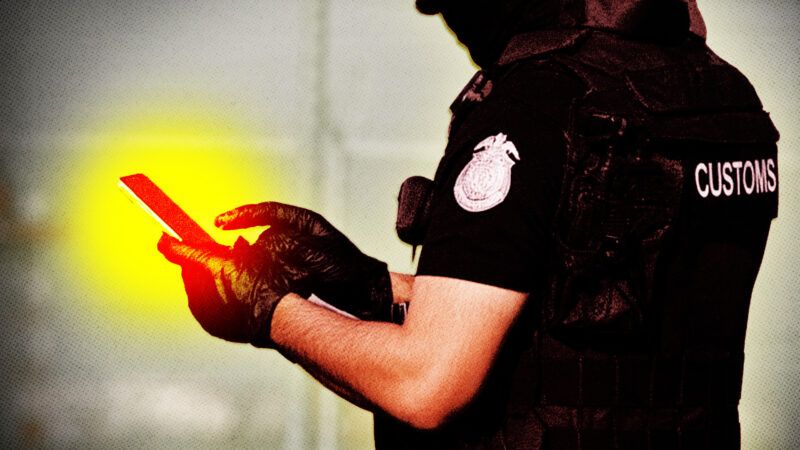
Travelers entering the U.S. through New York, Vermont, or Connecticut should be aware: The government can search your cellphone even if it doesn't suspect you of criminal activity.
That's the crux of a ruling the U.S. Court of Appeals for the 2nd Circuit released Thursday. Judge Steven Menashi writes that "no suspicion is required before the government searches a traveler's property at the border." Citing the Supreme Court in U.S. v. Ramsey (1977), the 2nd Circuit found that the "longstanding recognition that searches at our borders without probable cause and without a warrant are nonetheless 'reasonable' has a history as old as the Fourth Amendment itself."
In U.S. v. Smith (2023) and U.S. v. Sultanov (2024)—cases within the 2nd Circuit's jurisdiction—district courts held that law enforcement needed a warrant before searching a suspect's cellphone at the border. Thursday's ruling rejects the warrant requirement, setting a precedent for future cases in the 2nd Circuit.
The case was brought by Chinwendu Alisigwe, a permanent resident of the U.S., who was convicted in 2024 of bank fraud, conspiracy to commit bank fraud, and conspiracy to commit money laundering.
In 2018, the United Kingdom Border Task Force seized a fake South African passport with an American nonimmigrant visa for Wilhelm Heintz. The task force shared the passport with the Department of Homeland Security, which matched it to Alisigwe, who had a pending application for naturalization in the United States. The fake passport led to a joint investigation between U.S. Citizenship and Immigration Services, Homeland Security Investigations (HSI), the HSI Attaché in London, and the Justice Department.
In 2019, Alisigwe was returning to America after a trip to Nigeria when HSI and Customs and Border Protection agents stopped him at John F. Kennedy International Airport. When an officer showed Alisigwe the fake South African passport, he "denied knowing when or where the photograph was taken." After instructing Alisigwe to unlock his cellphone, an officer then "scrolled through Alisigwe's cellphone and used his own cellphone to photograph images contained in Alisigwe's photo gallery." A few years later, federal officers stopped Alisigwe at the same airport as he returned from an international trip and "manually reviewed his cellphone by scrolling through it and taking photographs."
After finding further evidence to support the fraud allegations against Alisigwe, officers released him into the country. He was "subsequently arrested" and charged with a litany of crimes, and he was ultimately sentenced to five years in prison.
During Alisigwe's initial trial in the U.S. District Court for the Southern District of New York, Judge Valerie E. Caproni denied the defence's motion to suppress evidence obtained from the cellphone. Caproni accepted that "cellphone searches cannot be conducted without reasonable suspicion of criminal activity because they are not routine border searches," but she reasoned that law enforcement agents "had reasonable suspicion to do so" both times they searched the phone.
The 2nd Circuit's opinion goes beyond Caproni's argument, reasoning that the government's interests at the border supersede an individual's right to privacy. The 2nd Circuit states that the "level of intrusion into a person's privacy is what determines whether a border search is routine."
A search can be considered non-routine, the court declared, only if it involves "intrusive border searches of the person," such as strip searches and body-cavity searches. Since a cellphone is merely property, the 2nd Circuit found that its precedents "establish that the government does not need to have reasonable suspicion before searching a traveler's cellphone at the border."
The ruling reaffirms federal courts' interpretation of the constitutional authority granted to the executive branch at border checkpoints, including airports.
In U.S. v. Flores-Montano (2004), the Supreme Court ruled that "the Government's interest in preventing the entry of unwanted persons and effects is at its zenith at the international border," meaning that "searches made at the border, pursuant to the longstanding right of the sovereign to protect itself by stopping and examining persons and property crossing into this country, are reasonable simply by virtue of the fact that they occur at the border."
While she concurred with the majority's judgment that "neither a warrant nor probable cause is necessary to search a cellphone at an international airport," Judge Eunice C. Lee declined to cosign the court's attempt to "interpret the Fourth Amendment to accept the further (and seemingly inexorable) diminishment of our privacy by way of suspicionless cellphone searches at the border." Lee took issue with the majority's opinion that federal officials can conduct warrantless searches "with no suspicion and for any reason (including political or discriminatory ones), without implicating constitutional rights."
In her concurring opinion, Lee states that the "unparalleled ability of a cellphone search to invade an individual's privacy should be considered when determining whether the searches of these devices at an airport are 'routine.'" She notes that "while a cellphone search may not be as physically intrusive as a strip search, it is much closer on the spectrum to a strip search than it is to the search of luggage because of the amount of information it reveals."
As Lee ultimately concludes, the court's decision erodes the Constitution's privacy protections.
"Allowing suspicionless searches of cellphones at the border undermines the essential privacy principles the Fourth Amendment was intended to protect," she writes. The court, she says, should "hesitate in creating rules that further weaken this cherished constitutional protection."