
The Self-Driving Car Fight in Congress Isn't Really About Safety at All
Bootleggers, Baptists, and the fight over who gets to write America's self-driving car rules.
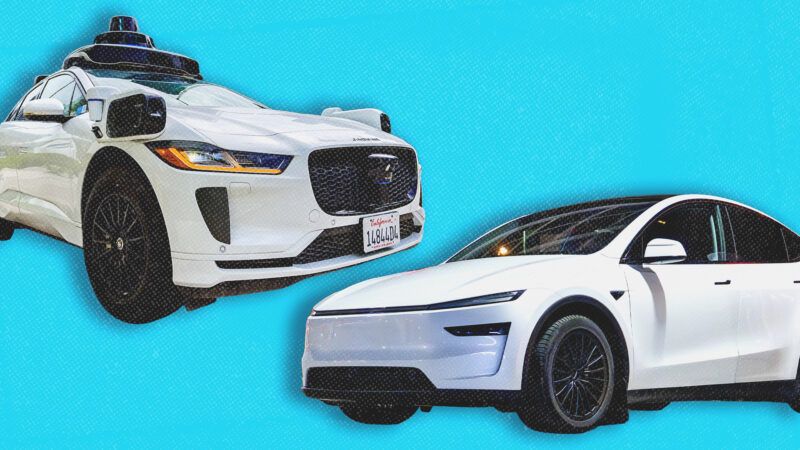
To put American traffic deaths in perspective, consider the Miami Marlins. Since 2012, the baseball team has played its home games at the stadium now called LoanDepot Park. The field's official capacity is 36,742, roughly the number of Americans who die in traffic crashes every year. America loses a baseball stadium's worth of lives to vehicular accidents every 12 months.
For the first time, there's a way to prevent many, and perhaps most, of those deaths: self-driving cars.
But self-driving cars are controversial. Some worry about safety. Others worry about jobs. Opposition from unions and local political figures has slowed their rollout in cities like Washington, D.C., and Boston. And Congress has now taken up the task of writing a law that would govern how self-driving cars operate and what safety measures they must meet. The bulk of current efforts has produced not one bill but two, which pull in opposite directions.
On one side is the SELF DRIVE Act, which would create the first federal statute on automated vehicle (A.V.) safety.
Along with companion legislation, the bill would require manufacturers to self-certify their systems against a "safety case" standard, i.e., a structured and evidence-based argument that their system won't pose an unreasonable risk of accidents. It would permit companies to deploy as many as 90,000 vehicles on public streets, up from the current cap of 2,500. The bill passed a House subcommittee in February on a 12–11 vote and now awaits a full committee markup (that has not yet been scheduled).
On the other side is the Stay in Your Lane Act, introduced in the Senate by Sens. Ed Markey (D–Mass.) and Richard Blumenthal (D–Conn.). It would require manufacturers to define an "operational design domain" (ODD), i.e., the specific conditions under which their system is designed to operate safely, and prohibit operation outside it.
The driving forces behind the bills and their different emphases will be familiar to anyone who has studied how high-stakes regulation often works. And it all goes back to Prohibition.
A century ago, both church folk and gangsters advocated for alcohol restrictions. The former backed Prohibition out of sincere moral conviction, the latter out of a desire to seize a market for themselves. To describe such unlikely alignments, economist Bruce Yandle coined the term "bootleggers and Baptists." The Baptists act as high-minded advocates who provide public legitimacy for a rule; the bootleggers serve as commercial interests who stand to benefit and provide political muscle.
The same sort of high-low coalition is present in the push for self-driving car laws. Though both bills are framed by their proponents as safety measures, each has its own mix of Baptists and bootleggers in support. Yet despite their safety-focused arguments, neither side is engaging with the actual safety data that would settle the debate.
The Bill Incumbents Wrote for Themselves
The "Baptist" case for the SELF DRIVE Act is simple enough: more self-driving cars, deployed more quickly, would save more lives. There's something to this idea. Most of the 40,000 road deaths annually are caused by human error; the deployment of driving automation at scale nationally could prevent many of them.
The current patchwork of 34 different state laws—some permissive, some restrictive, and often incompatible—makes that difficult. The U.S. Chamber of Commerce has argued that Chinese firms now lead in cumulative miles without a human driver, total deployments, and fleet size: a claim the industry deploys freely, and one that points to real competitive anxiety. The SELF DRIVE Act addresses both concerns by allowing American firms to deploy more automated vehicles faster.
Behind the Baptists are the bootleggers. The SELF DRIVE Act would require manufacturers to develop a "safety case" for each version of their automated driving system, meaning a structured argument, backed by evidence, that their system doesn't pose an unreasonable risk of accidents. This sounds more rigorous than it is: The framework rests on subjective language—systems must be "sufficient," behave "appropriately," be "likely" to meet standards—a low bar in any product-safety context.
The bill also relies on manufacturer self-certification, meaning manufacturers grade their own homework. There is no requirement that the safety case be reviewed by the National Highway Traffic Safety Administration (NHTSA) or a third party before deployment; a manufacturer submits it and begins operating unless the agency objects. (The Owner-Operator Independent Drivers Association, which represents small commercial carriers who would share roads with these vehicles, has raised the same objection to self-certification in formal opposition to the bill.)
The bill bends the regulatory regime in other ways. The current cap on the number of vehicles a manufacturer may deploy under a testing permit, which exempts them from the federal safety standards written for human-driven vehicles, is 2,500 per year. Companion legislation traveling with the bill would raise that cap to 90,000, a 36-fold increase. More striking still, the bill allows manufacturers to earn revenue from freight and passengers during the testing phase. If self-driving vehicles are in commercial service while being "tested," what one has is not a development stage but a business model.
Who benefits from self-certification, a 90,000-vehicle exemption cap, and revenue during testing? The answer is the incumbents, firms like Waymo, Tesla, Aurora, and Uber: companies large enough to deploy at these levels, sophisticated enough to comply with the bill's requirements, and established enough to have the regulatory teams to navigate subjective standards. The subcommittee vote was 12–11, near the party line, with Democrats criticizing the bill's divergence from an earlier bipartisan draft they'd helped write. What emerged has the unanimous backing of the industry: Waymo, Tesla, Aurora, Uber, the Autonomous Vehicle Industry Association, and the U.S. Chamber of Commerce all support it.
With every incumbent in the sector aligning behind a bill for which the vote breaks almost entirely along party lines, it's clear that the Baptist framing is doing a great deal of work here. Specifically, it's providing insulation for a bill that raises the deployment ceiling, lowers the compliance bar, and lets the largest players earn revenue before the rules are finalized.
The Bill That Costs Waymo Nothing and Tesla a Lot
The Baptist case for the Stay in Your Lane Act treats the problem differently. Instead of speeding up the deployment process, it focuses on defining specific safe use cases so that self-driving technology isn't used in a way likely to cause accidents.
To be fair to this approach, the bulk of serious A.V.-related incidents have all been caused by Advanced Driver-Assistance Systems (ADAS), most notably Tesla's Supervised Full Self-Driving (an oxymoron).
Self-driving cars are judged on the SAE (Society of Automotive Engineers) taxonomy, which provides a five-level designation for each type of self-driving vehicle. Lower-level systems are less than fully autonomous. Higher-level systems have more ability to operate without human assistance.
ADAS is what engineers refer to as a Level 2 system, one that can assist a human driver by undertaking simple operations like maintaining the vehicle's speed and position, changing lanes, and so forth, but requires a human driver present and ready to intervene in situations the system can't handle. Today, ADAS is permitted to operate on any road in the country, without limits on where or under what conditions it may engage.
Incidents involving ADAS dominate NHTSA's crash-reporting data, in part because Tesla alone operates millions of Level-2-equipped vehicles, dwarfing the entire Level-4 fleet in scale. The act correctly treats ADAS incidents as a problem, and requires that manufacturers define an ODD and prohibit operation outside it. The act's advocates, Consumer Reports and Advocates for Highway and Auto Safety, are arguing for what they think is a reasonable safety requirement.
The bootleggers here are harder to spot. The bill does have a clear competitive effect: its functional definition of driving automation covers any system performing simultaneous lateral and longitudinal vehicle control, which would include both Tesla's ADAS and Waymo's SAE Level 4 ADS.
But Waymo already operates within a defined geofenced operational design domain as a matter of practice: its robotaxis carry no human driver, operate only on premapped urban roads, and follow a policy of reporting every minor contact event, regardless of severity.
In other words, the bill codifies as a requirement what Waymo already does voluntarily. Conversely, Tesla operates without such restrictions, on any road, under any conditions. The Stay in Your Lane Act is therefore largely costless to Waymo and constraining to Tesla.
That asymmetry is founded on the fact that Waymo has built a system disciplined enough to operate safely within defined limits, while Tesla hasn't. ODD-bounded operation is how Level 4 systems actually function: They handle specific conditions well, not every condition adequately, and require manufacturers to define and enforce those conditions in line with the technology's actual architecture.
The argument that the ODD standard might appear meritorious but is just being pushed to give Waymo a competitive advantage would require evidence that the standard's architects shaped it around what Waymo already does. There is no such evidence in the public record; Waymo has simply built a system disciplined enough to pass a test that Tesla currently cannot.
You would expect the bootleggers here to be the unions, but they have been curiously silent. In 2017, when the SELF DRIVE Act was first introduced, the International Brotherhood of Teamsters successfully fought to exclude heavy commercial vehicles from its scope. The 2026 version removes that exclusion; automated trucks are explicitly covered. The Teamsters' standing federal policy demands a human operator in every vehicle regardless of automation level. Yet no public, bill-specific statement on the SELF DRIVE Act has been issued, despite active campaigning on autonomous vehicle legislation in several states. Whatever the Teamsters are doing, they're not doing it in public.
The Evidence Nobody Wants To Cite
Given that both sides are making the case that their preferred bill makes the public safer, it's striking how little either engages with the evidence that we have.
Start with the official data: NHTSA's crash-reporting framework requires manufacturers to report incidents but does not require disclosure of fleet size or distances traveled. Without a mileage denominator, no per-mile crash rate can be calculated; we know how many crashes occurred but can't say whether that number is high or low. Congress knew this before it began drafting legislation, and drafted anyway.
Consumer Reports and Advocates for Highway and Auto Safety are the two most prominent consumer-safety organizations in the federal AV debate: They submitted formal opposition letters to the House subcommittee, testified before the Senate, and have staked out the position that the SELF DRIVE Act "lacks requirements for independent verification or certification" of manufacturer safety claims. This would be a reasonable demand, except that none of them have acknowledged, disputed, or engaged with the peer-reviewed evidence that already exists.
Waymo's crash rate study, published in Traffic Injury Prevention by Kusano et al. in 2024, found an 80 percent reduction in any-injury crashes and a 55 percent reduction in police-reported crashes against comparable human benchmarks across 7.1 million rider-only miles. A joint study by Swiss Re and Waymo, published in Heliyon, found a 76 percent reduction in property damage liability claims and zero bodily injury claims over 3.8 million miles, against a Swiss Re baseline of more than 600,000 claims.
It's true that all authors on the crash-rate study are Waymo employees, and the methodology has not been independently replicated. But no public document from Consumer Reports or Advocates for Highway and Auto Safety cites, disputes, or engages with any of it. They are demanding to be shown exactly the kind of evidence that already exists, which is a strange posture for organizations that describe themselves as evidence-driven.
The opposition from these safety advocates appears to be procedural and institutional, not empirical: They object to self-certification, broad preemption, and the absence of independent verification. Engaging with the Waymo data on its own terms would require them to distinguish between the reckless use of Level 2 systems and the demonstrated safety of mature Level 4 technology. Making that distinction would complicate their opposition to the SELF DRIVE Act, and so they have not made it.
Choosing Our Lane
Thinking about the bills this way leads to a sour conclusion. The best possible federal A.V. framework—one that would prevent state patchwork, mandate independent verification of safety cases, and write the Level 2/Level 4 distinction into statute—has no bootleggers behind it.
No major industry player wants genuine independent verification when self-certification is available; no safety advocacy coalition wants to make the Level 2/Level 4 distinction when blurring the two makes restriction easier to argue for; and no union wants to appear in public opposing a safety bill. Yandle's framework predicts why the solution isn't on offer: Every actor with legislative capacity has chosen their own side, none of which maps perfectly onto the public interest.
The ODD framework from the Stay in Your Lane Act, folded into the preemptive structure that only the SELF DRIVE Act provides, and stripped of self-certification, would be a bill worth supporting. It is not on offer. The question to consider is, given two imperfect bills, which one leaves more room for correction, and which coalition, if it wins, will be more receptive to the amendments the evidence demands.
The SELF DRIVE Act is the better bet. Structurally, it alone establishes a comprehensive preemptive federal framework for self-driving regulation, and without one there is nothing to improve: 34 state regimes calcifying in place are harder to fix than a weak federal standard, which can be amended by rulemaking. Analytically, the coalition behind the Stay in Your Lane Act has spent its credibility demanding empirical verification of A.V. safety claims while declining to engage with the peer-reviewed evidence that already supplies it. If a coalition that refuses to read the evidence gets its way, there's no reason to think it is going to do better on amending it.
The SELF DRIVE Act's bootleggers are getting more than they deserve. But a bill animated by Baptists who won't engage with the evidence is a poor instrument for a problem that evidence should decide. There's a baseball stadium's worth of Americans every year whose lives depend on getting this right.