
Minnesota Bills Would Create State Right To Sue Government Officials for Constitutional Violations
Two different pieces of legislation aim to create state workarounds to the procedural quagmire of federal civil rights litigation.
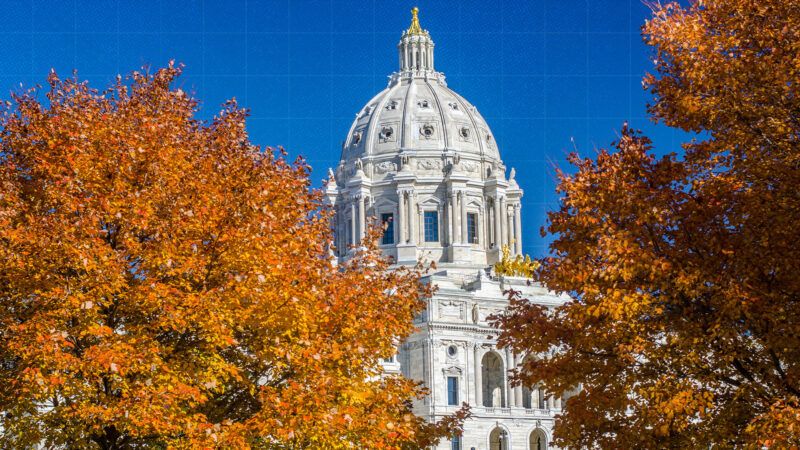
Bills moving through the Minnesota Legislature this session would create a state right to sue law enforcement officers and other government officials for constitutional violations.
The legislation comes amid allegations of wide-scale civil rights abuses by federal immigration officers deployed to the state by the Trump administration, but also the shocking case of a Minnesota police officer who fabricated evidence and lied under oath—only to be granted immunity from a civil suit filed in federal court by her victim.
One bill would create a "cause of action" in Minnesota's statutes for residents to sue government officials who violate their civil liberties.
Another bill, the Minnesota Civil Remedies Act, would make government employees liable for violating or failing to intervene in the violation of someone's civil rights. It would go somewhat further than the cause of action bill and also not allow certain immunity defenses, such as "qualified immunity"—a legal doctrine that allows government employees to dodge lawsuits in cases where the right they're accused of violating hasn't been clearly established.
Qualified immunity was supposed to protect officials who couldn't reasonably know they were violating someone's rights, but in practice it has become a time-consuming and frequently absurd legalistic roadblock to even getting civil suits against police officers to trial. (And although it's most commonly associated with police officers, qualified immunity also covers government employees such as school administrators and child welfare investigators.)
What these bills are attempting to do is give residents a state remedy for civil rights claims, rather than having to face the procedural quagmire of litigating those claims in federal court.
The cause of action bill was introduced by Democratic-Farmer-Labor Party (DFL) Rep. Jamie Long and state Senate President Bobby Joe Champion (also of the DFL). It failed to advance out of a House committee last month but is still active. The Minnesota Civil Remedies Act has bipartisan sponsors in the Senate and House but is still awaiting a committee hearing. Legislation in Minnesota is commonly packaged into larger omnibus bills.
"The proposal is simple: Minnesotans injured by unconstitutional acts should be able to seek a remedy from an independent and impartial court," the co-sponsors of the cause of action bill wrote in an op-ed in The Minnesota Star Tribune. "This will not eliminate the harm done, but it may at least begin the process of repair for Minnesotans whose rights have been trampled."
While the surge of federal immigration agents to Minnesota in December grabbed state and national attention, Estrella López, the senior state policy manager at the Justice Action Network, a criminal justice advocacy group, says the cause of action bill is about the broader principle of keeping government accountable.
"Accountability is what makes legitimate authority possible. Our government relies on a social contract: Citizens grant authority, and in return, officials remain answerable to the people," López says. "This bill isn't partisan, it isn't about targeting any specific agency, it's about ensuring that unchecked power doesn't become the norm, and that every Minnesotan has a meaningful path to justice when their rights are violated. When government actors know that constitutional violations have real consequences, it protects both the public and the officers who do their jobs with integrity."
The case of St. Paul police officer Heather Weyker is just one recent and particularly striking example of what López and other groups are talking about.
Weyker used a bogus investigation into an interstate sex-trafficking ring allegedly run by Somali refugees to imprison a woman, Hamdi Mohamud, for just over two years on false charges. Overall, Weyker's investigation netted 30 indictments, nine trials, and zero convictions.
Mohamud sued Weyker, and in 2018, a federal judge ruled that Weyker did not have qualified immunity from Mohamud's claims that she violated Mohamud's Fourth Amendment rights, finding that Weyker fabricated information and lied to a grand jury.
However, the U.S. Court of Appeals for the 8th Circuit ruled two years later that, despite the trial judge's findings and another appellate court's "acute concerns" that Weyker's sex-trafficking investigation "may be fictitious," Weyker was immune from Mohamud's suit—not because of qualified immunity, but because she was participating in a federal law enforcement task force, and thus fell under the umbrella of legal protections for federal officers.
The Supreme Court created a right to sue individual federal law enforcement officers for civil rights violations in the 1971 case Bivens v. Six Unknown Named Agents of the Federal Bureau of Narcotics. That sounds like it should have been bad news for Weyker, but the Supreme Court has sharply narrowed the scope of Bivens in the decades since, to the point where today it's more or less a dead letter. The result is that, unlike local and state police, it's next to impossible to sue an individual federal officer for deprivations of civil rights.
The Supreme Court declined to hear Mohamud's case earlier this month. Her suit was one of more than two dozen filed against Weyker.
The Institute for Justice, a public interest law firm that represented Mohamud and advocates for removing legal immunity protections for government officials, says the legislation would give a clearer path for police abuse victims like Mohamud to be made whole again in civil court.
"This case shows that even when someone is clearly a victim of government abuse, our legal system can leave them without a meaningful path to justice," Meagan Forbes, the Institute for Justice's director of legislation, says. "Minnesota needs reform so people can hold government officials accountable when their constitutional rights are violated. Minnesota lawmakers have multiple opportunities this session to fix this problem, and the legislature should act to ensure that our constitutional rights are more than just words on paper."