
The Insurrection Act, Which Trump Keeps Threatening To Invoke, Is Alarmingly Vague and Broad
The antiquated statute arguably allows the president to deploy the military in response to nearly any form of domestic disorder.
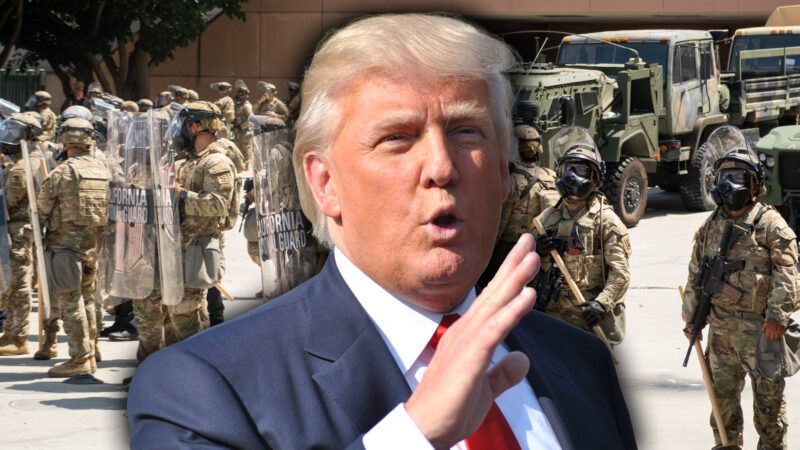
President Donald Trump, who has periodically threatened to invoke the Insurrection Act before reconsidering, performed that familiar two-step again last week. "I don't think I need it right now," Trump told reporters the day after he said he might deploy active-duty military personnel against "professional agitators and insurrectionists" in Minnesota.
The Pentagon nevertheless told 1,500 soldiers stationed in Alaska to be ready for that assignment, just in case the president changed his mind again. It therefore seems like a good time to recall why critics of the Insurrection Act, which on its face gives the president alarmingly broad authority to send in the troops, say it desperately needs reform.
That law, which descends from legislation that Congress approved between 1792 and 1871, includes two provisions that could be especially useful to any president who is itching to use the military for law enforcement. Both include outmoded language that is puzzling to modern readers, and both seem to give the president wide discretion in deciding when soldiers should become cops.
The second section of the Insurrection Act applies "whenever the President considers that unlawful obstructions, combinations, or assemblages, or rebellion against the authority of the United States, make it impracticable to enforce the laws of the United States in any State by the ordinary course of judicial proceedings." In that case, the president "may call into Federal service such of the militia of any State, and use such of the armed forces, as he considers necessary to enforce those laws or to suppress the rebellion."
The third section of the Insurrection Act says the president, "by using the militia or the armed forces, or both, or by any other means, shall take such measures as he considers necessary to suppress, in a State, any insurrection, domestic violence, unlawful combination, or conspiracy" in either of two situations. One trigger, which involves violations of constitutional rights that a state has proven unwilling or unable to protect, has been invoked by past presidents but does not seem relevant to the unrest that troubles Trump.
The other trigger is more open to interpretation. It authorizes domestic military deployments when any of the listed illegal activities "opposes or obstructs the execution" of federal laws or "impedes the course of justice under those laws."
The Insurrection Act's terms are so hazy and sweeping that the statute arguably allows the president to deploy "the militia or the armed forces" at will in response to nearly any form of domestic disorder. If so, it is hard to see what remains of the Posse Comitatus Act, which makes it a crime to deploy the armed forces "to execute the laws" except in "cases and under circumstances expressly authorized by the Constitution" or an act of Congress.
The Insurrection Act "provides broad authority without sufficient checks and
balances," the American Law Institute (ALI), whose membership "spans a range of legal and political views," warned in 2024. "It is an old statute with vague triggers for the indefinite domestic use of military force."
Some of those triggers, the ALI noted, "are expressed in antiquated language," such as "combinations," "obstructions," and "assemblages," with no clear contemporary meaning. Worse, "the Insurrection Act contemplates no role for Congress in the use of the authorities under the Act even though the president receives those authorities from Congress."
Those flaws "have been clear for a long time and have prompted numerous proposals for reform," the ALI noted. In addition to updating the law's language, the ALI recommended that Congress "strengthen the conditions" for using the Insurrection Act, impose time limits on deployments, and require "reporting and consultation."
The Insurrection Act may be newly appealing to Trump now that the Supreme Court has cast doubt on his use of a different, less permissive statute to deploy National Guard members. But even Americans who have complete faith in Trump's wisdom and self-restraint should worry about how future presidents might abuse this dangerously vague law.
© Copyright 2026 by Creators Syndicate Inc.