
DHS Invokes Immigration Enforcement To Justify Gathering Americans' DNA
A proposed rule change would allow routine gathering of biometric data without a warrant.
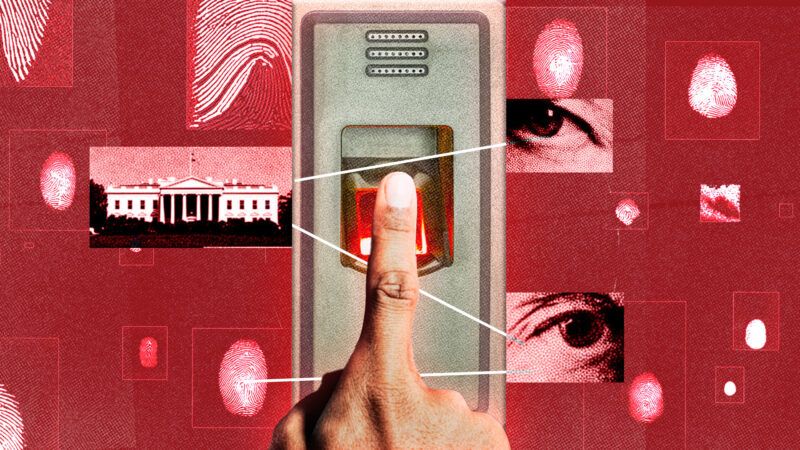
Government agencies inevitably turn enforcement responsibilities into opportunities to extend the security state. Every initiative to document, monitor, track, or otherwise spy on Americans starts with a mandate to ensure that people are obeying some rule or law. So it is with immigration policies, which fuel government efforts to gather biometric information not just on those who want to enter the country, but on citizens born and raised here. Fortunately, the scheme is getting pushback.
You are reading The Rattler from J.D. Tuccille and Reason. Get more of J.D.'s commentary on government overreach and threats to everyday liberty.
Massive Data Sweep Hiding in a Proposed Rule Change
On November 3 of last year, the Department of Homeland Security (DHS) proposed a rule change allowing its agents to gather and store more biometric data on anybody associated with applications for "benefits" including family visas, Permanent Resident (green) Cards, and work permits. The DHS summary of the rule states, in part:
DHS proposes to require submission of biometrics by any individual, regardless of age, filing or associated with an immigration benefit request, other request, or collection of information, unless exempted; expand biometrics collection authority upon alien arrest; define "biometrics;" codify reuse requirements; codify and expand DNA testing, use and storage; establish an "extraordinary circumstances" standard to excuse a failure to appear at a biometric services appointment…
According to the proposal, the purpose of gathering biometric data, including fingerprints, photographs, signatures, voice prints, ocular images, and DNA (which is heavily emphasized by DHS) is "identity management" to verify that people are who they say they are.
Immigrants aren't especially popular in certain U.S. circles at the moment, or perhaps it's more accurate to say that leniency towards those who want to enter the country is unpopular. But the rule change also ropes in lots of Americans. The proposal specifies that "by 'associated,' DHS means a person with substantial involvement or participation in the immigration benefit request, other request, or collection of information, such as a named derivative, beneficiary, petitioner's signatory, sponsor, or co-applicant."
As attorneys Alessandra Carbajal, Lee Gibbs Depret-Bixio, and Ryan Mosser note in an analysis, the new rule would affect not just immigrants but "U.S. citizens, nationals, and lawful permanent residents, regardless of age." They add that "signatories for employers that serve as sponsors/petitioners may potentially be subject to biometrics requirements. This would mark a departure from current practice, where only foreign nationals seeking benefits typically provide biometrics."
"This data collection would not be limited to just immigrants, it would also impact millions of American citizens," agrees Institute for Justice (I.J.) attorney Tahmineh Dehbozorgi. "DHS is claiming this DNA collection is meant to serve one narrow purpose, but realistically, it is creating a vast genetic dragnet that endangers the Fourth Amendment rights of everyone, all without Congress' approval."
A 'Genetic Panopticon' Without Congressional Authorization
That said, the proposed rule is exactly that—proposed. DHS pursued a similar biometric sweep in 2020, only to withdraw it after receiving thousands of comments, many objecting to its intrusiveness. The comment period on the latest proposal ended January 2, which was the day I.J. filed its objections to such wide-ranging collection of biometric data.
DHS "proposes to compel U.S. citizens to turn over their DNA in civil immigration benefit adjudications, convert that biological material into persistent DNA-derived records, retain those records indefinitely, and make them available for future law-enforcement and investigative use," the pro-liberty public interest law firm objects in its comment. "DHS's sweeping proposal is exactly the kind of generalized, future-facing data collection that the Fourth Amendment is meant to guard against. Moreover, Congress has never clearly authorized the agency to create such a regime, and DHS cannot arrogate such a power to itself."
I.J.'s comment points out that DHS's goals in gathering biometric data appear to extend beyond the immigration issue: "It looks less like DHS is genuinely trying to resolve particular cases and more like it is attempting to use immigration as a stalking horse to build out a general-purpose investigative capability."
I.J. invoked the late U.S. Supreme Court Justice Antonin Scalia's 2013 dissent in Maryland v. King warning that routing gathering of genetic samples would result in a "genetic panopticon" no matter the law enforcement justifications for gathering such data.
The comment also reminded DHS that since its last attempt to change the rules on biometrics, the Supreme Court has ruled in 2022's West Virginia v. EPA that federal agencies cannot assert "highly consequential power beyond what Congress could reasonably be understood to have granted" without specific legislative authorization. Gathering vast quantities of biometric data into a centralized database would fall into that category.
DHS's Growing Interest in Centralizing Biometric Data
DHS also underlined its interest in biometric data last summer when it highlighted the role of a previously little-known federal agency involved in collecting biometric data.
"The Department of Homeland Security is streamlining control over the federal government's largest database of biometric data, placing its chief information officer in control of the Office of Biometric Identity Management, a small but powerful agency technology office," Rebecca Heilweil reported for FedScoop in August 2025. "Antoine McCord, a former Marine and intelligence veteran who took over as DHS's CIO in March, is now charged with overseeing one of the largest biometrics systems in the world, including a resource that houses more than 300 million profiles sourced from records of peoples' faces, fingerprints, and irises."
DHS's proposal, if it is enacted, would further formalize the gathering and storing of deeply personal identifying information about millions of people. Their details would be added to a database in the name of enforcing immigration law but would be available for whatever uses the government could come up with in the future. Once biometric collection without suspicion or a warrant becomes routine in one context, there's no reason to believe it would stop there.
I.J.'s comment is worth reading for its warnings about the dangers of letting biometric data sweeps become routine practice. Hopefully those objections will, again, help to spike a bad rule change that would threaten our Fourth Amendment protections.