
Trump Orders the 'Expeditious' Reclassification of Marijuana
The long-awaited move will facilitate medical research and provide tax relief to the cannabis industry, but it falls far short of legalization.
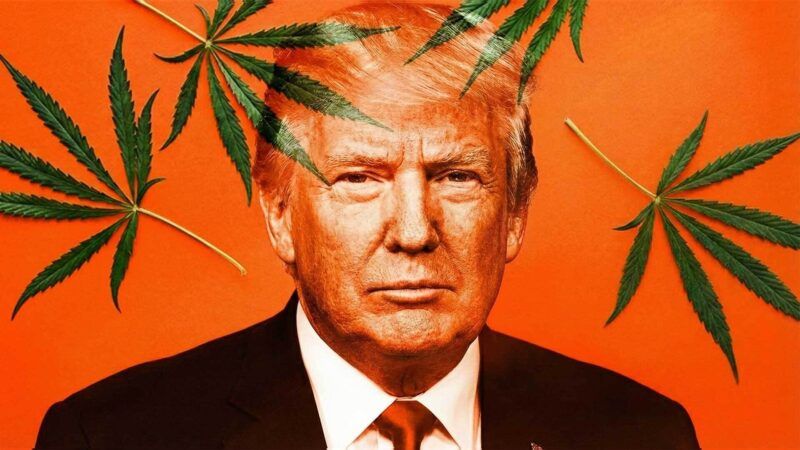
On Thursday, President Donald Trump delivered on his promise to proceed with the reclassification of marijuana under the Controlled Substances Act, a long-awaited step that recognizes the drug does not meet the criteria for Schedule I, the law's most restrictive category, where it has been listed since 1970. Instead of starting over with a new regulatory review, Trump's executive order instructs Attorney General Pam Bondi to "complete the rulemaking process" that the Biden administration began last year "in the most expeditious manner" allowed by federal law.
Under a proposed rule that the Justice Department published in May 2024, marijuana would move from Schedule I, a category supposedly reserved for especially dangerous substances with a high abuse potential and no currently accepted medical applications, to Schedule III, which includes prescription drugs such as ketamine, anabolic steroids, and Tylenol with codeine. Trump presented that change as a boon to medical marijuana research with the ultimate aim of making cannabis-based medications legally available to patients who might benefit from them.
"We have people begging for me to do this, people that are in great pain for decades," Trump said. "This action has been requested by American patients suffering from extreme pain, incurable diseases, aggressive cancers, seizure disorders, neurological problems and more—including numerous veterans with service-related injuries and older Americans who live with chronic medical problems that severely degrade their quality of life."
Trump emphasized that his order "doesn't legalize marijuana in any way, shape or form, and in no way sanctions its use as a recreational drug." That is true, since state-licensed marijuana businesses will still be criminal enterprises under federal law. Those businesses nevertheless will benefit from marijuana's rescheduling because it will allow them to claim standard deductions on their income tax returns. Their inability to do that, the result of a law targeting businesses that illegally supply Schedule I or Schedule II drugs, results in staggeringly high effective tax rates that impose a huge financial burden on the cannabis industry.
"This monumental change will have a massive, positive effect on thousands of state-legal cannabis businesses around the country," cannabis lawyer Brian Vicente said in an emailed press release. "Rescheduling releases cannabis businesses from the crippling tax burden they have been shackled with and allows these businesses to grow and prosper."
Although the tax implications of moving marijuana to Schedule III will be the biggest and most immediate effect of that change, Trump did not mention that angle. He instead focused on the promise of research that aims to "better inform patients and doctors" about marijuana's medical benefits and risks. It is true that such studies will be easier to conduct once the special regulatory requirements that apply to Schedule I drugs are eliminated. But reclassifying marijuana will not legalize medical use unless and until the Food and Drug Administration approves specific cannabis-based products as prescription drugs—an iffier and more distant prospect.
Still, it is significant that Trump accepted the conclusions that led the Department of Health and Human Services (HHS) to recommend placing marijuana in Schedule III. His order notes that the 2023 HHS review "found scientific support for [marijuana's] use to treat anorexia related to a medical condition, nausea and vomiting, and pain." Based on that assessment and the practices of clinicians in states that recognize marijuana as a medicine, Trump notes, HHS concluded that it "has a currently accepted medical use," meaning it does not belong in Schedule I.
HHS also assessed marijuana's "potential for abuse," noting that "the vast majority of individuals who use marijuana are doing so in a manner that does not lead to dangerous outcomes to themselves or others." All things considered, it said, marijuana's dangers do not justify keeping it in Schedule I, the same category as heroin, or moving it to Schedule II, which includes fentanyl, PCP, and methamphetamine. While Trump's order does not mention that part of the HHS analysis, his endorsement of placing marijuana in Schedule III implicitly accepts the department's assessment of the drug's relative hazards.
Trump's order "validates the experiences of tens of millions of Americans, as well as those of tens of thousands of physicians, who have long recognized that cannabis possesses legitimate medical utility," said Paul Armentano, deputy director of the National Organization for the Reform of Marijuana Laws. "It wasn't long ago that federal officials were threatening to seize doctors' medical licenses just for discussing medical cannabis with their patients. This directive certainly marks a long overdue change in direction."
Trump's move, in other words, acknowledges that the federal government has been exaggerating marijuana's dangers and ignoring its potential benefits for half a century. That concession counts as progress of a sort, although it falls far short of resolving the conflict between federal prohibition and state laws that allow medical or recreational use of marijuana.