Jesse Walker | October 23, 2008
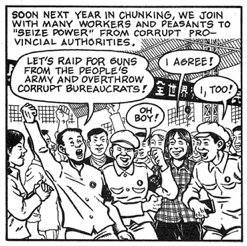
Anxious at the spreading unrest among farmers left behind in the rush to get rich, China's Communist Party leaders...unveiled sweeping reforms to give its 730 million or more rural residents more say in what they do with their land....
Approved at a twice-a-year plenum of the party's Central Committee earlier this month, the scheme will allow farmers to transfer their land-use rights and to join share-holding entities with their farmland. The policies, still lacking in crucial details, effectively give farmers -- rather than village leaders -- the authority to decide how to use their land.
Tens of thousands of peasant protests erupt each year and nearly half are linked to land grabs by local officials who see a chance to make money by turning over land on the outskirts of towns and villages to developers.
This isn't the first time disobedience from below has forced China's leaders to allow more economic liberty. As Gordon Chang pointed out two years ago,
We now know Deng as a reformer, and we credit him and the Communist party for debating, then planning, and finally executing the startling transformation of Chinese society. Yet the truth is that reform progressed more by disobedience than by design. Deng began his tenure in adherence to orthodox Communist economics, by trying to implement a ten-year plan. But his early failure to meet the plan's goals forced him to back away and permit individual initiative, at first under strict rules. Peasants on large collective farms, for example, were allowed to form "work groups" to tend designated plots, but it was specifically prohibited for just one family to make up a "work group." The prohibition did not last: in clear violation of central rules, families started to till their own plots, and local officials looked the other way.
Subterfuge on the farm was followed by subterfuge in towns and cities. Although private industry was strictly forbidden, entrepreneurs flourished by running their businesses as "red hat" collectives: private companies operating under the guise of state ownership. Such defiance would once have been unthinkable. By Deng's time, frustrated bureaucrats and countless individuals, including some of the poorest and most desperate citizens in China, were ready to take the next step -- ignoring central-government decrees and building large private businesses that now account for at least 40 percent of the Chinese economy. This became China's "economic miracle," brought to fruition even as government officials remained holed up in their offices in Beijing, preparing meticulously detailed five-year plans.
Today, Chang notes, "virtually every segment" of Chinese society ("except, of course, senior Communist leaders and wealthy entrepreneurs") regularly joins in much more public protests. "Almost anything, whether or not it is a genuine grievance, can trigger a sit-in, demonstration, or riot against party officials, village bosses, tax collectors, factory owners, or township cadres." The new extension of rural property rights is among the results.
Elsewhere in Reason: More comments on Chang's article.
Help Reason celebrate its next 40 years. Donate Now!
Try Reason's award-winning print edition today! Your first issue is FREE if you are not completely satisfied.
It's nice that a major part of the world is moving away from socialism and towards liberty.
When laborers revolt against your Communism, it would seem you are doing it wrong.
Maybe Obama needs to go over there and lecture them on the evils of unfettered capitalism. Clearly, the average Chinese just doesnt' get it.
Or maybe John McCain can explain to them how much better off they'll be if the government nationalizes their assets, John
History leads me to believe hope that
freedom in China will be taking two steps forward, one step back
for decades.
This would be a good thing. Realistically I can't expect an
explosion of people power to topple the regime, remove the leaders
and install representative government. Like South Korea, Taiwan,
the Phillippines, this is going to take quite some time.
It appears, in Asia at least, that economic freedom is a
prerequisite for political freedom. It is also becoming obvious
that the only way out of third world living standards is granting
economic freedom.
Jesse! Great work!
The hottie Asian chicks who want to meet me are all over the ad
boxes!
I pick the 47 yo, 65 kg, 171 cm brunette. Well, after I get over to
the google conversion to see what she is in real weight/height,
that is.
Our democracy began at the level of town meetings. It was almost two centuries before it reached the national government.
Our democracy began at the level of town meetings. It was
almost two centuries before it reached the national
government.
History also teaches us that the democracy genie can be
put back in the bottle by a sufficiently ruthless government.
We can only hope that's not the case here.
When laborers revolt against your Communism, it would seem
you are doing it wrong.
If your philosophy is flawed it doesn't much matter whether you do
it right or wrong.
History also teaches us that the democracy genie can be put
back in the bottle by a sufficiently ruthless government. We can
only hope that's not the case here.
"Here" as in this article or as in the U.S? McCain, Obama, not a
lot of difference. Who'd have thought we'd need lessons from Red
China?
Buddy Holly,
[whispers] psst! hey Buddy, we live in a Republic.
It gets harder and harder to say that with a straight face each
day.
An Islamic Republic?
A People's Republic?
Why, no, we live in a democratic republic.
"Here" as in this article or as in the U.S? McCain, Obama,
not a lot of difference. Who'd have thought we'd need lessons from
Red China?
Referring to the article of course. McCain or Obama, neither worth
a fuck for a libertarian, will still be an improvement over the
arrogant power grabbing asshole who presently occupies the Oval
Office.
Like South Korea, Taiwan, the Phillippines, this is going to take quite some time.
I don't think those countries' governments managed to display quite
the same level of ruthlessness that China's Communists have in
maintaining its grip on power by any means necessary.
Anyway, notice that the farmers in China still don't actually own
their land. This is just a bone being tossed their way to keep them
quiet.
There are new lands of opportunity appearing around the world as we speak. America is now the equivalent of Old Europe in the 1700's.
Actually, we live a democratic republic, which is another term
for a representative democracy.
All of which fit nicely under the term "democracy," which also
encompasses the direct democracy of New England towns.
I thought we lived in a constitutional republic with a strong democratic tradition.
sage,
Since the popular vote is a hard-wired element of how the
government operates, I'd say the democratic element goes well
beyond being a "tradition," and is a fundamental part of our
political system.
But I think we're splitting pointless hairs here. This is what I
wrote:
Our democracy began at the level of town meetings. It was
almost two centuries before it reached the national
government.
We do have democracy in this country, which plays an important role
in our government. In 1630, it was limited to being the legislative
branch of government in New England towns. Since then, our
democracy's role has expanded within our system of government, to
include such elements as the direct election of representatives to
one then both houses of Congress; the direct election of
representatives in state legislatures; the direct election of
governors; ballot initiatives in many states; and a
mediated-but-still democratic system of electing the president.
Democracy may not be all there is to our political system, but it's
plainly a pretty big part.
It's a misnomer to label us democratic. We elect representatives, period. Unless we're assembling to pass legislation, we're not very democratic. Look at the size of the House versus the size of the general population, for instance. Even the word "representative" is rather weak when one considers just how many people each representative is supposed to represent.
Central Planners Are Paper Tigers
That has tragic irony to it, considering they are giving land
reform with one hand and plotting
centrally planned healthcare with the other.
I suppose there's more than one way to administer population
control policy. I'll be the first to argue, though, that effective
land reform in China is vastly more important to everyone's
freedom.
You're fooling yourself. We're living in a dictatorship: a self-perpetuating autocracy in which the working classes--
"The hottie Asian chicks who want to meet me are all over the ad
boxes!"
Maybe my browser isn't working, unless Drew Carey, Bob Barr and
John McCain qualify as hot Asian chicks. Those are the only
pictures I'm seeing on the ads.
Our democracy began at the level of town meetings. It was
almost two centuries before it reached the national
government.
...and, seeing as how I'm an advocate of liberty, rather than
democracy, I'm not sure that's such a good thing. Instead of just a
few town busybodies dictating what I do with my life and property,
now I have to worry about some activists who live 2000 miles away
getting the ear of Congress or federal bureaucrats, too.
I wonder if they're expecting free Dr Pepper.
(Reference
explained here.)
The hottie Asian chicks who want to meet me are all over the ad
boxes!
Some of the other sites that I regularly visit show ads for
Indian-matrimony sites all the time.
cunnivore,
If government policy is those villages becomes more democratic, and
the public officials more answerable to the citizens via democratic
elections, do you think it would result in an advance of liberty or
the opposite?
You'd think it would result in an advance of liberty...but our experience in the US is that it is a temporary advance at best.
nearly half are linked to land grabs by local officials who see a chance to make money by turning over land on the outskirts of towns and villages to developers.
I am shocked...SHOCKED to hear that this kind of thing would happen
in a modern industrialized country.
*thumbs up @ Paul*
China's beginning to respect private property rights? There's hope
for the US yet...
China's beginning to respect private property rights?
No.
The farmer's lease the land from the government.
Central planning failed, so no planning or regulation at all will obviously succeed. Why can't people see that? It's plain as the nose on your face. If something fails, you go to the other extreme. Duh!
Lefiti,
How is removing the absolute conrol of land rights from corrupt
officials "going to the other extreme"?.
It seems like a good development, however you parse it. And when you consider that the PRC threw away decades of economic development in the Great Leap Forward, benign neglect and allowing privatization-in-all-but-name to go forward sounds pretty good to me.
Site comments/questions:
Media Inquiries and Reprint Permissions:
(310) 367-6109
Editorial & Production Offices:
3415 S. Sepulveda Blvd.
Suite 400
Los Angeles, CA 90034
(310) 391-2245