Katherine Mangu-Ward from the August/September 2008 issue

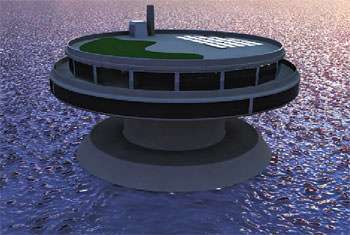
Seasteading—homesteading on the high seas—is an idea that has long attracted libertarians, along with others who would like to see a little more competition between forms of social organization. The idea is to get out into international waters and set up a floating outpost (or 12, or 1,200) from which people can come and go, experimenting with different types of legal, social, and contractual arrangements. The basic unit, consisting of essential infrastructure and plenty of space to moor your boat, might be something like the platform imagined above.
In April, PayPal founder Peter Thiel announced a $500,000 investment in the Seasteading Institute. Thiel’s co-conspirator and resident big thinker is none other than the impeccably credentialed Patri Friedman, the son of David “Machinery of Freedom” Friedman and grandson of Milton “Capitalism and Freedom” Friedman. Patri, 31, hopes to dodge the curse that has beset other watery “new country” projects such as Minerva Reef, an uninhabited dredged island “invaded” by neighboring Tonga and eventually more or less reclaimed by the sea.
Friedman says he’ll be the floating autonomous entity’s first resident. Despite the seemingly radical idea he’s championing, he sees himself as a practical guy. “Starting a new country is actually a much less hard problem than, say, a libertarian winning a U.S. election,” he says.
Help Reason celebrate its next 40 years. Donate Now!
Try Reason's award-winning print edition today! Your first issue is FREE if you are not completely satisfied.
"easier than a libertarian winning a US election"
Amen. When can I join?
However, I'm a little bit skeptical of using the sea as the archetypal libertarian paradise. Generally, when a statist wants to justify tyranny he or she often uses a seafaring metaphor.
My curiosity is that such a development would of course depend on trade with other nations in order to meet some basic needs and succeed. That itself isn't the problem -- the problem is what do the people living here have to offer in return? Would this outpost be able to actually produce or manufacture anything in a decent volume? If not, it seems like it would inevitably end up as a rich libertarian haven. That's not a criticism -- I certainly hope to become a rich libertarian someday -- but it's also not a solution.
This will make the proper 10:1 ratio of women to men easier, because, as everybody knows, hot chicks like hanging out on boats.
That itself isn't the problem -- the problem is what do the
people living here have to offer in return?
The same thing people living anywhere do?
http://www.youtube.com/watch?v=4LCZGO96V2U
It's all fun and games until the zombies break out.
I was wondering when the first Bioshock reference would be. I
almost made one myself. (I settled for linking to the piece on a
gaming forum I frequent).
R C Dean, what I mean is I'm curious as to how these outposts would
develop a functional, successful economy. It seems like most things
would have to be imported, so I'm wondering what it would export. I
imagine the services of the inhabitants would probably be the most
profitable solution, but I'm curious as to what end.
Wait, I know this story. Didn't Richard Dryfus star in the documentry?
It seems like most things would have to be imported, so I'm
wondering what it would export.
See the K M-W post about selling eggs of brainey hot women.
I'd move there just so I could say whenever a friend visits, "You've got a lot of guts coming here, after what you pulled."
See the K M-W post about selling eggs of brainey hot
women.
wasn't that K-H?
Fun in theory, but what happens when that one big storm comes
along and makes a hash of the thing? Or there are sanctions placed
on the new "country"?
Of course, you'd want to use all those alternative energy sources
the dirty fucking hippies are advocating, to be independent, I'd
think...
You all could call it Galt's Trough!
Fun in theory, but what happens when that one big storm
comes along and makes a hash of the thing?
Open a cafe?
I imagine it would be based around service industries. Banking (this would be huge), web hosting (gambling), maybe software companies, there are tons of businesses that don't require any physical plant. Tourism (if it's big enough) would be huge too. Legal drugs, prostitution and gambling, oh my!
I suppose they could buy one of the old nuclear powered navy
ships...
Watermakers would be an absolute must..though to be less dependent
on the outside world and it's mercurial political moods one would
think that development of hydroponics, etc would lessen the need
for imports of neccessities.
I'm still not sure what these communities would offer as trade. And
you'd want a "coast guard"...would it depend on volunteers or would
all the residents be armed and required to learn sea rescue and
defense?
And what about the sewage?
I've spent a month ar sea at a time, it's complicated.
I suppose they could buy one of the old nuclear powered navy
ships...
Snowcrash, I knew it. It always comes back to Snowcrash.
And what about the sewage?
Not sure how I messed that comment up.
And what about the sewage?
Sea. Diluted sewage is food for the sea, you see.
"I don't have a goddamn clue. Don't worry, they'll row for a month before they figure out I'm fakin' it. "
I'm still not sure what these communities would offer as
trade. And you'd want a "coast guard"...would it depend on
volunteers or would all the residents be armed and required to
learn sea rescue and defense?
Those automagical defense guns on the used nuclear ship should do
in a pinch.
And you'd want a "coast guard"...would it depend on
volunteers or would all the residents be armed and required to
learn sea rescue and defense?
They'll listen to reason.
Old tankers or even stripped carriers would be virtually
unsinkable and would provide a ton of room, plus they could get out
of the way of storms.
I'd be willing to try it. It would be exciting and different.
Old tankers or even stripped carriers would be virtually
unsinkable and would provide a ton of room, plus they could get out
of the way of storms.
Hmm, no, just the opposite.
The moon may be a harsher mistress, but the sea is still an amazon
dominatrix.
Like economist alludes to above, no place on earth has more of an
issue with (literal) hydraulic despotism and collective action
problems (Anarctica is comparable, though).
And as an aside:
view of the sea from land - very pretty
view of land from the sea - stunningly beautiful
view of the sea from the sea - terribly montonous and nearly
identical for 130 million square miles.
view of the sea from the sea - terribly montonous and nearly
identical for 130 million square miles.
What if you just took some legal LSD?
Guy Montag | August 1, 2008, 2:20pm | #
Not sure how I messed that comment up.
And what about the sewage?
Sea. Diluted sewage is food for the sea, you see.
There's the rub. If other nations don't like the seastead, they can
place sactions on it for dumping in the UN's ocean. Lets face it,
there hasn't been any physical shortage of land since sky scrappers
where invented. There's just been a shortage of NIMBY-free
space.
Even though this is forecast as a paradise for Ls, I can't help
but flash on Pournelle and Niven's "Oath of Fealty" - in any
precarious, isolated, technology-dependent outpost like these will
be (for quite a long while, anyway), there may well be
insurmountable barriers to a true freedom, and irresistable drivers
towards a severe collectivism.
Even Heinlen's Luna of "TMiaHM" or "TCWWTW" was totally dependent
on outside supply for quite a while (decades) while the (in effect)
slave labor of the residents were forced to build the societal
infrastructure out of _nothing_.
IOW, keen idea, but it's got a LONG way to go before it becomes
viable, even on paper.
--AGP
jtuf,
Who said that Katherine Mangu-Ward Kerry Howley Libertopia Hottie
Brainey Chickland has to be part of the UN?
Hi all. I did write a book on the subject, so there's no
shortage of source material to answer your basic questions. It's a
bit out of date (we're now paying real engineers to do the
designs), but is good background reading:
book
FAQ
political theory
The tentative plan right now is to use a resort as the initial
business model - Las Vegas on the ocean with less rules. It will
definitely be a challenge to transition that to a permanent
society, but I think it's the best angle of attack.
The tentative plan right now is to use a resort as the
initial business model - Las Vegas on the ocean with less
rules.
Just like Westworld!
So this will depend on an "underclass"...so to speak. Who will
do the maintenance? Will they have a stake in this? Certainly you
realise that ar sea, the constant upkeep will require a lot of
people.
Not just the mechanics of it, but simple exterior upkeep because of
the corrosive nature of the sea. Rust is a veritable insomniac on
the open ocean.
I see you are recommending ferro cement, again the maintenance of
such a large structure will require workers..who I ask again, will
they have a stake in the enterprise?
Will the people who have the actual skills to operate and keep the
"vessel" safe have more worth than the residents. Someone who does
off shore banking would be less needed than someone who can keep it
from sinking or..fixing the watermaker... :)
A.G. Pym has it correctly, I believe.
A few years ago, there was an article about baby boomers putting
their parents permanently on cruise ships. The cruise lines are
required by law to provide a certain level of emergency medical
care, and it was cheaper to keep the old folks on cruise ships.
Evidently you get more for your dollar with a cruise ship, as
opposed to a land based senior care facility, where Government
regulations drive up the cost.
Especially if marijuana use is legal; saves tens of thousands of
dollars on medication.
The idea of permanently traveling around on a ship is not so bad.
You go ashore at places like Rio de Janeiro, the Virgin Islands,
Bermuda, Crete, etc.
You could have yearly elections to vote on where you want to move
the ship to, and how long to stay in one place.
I've been thinking about this for a while, and what made me
wonder: Why always build relatively high-tech, multi-level
facilities?
Why not a large array of more-or-less bound-together large floats,
like heavy-built wooden boxes filled with rugged air baloons? Too
easy a victim of large waves or..?
The idea would be, have a lot of cheap things that may fail (with
some advance warning as in sagging - they would remain above water
in case of single failures due to the linkage to others anyway) and
just replace them instead of major maintenance. I.e., move the
superstructures to another float, scuttle/sink the current one,
build new one in place (and build new stuff on it).
Floats could be built in cheap-labour countries and piloted there
by small ships. a 200mx200m float should offer pretty good
stability, not be too expensive, and e.g. 3 meters of air pillow
should offer enough lift to even build heavy stuff on top.
For power I always imagined nuclear reactors suspended from the
floats: If you keep the primary and secondary cycle internal and
just have an open tertiary for effective cooling of the secondary
coolant, you should be at least as safe pollution-wise as nuclear
ships. If shit does happen, you just break the chains and let it
sink to the floor, where the sheer pressure will prevent nuclear
material from getting distributed too much. Just means the floats
should stay where it's deep.
Why bother creating a "homestead" (implying government), when
all you really need to do is BUY A DAMN BOAT, get your friends to
do the same, and invest in a little "infrastructure" . . ?
You need a floating flat space large enough to use as an airfield,
a couple of fuel tankers and a couple of freighters (two each of
the last so that one can go for replenishment while the others of
each act as fuel and grocery stores).
To refine this a bit, instead of 500 people buying boats, those
same 500 people buy an older passenger liner, and keep it outside
of territorial waters, with one each of the stores ships (the liner
will have plenty of bunker and warehouse space).
The real challenge will be in getting recognition by government of
an independent status -- necessary for such things as entering
those countries for travel, hospitalization, commerce etc.
There is already a strong subculture in the US of people who are
fulltime RVers, liveaboard boaters, and so on, who would be the
early adopters (and gurus for the rest of you people who don't know
how to live without your stick house).
Perhaps a better solution is to register your fleet with an island
nation, such as the Philippines, Kiribati, Micronesia, etc., thus
to get the benefits of the state without having an overbearing
bureaucracy come along with them.
Go, Patri, go!
Overwhelming cynicism doesn't allow me much faith in the success of
your venture. But I wish you luck.
I hope to do this on a smaller scale (myself on a boat) in the
distant future.
For power I always imagined nuclear reactors suspended from
the floats:
Just remember, your trying to make buoyant pretty much the densest
materials on this planet.
There is already a strong subculture in the US of people who
are fulltime RVers, liveaboard boaters,
These people are nomadic but not even close to self sustaining.
If you do anything that the US government does not approve us (secret banking, gambling, or especially drugs) you can be sure that the Feds will be there to bomb you. If you are lucky you will only have a SWAT team raid.
cynic: read me again - I don't want the stuff to be buoyant at all, quite the contrary for emergency scuttling. I want to suspend them. The *payload* of a research balloon doesn't float either.
Overwhelming Cynic wrote:
"'There is already a strong subculture in the US of people who are
fulltime RVers, liveaboard boaters,'
These people are nomadic but not even close to self
sustaining."
If you mean growing their own food, no. But if you think it's
simple to make the shift from stick house to extended living
without the benefits of a fixed location, well, TRY IT!
The sea colony won't be self-sustaining, either, any more than
Hawaii is. There are way too many things that you need from the
mainland.
Utopia is an idea that gets you a couple of times during your
life, it is as fascinating as difficult.
Science fiction is full of very creative scenarios. Once you
consider it for a reasonable period of time you realize it is not
very realistic. But I like the mental exercise anyway. Here some
ideas.
* I would rather buy an empty island or try to build one on shallow
waters, you need a 'seed' land, and afterwards you can use floating
and underwater construction to expand.
*You can receive garbage in order to grow your land AND get paid
for it.
* It you succeed, you will need armed forces to guard you frontier
from unwanted people.
* You cannot get socially 'very advanced' from the rest of the
world, they might react and again you need armed people. By the
other hand, your example might be tempting to emulate, you may find
yourself on the other end of the spectrum that begins with Fidel
Castro.
*Consider "buying" a very poor country like Haiti, you can help a
lot of people and put your libertarian ideas at work to see if they
are as good as we think. After all, churches do that all the time.
This reality check can be very challenging for libertarians and
'uneducated' people alike.
* Science and technology as a national basic duty can make wonders.
Add individual creativity and results can be amazing. Social
success is not that easy, even for libertarians. The evolutionary
perspective needs to be studied deeply.
I agree starting a country is easier than electing a
libertarian, but it is even easier to do so on land. You just need
to look at the world map in the right way, and suddenly, the
opportunities to start new cities appears.
Taxfreesociety.com is working to start a tax-free, visa-free,
inflation-free city on $350,000.....which is less that Thiel's
investment. Learn more at taxfreesociety.com
Rather than keep blabbing, why not check out the literature that the Institute and Patri has provided?
Bureaucrash's official podcast, the podcrash, just posted an interview with Patri Friedman about seasteading, listen here: http://www.Bureaucrash.com/Podcrash
So, the reference to Heinlein novels above makes me
wonder...
Does anyone else get as pissed off as I do when someone quotes
works of fiction to try and make a point about future
developments?
It just irks me.
Governments, or rather the people who control them, tend to be greedy for money and political power. If libertarian "seasteading" were successful, then how long would it be before the U.S.A., China, Russia, and other huge military powers decided to divide up "seasteads" for the sake of money and power for the militarist statists? Why would the history of the open sea be any different from what is now going on in the Arctic Ocean?
Site comments/questions:
Media Inquiries and Reprint Permissions:
(310) 367-6109
Editorial & Production Offices:
3415 S. Sepulveda Blvd.
Suite 400
Los Angeles, CA 90034
(310) 391-2245