
Our Amicus Brief in Case Challenging Trump's Section 338 Tariffs Against Canada
The Cato Institute and I filed an amicus brief explaining why the tariffs violate statutory requirements, and also run afoul of the major questions and nondelegation doctrines.
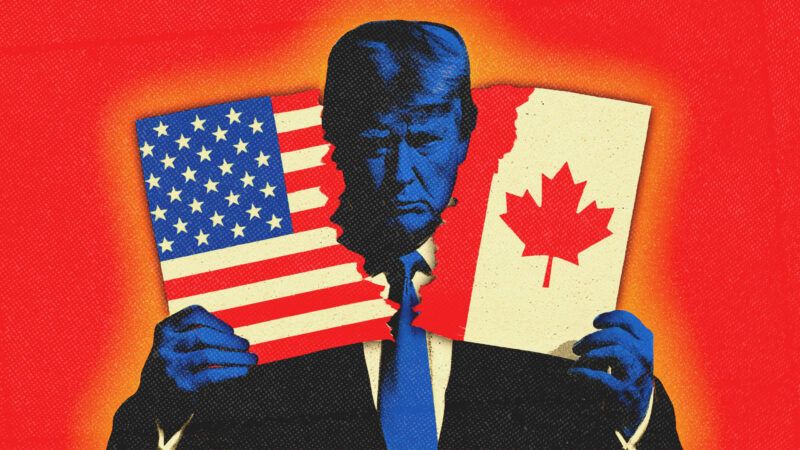
Yesterday, the Cato Institute and I filed an amicus brief before the US Court of International Trade, in Gellert Global Corp. v. Trump, the first case challenging Donald Trump's massive 50% Section 338 tariffs against Canadian imports. The plaintiff is represented by the Liberty Justice Center, the public interest law firm I worked with on the case challenging the massive tariffs Trump imposed under the International Emergency Economic Powers Act (IEEPA). That case resulted in the tariffs' invalidation by the Supreme Court earlier this year.
I previously wrote about the Section 338 tariffs and why they are harmful and illegal in an article in The Dispatch, and a paper for the Montreal Economic Institute.
We are grateful to Daniel Cannistra and others at Crowell & Moring for their invaluable pro bono assistance in helping draft and submit the brief on very short notice. Here is a summary of our key arguments, which should soon be posted at the Cato website:
This brief explains why Section 338 of the Tariff Act of 1930 cannot be used to impose the tariffs enacted by Defendants, and why doing so violates the major questions and nondelegation doctrines.
The Court should strike down the Section 338 duties for three reasons. First, Section 338 requires that any tariffs imposed be in response to discriminatory trade restrictions enacted by foreign trading partners, and that those tariffs "offset" the barriers imposed by those countries. The Section 338 tariffs imposed by the Trump administration violate both of these requirements. In addition, Section 338 has been superseded by later statutes and is no longer operative.
Second, the major questions doctrine forecloses interpreting Section 338 to permit the President to impose extraordinary import taxes whenever another country imposes any trade restrictions or declines to purchase American goods. to "speak clearly" when it assigns to the executive "decisions of vast 'economic and political significance.'" The sweeping power claimed by the administration in this case undeniably raises a major question, and it is at the very least unclear that Section 338 actually grants such vast authority.
Third, stripping the statute's qualitative conditions of operative force violates the nondelegation doctrine, which constrains delegation of legislative power to the executive. An extremely high rate ceiling of 50 percent cannot substitute for clear legislative limiting how and when tariffs can be imposed.
Cato and I (together with Prof. Michael McConnell) also recently submitted an amicus brief in litigation challenging Trump's massive Section 301 tariffs.