
Trump's Plan to Seize Greenland is Simultaneously Evil, Illegal, and Counterproductive
It would alienate allies, impose US rule on an unwilling population, and blatantly violate both US and international law.The plan to impose tariffs on nations opposing the seizure is also illegal and harmful.
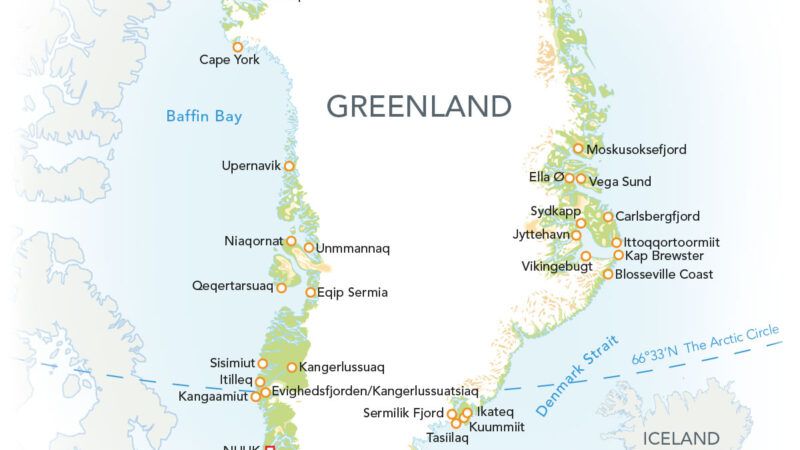
Donald Trump's plan to seize Greenland has the rare distinction of simultaneously combining grave injustice, massive illegality, and extreme counterproductive stupidity. The same is true of his more recent effort to impose tariffs on eight European countries opposing the plan.
Let's start with first principles. As the Declaration of Independence states, government should be based on the "consent of the governed." No real-world government is fully consensual. But a US conquest would make the government of Greenland less consensual than it is now. Polls indicate some 85% of Greenlanders oppose annexation by the US, while only 6% support it. In the 2025 Greenland election, the overwhelming majority of them voted for parties that support either independence or continued rule by Denmark.
Forcible annexation could perhaps be justified if it were the only way to stop some kind of severe oppression. But there is nothing like that in Greenland. Nor is there any reason think that US rule would be significantly better in terms of protecting various human rights than the current combination of Danish rule and extensive regional autonomy.
In addition to being unjust, US conquest would also obviously be illegal. It would, in fact, be a war of aggression similar to Russia's assault on Ukraine. The Nuremberg tribunal ruled that starting a war of aggression is "the supreme international crime," and this was one of the main charges on which many of the Nazi defendants were convicted. Denmark has owned Greenland for centuries and its sovereignty over that territory is universally recognized, including by the US in a 1917 agreement, in which the US accepted the "extension" of Danish control over all of Greenland.
The initiation of war - perhaps even an illegal war - can sometimes be justified for the purpose of removing a brutally oppressive regime. But, again, Danish rule in Greenland is nothing like that.
A war of aggression to conquer Greenland would violate US law, as well as international law. The US and Denmark are both signatories to the North Atlantic Treaty, which established NATO. Article V of that treaty requires the parties to come to each other's defense in the event of an "armed attack" against any of them, in Europe or North America. If the US is required to help defend Denmark against attack, it is obvious that it also has an obligation not to attack Denmark's territory itself.
Under Article VI of the Constitution, "all Treaties made, or which shall be made, under the Authority of the United States, shall be the supreme Law of the Land." Thus, Trump and other US officials are required to obey both the North Atlantic Treaty and the 1917 treaty recognizing Denmark's sovereignty over Greenland.
These points all still apply if Trump's plan is "merely" to use the threat of force to coerce Denmark into selling Greenland. Using the threat of an unjust and illegal war to take another nation's land is itself unjust and illegal. It's a kind of international extortion scheme.
In addition to being unjust and illegal, the plan to seize Greenland is also incredibly stupid and counterproductive. The main official rationale is the supposed need to protect Greenland from seizure by Russia and China. But those countries have no forces in the region that could possibly take it. Moreover, in the unlikely event that a genuine threat were to materialize, an existing agreement with Denmark already allows the US to station as many troops in Greenland as it needs for defense. In the event of attack, the two nations could also call on the assistance of the other NATO states.
If Trump really wanted to counter Russia, he would join with other NATO allies in backing Ukraine. If Russia is defeated in Ukraine, or even just remains bogged down there, it cannot pose much of a threat to Greenland or any other NATO territory. Instead, Trump has been betraying Ukraine and undermining NATO by threatening an ally's territory. Such moves actually help Russia and our other enemies, rather than hinder them.
An attack on Greenland would predictably alienate the allies, and severely undermine the alliance, if not destroy it completely. The loss of our most important allies would weaken the US and strengthen our enemies far more than owning Greenland could possibly benefit us. Denmark itself is a longtime steadfast ally, and sent some 10,000 troops to support us in Afghanistan. If we betray a close, longstanding ally in such an egregious way, other allies will see they cannot count on us, and will draw the obvious conclusions.
Another possible rationale for Trump's move is obtaining Greenland's mineral wealth. But we can far more easily obtain access to it through the simple mechanisms of trade and investment, to which Denmark and Greenland are open. In any event, any economic or strategic gain here is far outweighed by the immense harm of alienating all our allies.
What is true of Trump's plan to conquer Greenland is also true of his more recent plan to impose 10% tariffs (slated to increase to 25% on June 1) on eight European nations opposing his effort. Using such economic coercion to promote an unjust goal is an additional injustice. In addition to unjustly punishing the European allies, it will also harm numerous US businesses and consumers, much as Trump's previous tariff increases are doing.
This use of tariffs is also illegal. The likely mechanism Trump intends to use is International Emergency Economic Powers Act of 1977 (IEEPA). As I have pointed out before, IEEPA doesn't authorize tariffs at all (the word isn't even mentioned in the statute). In addition, IEEPA can only be used to counter an "unusual and extraordinary threat" to America's economy, national security, and foreign policy.
There is nothing unusual and extraordinary about Danish rule over Greenland. It has existed for centuries! Nor, for reasons noted above, does it pose any kind of threat to the US. The utter ridiculousness of claims to the contrary is yet another example of why courts should not defer to executive invocations of extraordinary emergency powers, but rather should require the executive to prove the claimed emergency triggering the use of extraordinary authority actually exists. Otherwise, emergency powers would become blank checks the president can use whenever he feels like it, which is the exact opposite of how emergency powers are supposed to work.
In the event there is uncertainty about what IEEPA means, the "major questions" doctrine, which requires Congress to "speak clearly" when authorizing the executive to make "decisions of vast economic and political significance," mandates a narrow interpretation here. Tariffs imposed for the purpose of facilitating a war of conquest that would have the effect of undermining America's most important alliance are pretty obviously an issue vast economic and political significance.
Furthermore, if IEEPA really is a blank check for the president to impose tariffs in any situation he wants, the law would become unconstitutional. It would violate the nondelegation doctrine, which limits the extent to which Congress can transfer its powers to the executive.
These and other issues related to IEEPA are among the questions currently being considered the Supreme Court in the tariff case in which I am one of the attorneys for the plaintiffs. If we prevail, it may prevent Trump from using IEEPA to try to help him seize Greenland, as well.
Trump could potentially instead rely on Section 232 of the Trade Expansion Act of 1962, which allows imposition of tariffs against imports that the Department of Commerce investigates and concludes "threaten to impair" national security. But, as with IEEPA, the claim that national security is threatened by imports here is absurd. If it were to be accepted by courts, Section 232 would also become a blank check for unlimited executive imposition of tariffs. Here, too, the major questions and nondelegation doctrines would weigh against the administration's position. The supposed threat is here is not actually the imports themselves, but Denmark's refusal to transfer Greenland to the US. And the claim that that is a threat is also ridiculous.
Finally, imposing massive tariffs on NATO allies in order to pressure them to abandon Denmark is yet another stupid and counterproductive move. It, too, alienates allies and undermines US national security far more than it could possibly benefit it. Having numerous European states as allies is infinitely more valuable than anything we could get from owning Greenland.