
Homeland Security Is Monitoring Activists Building Anti-Flock Tech
SparrowMap uses volunteer cameras to track the police in the same way police track the public. The government considers it a potential threat.
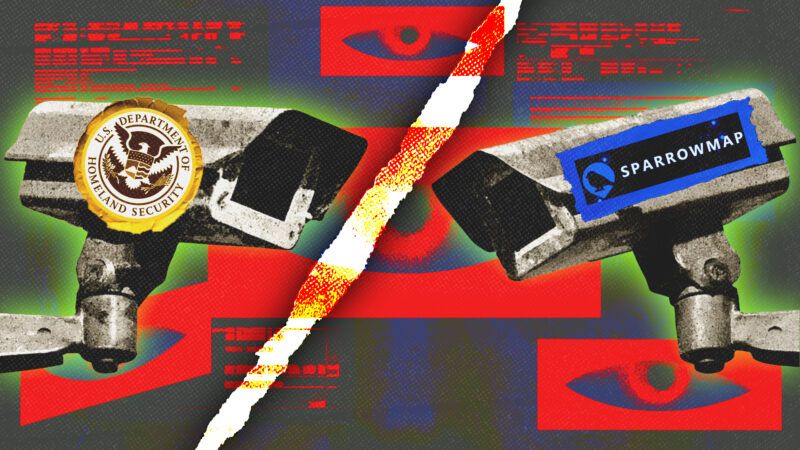
Department of Homeland Security (DHS) fusion centers have started monitoring anti-surveillance activists, according to records obtained by Reason. An intelligence report compiled in Massachusetts and redistributed by a Wisconsin fusion center shows that the government is tracking online critics of automated license plate readers (ALPRs) like Flock Safety. Included among the critics is a website, SparrowMap, that uses ALPR technology to track police vehicles in real time.
"Recent social media and forum users have called for the surveillance of government vehicle movement, to include law enforcement vehicles," the Massachusetts intelligence product states. "Users have mapped the movement of government vehicles across the United States through SparrowMap. The Commonwealth Fusion Center is providing this information for situational awareness. The CFC has no indication threat actors within the Commonwealth intend to leverage this information for criminal or nefarious purposes."
There is nothing illegal about SparrowMap. The platform processes publicly available livestreams from municipal cameras and footage provided by volunteers using everyday cameras, whether on an old laptop, iPhone, or Ring doorbell. Out of the 300,000 vehicles picked up by the network's 14,196 cameras every day, only a few dozen are police vehicles, and the rest of the data are quickly deleted.
Per SparrowMap's own how-to guide, "Volunteers point cameras at public roads, and everything they see goes into one shared database that anyone can read — no account, no login, no permission. Recognition happens on the contributor's own machine, so no video is ever uploaded. A person confirms anything before it is published as a government vehicle. Everything else becomes an anonymous dot that fades in forty-five seconds and is deleted in fourteen days."
The organization's code is publicly available on Github, and its founder, Matthew Montney Jr., posts his heavy metal music to the Instagram account tied to SparrowMap.
Despite the Massachusetts fusion center's standard caveat that it is not accusing anyone specific of criminal activity, the report hints that SparrowMap is linked to threats identified by the Trump administration. "On 12 August 2026, Reddit users encouraged the collection of government vehicle information, to include law enforcement and Immigration and Customs Enforcement (ICE), and uploading it into SparrowMap. One user called for the creation of a 'mesh network' of cameras and forming a public oversight committee. The user also suggested surveilling the movement of government officials as retaliation for purported government surveillance," the report states.
Under National Security Presidential Memorandum 7 (NSPM-7), titled "Countering Domestic Terrorism and Organized Political Violence", President Donald Trump instructed federal law enforcement to begin criminalizing opposition to the administration, including by persecuting those opposing its surge of federal law enforcement into the Midwest as part of a nationwide immigration crackdown.
In response to the memorandum, then–Attorney General Pam Bondi issued her own directive explicitly directing the FBI, Drug Enforcement Administration, Bureau of Alcohol, Tobacco, Firearms and Explosives, U.S. Marshals Service, and U.S. attorney's offices around the country to focus on "ending political violence against ICE." Part of this effort also included seconding local police into a newly created federal "ICE Protection Task Force." By linking SparrowMap to threats against ICE, the fusion center flagged for federal surveillance and potential prosecution an activist group that it recognizes as law abiding.
The federal government created 80 fusion centers around the country in the wake of 9/11, as an effort to eliminate the intelligence-sharing gaps that led to the deadliest terror attack in American history. These centers are usually headquartered within the offices of state police departments, and they compile local and state intelligence products before circulating them to the Department of Homeland Security and the FBI.
The information also flows the other way around, with both FBI and DHS memos routinely circulating intelligence reports to statewide fusion centers before making their way down to local police departments and sheriff's offices. In recent years, both federal law enforcement and state fusion centers have increasingly described activists who oppose mass surveillance—as well as AI and data centers—using language usually reserved for domestic terrorists.
Fusion centers and the analysts manning them are equipped with extraordinarily powerful open source intelligence tools, whose prohibitive cost means that law enforcement and corporate security are their most frequent customers. Tools integrated into LexisNexis, like ShadowDragon, query millions of posts and dark web breaches in an instant. Ironically, this system allows the government to surveil those opposing the very surveillance the government is engaged in.
The Massachusetts fusion center report on SparrowMap combines two novel threat categories that have been building momentum inside federal and local law enforcement agencies and the nonprofit think tanks that advise them. Earlier this year, WIRED reported that federal law enforcement and the New York Police Department (NYPD) intelligence bureau were circulating memos using a new term, "anti-technology extremism," to describe opponents of data centers and AI systems.
"We expect anti-technology violence, and violence leveraging technology," NYPD Deputy Commissioner for Intelligence and Counterterrorism Rebecca Ulam Weiner wrote in an article for Police Chief Magazine reflecting on the 25th anniversary of 9/11, adding that "2027 will be no different" when it comes to anticipating and counteracting new threats.
But as widespread resistance to mass surveillance builds across the country, it seems that the threat category "anti-technology extremism" fails to capture activists groups like SparrowMap, which are set on utilizing technology to oppose and counteract mass surveillance. Instead, a new threat category is taking shape, dubbed "anti-surveillance extremism" by Simon Purdue, director of the Violent Extremist Threat Monitor at the nonprofit Middle East Media Research Institute.
The institute was co-founded by Meyrav Wurmser, who worked in a variety of neoconservative think tanks and is married to David Wurmser, the adviser to former President George W. Bush who helped push false information in support of the Iraq War. It regularly shares reports with federal law enforcement.
In an article for Homeland Security Today earlier this month, Purdue warned of "the emergence of anti-technology and anti-surveillance extremism targeting public infrastructure, including [London's Ultra Low Emission Zone] cameras, data centers, telecommunications assets, and related technological systems. These incidents reflect growing hostility toward perceived mechanisms of state, corporate, and technological control and demonstrate how anti-government sentiment is increasingly translating into attacks against critical infrastructure."
When an external partner invents a new threat category, federal law enforcement tends to follow suit. But the federal government's desire to beat back the growing wave of "anti-surveillance extremism" will have to contend with the reality that impassioned sentiment opposing the companies and methods of AI-powered surveillance are now a majoritarian position across America.
Politicians from both political parties have scrambled to introduce legislation curbing or eliminating automated license plate readers altogether, at the same time that police associations hold secret briefings in Washington attempting to stem the anti-surveillance tide. A Reuters/Ipsos poll conducted last month found that 47 percent of respondents did not want a Flock Safety camera in their neighborhood a net unfavorability of 11 percentage points, with only 21 percent of adults below the age of 35 supporting Flock cameras.
"License plate readers went up on my roads without anyone asking, and the data only goes one way. I built SparrowMap to give people the government transparency they're entitled to, and honestly, to give the watchers a taste of how it feels to be watched," Montney, the founder of SparrowMap, tells Reason. "If it makes them uncomfortable, they should understand why the public doesn't want mass surveillance."