
D.C. Circuit Upholds Injunction Against Trump's Ballroom
The Constitution assigns control of federal property to Congress, which never approved the president's demolition and replacement of the East Wing.
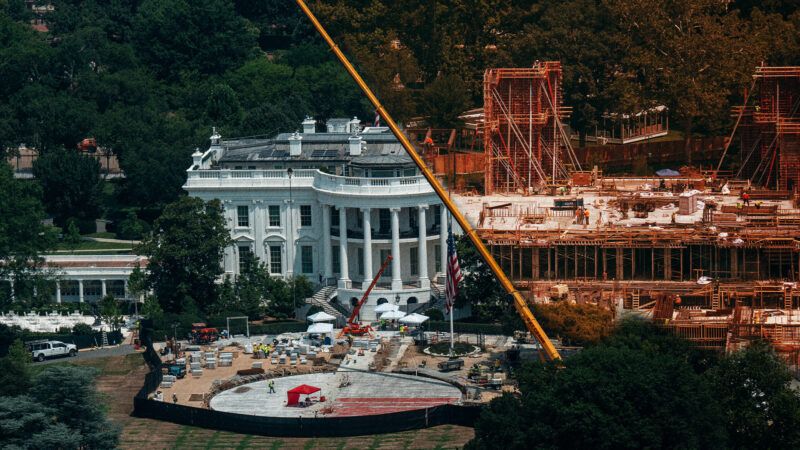
President Donald Trump demolished the East Wing of the White House last October, planning to replace it with a new structure that includes a 90,000-square-foot ballroom. Trump did not have the legal authority to do that, the U.S. Court of Appeals for the D.C. Circuit ruled on Friday, saying he may not complete the project unless and until Congress approves it.
"Each President is a temporary tenant, not the owner, of the White House and its Executive Residence," writes Judge Patricia Millett, a Barack Obama appointee, in an opinion joined by Judge Bradley Garcia, who was nominated by Joe Biden. "We are aware of no instance in American history in which a President unilaterally and using privately collected funds demolished substantial portions of the White House that Congress authorized to be built and American taxpayers paid for. Until now."
The decision in National Trust for Historic Preservation v. National Park Service upholds a preliminary injunction that U.S. District Judge Richard Leon, a George W. Bush nominee, issued on March 31 and later modified to exclude underground construction and parts of the project "strictly necessary" for security purposes. Leon's order never took effect because the D.C. Circuit temporarily blocked it while the government's appeal was pending. The injunction remains on hold because the D.C. Circuit gave the Trump administration 14 days to file an appeal with the Supreme Court, which the president said he will do.
Whatever its ultimate effect, the D.C. Circuit's decision affirms the rule of law and the separation of powers by rejecting Trump's claim that he can do whatever he wants with the White House. According to Trump's logic, Millett notes, citing Leon's opinion, "the President could bulldoze the entire White House and replace it with a new building of his own design, including a 'skyscraper.'"
The government conceded that the Constitution assigns control of federal property to Congress. But it cited several statutes that it said combined to authorize his replacement of the East Wing with a huge, gaudy structure that would be 60 percent larger than the White House residence in square footage and more than three times as large in cubic volume.
Like Leon, the D.C. Circuit did not buy it. "Congress does not 'hide elephants in mouseholes,'" Millett says, quoting a 2001 opinion by Justice Antonin Scalia, whom Trump has described as the very model of a "great" jurist. "If Congress, acting against the backdrop of other statutes that strictly limit construction within Park System units
in the District of Columbia, and which require the government to jump through significant procedural hoops to accept even donations of furniture at the White House, wanted to convey to the President unchecked construction authority over the White
House, we would expect it to do so with language saying just that."
Congress never did that. But it did enact 40 USC 8106, which says "a building or structure shall not be erected on any reservation, park, or public grounds of the Federal Government in the District of Columbia without express authority of Congress."
In lieu of such "express authority," the Trump administration cited 54 USC 100101, which says the National Park Service (NPS) "shall promote and regulate the use of the National Park System by means and measures" that aim to "conserve the scenery, natural and historic objects, and wild life" of the system's units. Those units include the White House and the rest of President's Park. Although demolishing a major component of that park might not look like "conserv[ing]" a "historic object," the Trump administration argued that the project fits within the NPS mission.
The government's lawyers noted that Congress has authorized the secretary of the interior to accept donations in support of the NPS, which can be spent via trust funds. And under the Economy Act, they argued, the NPS could transfer those donations to the Office of the Executive Residence (EXR) as payment for a "contract" to build the ballroom.
Contradicting that description of the arrangement, the government has said the project "is being planned, directed, and executed by the Executive Office of the President" and the EXR, which suggests the NPS is not in charge. Rather, as Leon observed, the NPS was dragooned as part of a "Rube Goldberg contraption" aimed at using private donations to close the gap between the estimated $400 million cost of the project and the much smaller amount of money that Congress has allocated for the care and maintenance of the White House.
Speaking of which, the Trump administration also invoked 3 USC 105(d), which authorizes the president to use appropriated money for "the care, maintenance, repair, alteration, refurnishing, improvement, air-conditioning, heating, and lighting (including electric power and fixtures) of the Executive Residence at the White House." In 2024, 2025, and 2026, Congress appropriated $2.5 million under Section 105(d), which was to be used for "required maintenance, resolution of safety and health issues, and continued preventative maintenance."
If you still are not seeing permission for a massive, landscape-altering project like this one, you are not alone. Millett notes that "the Economy Act does not authorize an agency to use another agency to do anything it could not lawfully do itself." The purported arrangement between the NPS and the EXR therefore is legally valid only if you accept the government's counterintutive interpretation of Section 100101.
Adding Section 105(d) to the mix does not really help the government's case. "The Defendants have authority to carry out the ballroom construction only if both statutes apply," Millett writes. "Section 100101(a) alone cannot support the project" because "the only statute that could supply EXR authority to lead the project is Section 105(d)."
The government "conceded at oral argument that Section 105(d) alone cannot support the project," Millett notes. "That is so because the project is funded by private donations given to the National Park Service and—even on the Defendants' view of the case—those funds can be used to support the ballroom construction only if the National Park Service could use the funds under Section 100101(a) for the identified purposes of conservation and preservation," which do not seem to fit this project.
Section 105(d) "does not confer independent authority upon the President absent an accompanying appropriation under that Section on which the President can rely," Millett writes. "Yet the Defendants are relying on privately donated funds, not congressional appropriations….Funds donated to the Park Service by third parties under 54 U.S.C. § 101101 are not funds 'appropriated under' Section 105(d) by Congress. There is no plausible argument to the contrary."
Nor do the terms of Section 105(d) easily fit the ballroom project. For one thing, that statute refers to work at "the Executive Residence at the White House," which is usually understood as distinct from the East Wing and the West Wing.
The defendants "breeze past the 'Executive Residence at the White House' qualifier and make no argument at all—not one word—that the East Wing is part of the Executive Residence at the White House," Millett writes. "The phrase 'Executive Residence at the White House' would be a very strange way to refer to the entire White House. Instead, it is most naturally read to refer only to" to the central part of the White House, which is where the president and his family live.
Even assuming that Congress meant to cover the East Wing, the terms it used do not clearly authorize a change as dramatic as Trump plans. The government argued that the references to "alteration" and "improvement" were broad enough to encompass what Trump has in mind. Millett, like Leon, thinks not.
"The interpretive instruction that a word in such a list is 'known by the company it keeps' applies with straightforward logical force here," Millett says. "Congress is extremely unlikely to have written a statute that says, in the same breath, that the President may maintain the Executive Residence at the White House, replace its light fixtures, fix the air conditioning, and demolish and replace the entire structure with whatever new structure he prefers. One of those things is not like the others."
The words alteration and improvement "can easily have independent meaning without coming anywhere close to the Defendants' expansive whatever-the-President-wants view," Millett writes. For example, "an 'improvement' to an existing structure often refers to renovations that update a structure without crossing the line to construction of an entirely new one. We need not precisely demarcate the bounds of that authority to recognize that demolishing and replacing an entire, major structure falls well outside of it."
The Constitution "assigns Congress—not the Executive—the responsibility to decide whether proposed changes to the physical design of the White House may proceed, even where those changes are said to serve security interests," Millett says. "The Defendants have not shown that Congress delegated that authority to either the President or the National Park Service. Whether or not a massive ballroom should be constructed is for Congress to decide and is not a matter for Executive self-help."
For many years, "Congress has regularly exercised its powers over federal property and the purse to authorize and fund improvements to the White House at the Executive's request," Millett notes. "The Defendants make no argument that, if a massive ballroom is indispensable to national and presidential security, Congress would refuse to allow it. And the equities do not swing in the Defendants' favor merely because end-running the Constitution's allocation of powers apparently seemed a more expedient route to their desired goal."
According to the defendants, none of this matters. "In their telling," Millett says, "the policy goals of having a ballroom are so imperative that construction must continue regardless of its legality." She is alluding to the position that Principal Deputy Assistant Attorney General Yaakov Roth took during oral argument in this case last June, when he repeatedly insisted that the courts have no business interfering with the president's vanity project, whether it is legal or not.
Writing in dissent, Trump appointee Neomi Rao says the points raised by Roth, who emphasized that the project serves national security interests and is already pretty far along, deserve more respect than the majority gives them. More fundamentally, she disagrees with the majority's conclusion that the National Trust for Historic Preservation probably had standing to challenge the project, which she thinks is "likely within the President's authority to make improvements to the Executive Residence at the White House." Agreeing with Roth, Rao says Leon's "extraordinary injunction" was "a blatant abuse of discretion."