
A Viral Tweet Set Off a Discourse on $20 Burritos. Here's the Truth About Inflation.
Americans are angry because everyday goods are much more expensive, and politicians think they should “stop whining.”
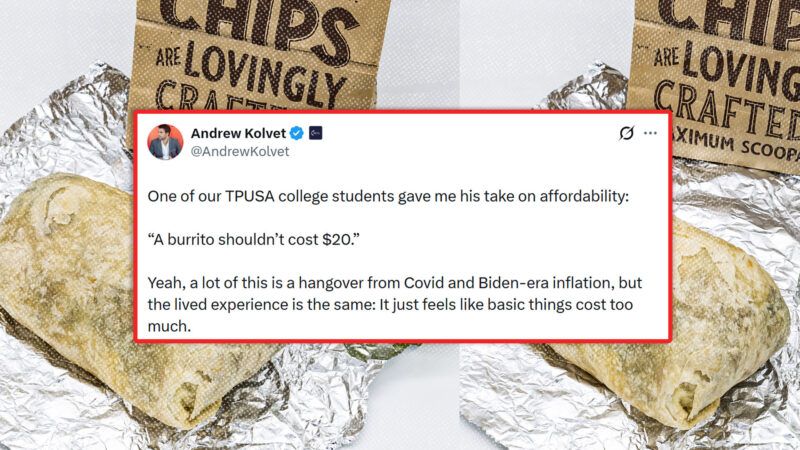
"A burrito shouldn't cost $20."
That's what one Turning Point USA college student recently told the organization's spokesman, Andrew Kolvet, who posted the comment on X in response to conservative pundit Matt Walsh's complaints about rising grocery prices. Kolvet's post garnered a massive response this week, sparking a debate among conservatives about the price of burritos and what the "America First" response should be.
One of our TPUSA college students gave me his take on affordability:
"A burrito shouldn't cost $20."
Yeah, a lot of this is a hangover from Covid and Biden-era inflation, but the lived experience is the same: It just feels like basic things cost too much. https://t.co/GEvmbea57o
— Andrew Kolvet (@AndrewKolvet) August 4, 2026
Weighing in on the discourse, conservative commentator Ben Shapiro posted: "Current 'common good conservative' inflation messaging: $20 burritos are a human right but also every serious methodology for making them cheaper (i.e. kill the tariffs, break the unions, and deregulate the food supply chain) isn't America First, so we need to complain a lot about how America is cooked and then surrender to Iran."
Helpfully, Advancing American Freedom—a nonprofit launched by former Vice President Mike Pence—even created a "Burrito Index," which found that a Chipotle steak burrito costs $14.10 in San Francisco and $13.50 in New York City. On the cheaper end, it costs $11.35 in Des Moines, Iowa, and $11.50 in Salt Lake City.
So why are burritos so expensive?
"A price change over a given period of time is affected by two factors: the general inflation in the economy, which is raising all prices, and specific things that are happening in individual markets that affect the relative prices of those goods," Ryan Bourne, an economist at the Cato Institute and author of The War on Prices, tells Reason. "If the question is why are burritos now so much more expensive in dollar terms than they were six years ago, overwhelmingly the reason for that is just the high inflation that we've lived through."
Bourne notes that overall consumer prices have increased by around 28 percent over six years, so general inflation "accounts for the vast bulk of the increase in burrito prices."
A myriad of other factors also contribute to the final price of a product, including tariffs, energy costs, minimum wage laws, and immigration crackdowns (which increase the cost of labor).
California provides a good test case for this. Earlier this year, Axios compared old and current menus at several popular Mexican restaurants in San Diego, and found increases ranging from around 19 percent to more than 70 percent. Harry's Taco Club raised its price from $9.95 in 2020–2021 to $15.99 in 2026, while Lolita's went from $7.75 in 2020 to $13.45 today. Restaurant owners attributed the increases to higher costs for labor, ingredients, rent, and insurance, with beef prices rising particularly sharply.
"There's this kind of fragile public acceptance with prices that when you see a big burst of price increases, people instinctively seem to treat the previous price as something good, fair, and holy, and the new price after that big surge in demand as something unjust, unacceptable, and in need of redress," says Bourne. "We still seem to be in that state of reacting to the inflation at the moment."
Politicians also sounded off on the burrito debate, including Rep. Dan Crenshaw (R–Texas), who told people to "stop whining, get a job, eat Ramen."
Washington Post columnist Marc Thiessen took a similar line: "A burrito only costs $20 when you buy it on Door Dash because you're too lazy to walk over to Chipotle or Taco Bell….When I graduated I lived on ramen noodles, had two roommates, and worked two jobs. I didn't whine about affordability, I worked hard so I could one day afford a better life."
A burrito only costs $20 when you buy it on Door Dash because you're too lazy to walk over to Chipotle or Taco Bell (where you can get one for $3.99). When I graduated I lived on ramen noodles, had two roommates, and worked two jobs. I didn't whine about affordability, I worked… https://t.co/thAdmRTOIo
— Marc Thiessen (@marcthiessen) August 5, 2026
It is, of course, true that fast food is more expensive than cooking yourself, but Bourne worries "that type of stuff kind of gets policymakers off the hook, because clearly what is annoying people is the change that they've seen in a short period of time."
"If politicians really do actually believe that food should be more affordable, there's plenty they could do. They could take off all the tariffs on food….They could get rid of the sugar program."
If a social media post about the cost of a burrito can spark an internet firestorm, it is clear that Americans are weary of the cost of living. Politicians can lecture people to lower their expectations (which is sure to backfire at the ballot box), or they can stop pursuing the inflationary policies that make burritos, and everything else, more expensive.