
Tariff Man
Plus: House votes on war powers as Trump enters Iran war "revenge mode," Ted Cruz worries about AI, Marvel movies are planned through 2042, and more...
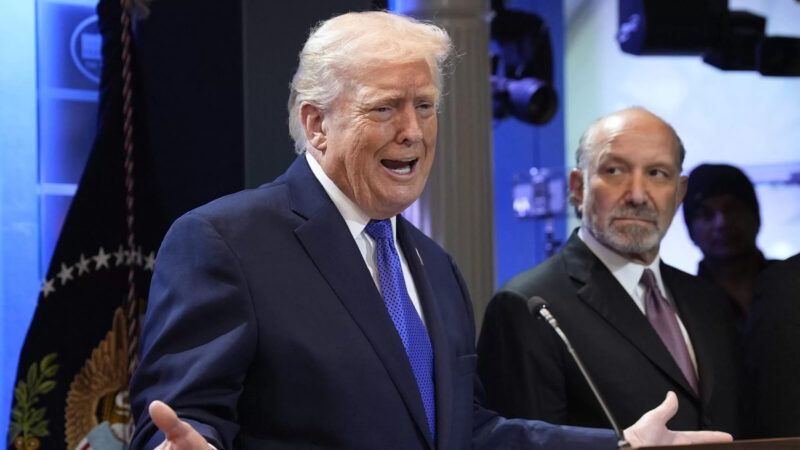
Call of duties. After most of President Donald Trump's unilateral tariffs were struck down by the Supreme Court earlier this year, the president reinstated a sweeping global 10 percent tariff under a different—and also questionable—legal authority. But the new legal authority comes with a 150-day clock, meaning the reinstated tariffs would eventually expire.
Today, the 150 days are up. And as of yesterday afternoon at 4 p.m. in Washington, D.C., no one knew precisely what the next tariff regime would look like.
The Reason Roundup Newsletter by Liz Wolfe Liz and Reason help you make sense of the day's news every morning.
Well, the new tariff regime has finally been announced, and it looks a lot like the old one. Most of America's significant trading partners—some 60 economies—will now face a 10 percent tariff. Those without laws intended to prevent forced labor will be hit with a 12.5 percent tariff.
Ostensibly, according to the administration, the move "encourages stronger labor rights enforcement abroad." The White House called the new tariffs "the most sweeping international labor rights action the United States has ever taken."
But there's some reason to be skeptical of the stated motivation, given that Trump has long pushed for widespread tariffs under a variety of justifications, not all of which are internally coherent. As visiting Georgetown Law scholar Peter Harrell told The New York Times, Trump's trading officials are "using this forced labor investigation as a pretext to impose tariffs that Trump wants to impose for his own economic theories and preferences."
Trump is just doing what he wants to do, and what he wants to do, now and always, is impose tariffs.
Congress, the opposite of progress. In theory, under the Constitution, only Congress has the power to declare war. In practice, under America's actual government, that has not always been the case.
At the beginning of May, Trump notified Congress that the war he'd started with Iran was officially terminated. There was a ceasefire deal in place, with a few formalities left to be worked out. That ceasefire, however, didn't last. And earlier this month, Trump notified Congress that the United States was once again at war with Iran. Officially speaking, it was a new war, giving the White House another 60 days to act without congressional go-ahead. As Politico reported at the time, the Trump administration framed the supposedly new war as a defensive measure, saying that the president was taking "military action consistent with my responsibility to protect Americans and United States' interests both at home and abroad." Meet the new war, same as the old war.
Congress, of course, could always weigh in and exercise some of its constitutional prerogatives over the executive branch. And yesterday, finally, one chamber did, sort of—in a way that was guaranteed from the start to be meaningless.
On Thursday, the U.S. House voted in favor of a resolution to stop the war. Four Republicans—Reps. Thomas Massie (R–Ky.), Brian Fitzpatrick (R–Pa.), Tom Barrett (R–Mich.), and Warren Davidson (R–Ohio)—voted with Democrats to put an end to Trump's unilateral war in the Middle East. But the resolution was a nothingburger from inception. As CNN notes, "even if it passed the Senate, it would not compel the administration to end the war. Concurrent resolutions, which are not presented to the president for signature or veto, lack the force of law."
The House was finally taking action—bold, meaningless action.
Meanwhile, a Senate effort to block the effort failed shortly after yesterday's House vote. The congressional position on the war amounts to a shruggie emoticon.
It's a fitting tribute to the current weakened state of Congress that even when it takes the time to exercise its constitutional prerogatives, it does so in a way that is intentionally guaranteed, from the outset, to be pointless and futile.
Substandard subpoenas. Speaking of the Constitution, remember the First Amendment? It has a number of elements, including freedom of the press, freedom of religion, and freedom of association. There's a lot going on. But one of the main things it does is protect the ability to say things, even potentially critical things, about the government, without fear of legal reprisal. This applies to Americans of all sorts, even journalists. One might assume that lawyers for the Justice Department know how these things work.
So it raised a few eyebrows when the Trump administration subpoenaed New York Times reporters following the publication of articles about Trump's glitzy new gift airplane from Qatar. The Times reporting suggested that the plane might lack some defense capabilities, like missile defense. Eventually, the White House announced the plane would be pulled from service so it could be "maxxed out." Meanwhile, the government subpoenaed the Times reporters, attempting to force them to testify in front of a grand jury.
The Times pushed back in court, and yesterday, after some stern words from a federal judge, Trump's Justice Department withdrew the subpoenas.
Scenes from Massachusetts: Despite declines in reading, bookstores are making a comeback, including in Boston.
QUICK HITS
- Trump is reportedly "losing patience" with the war in Iran. "A senior administration official said Trump believes that the only thing Iran understands is military force, adding that he was in 'revenge mode' against Tehran," reports The Wall Street Journal. This means that the amped up strikes will most likely continue, even though Trump seems to want out of the war. One way to avoid this sort of conundrum is to just…not start a war in the first place.
- Sen. Ted Cruz (R–Texas) is reportedly looking at a bill intended to take up catastrophic AI risk. Meanwhile, Anthropic's chief economist discusses why AI has yet to increase unemployment.
- Congress is working on another spending bill. It's already passed the House, which is now pushing the Senate to move quickly on their end. The budget bill would allow an additional $95 billion to be added to the federal budget deficit, and with interest, the figure is more than $100 billion.
-
this interview is the skeleton key to his genius, i think, bc nolan's work is kind of like, what if a filmmaker had just two north stars: jorges luis borges short stories and fast and the furious films https://t.co/iaN02lFcJG
— Derek Thompson (@DKThomp) July 23, 2026
- Congrats, Xbox owners: There's a new Halo game, but it's just the old Halo game, remade.
- The Marvel Cinematic Universe (MCU) has struggled at the box office recently, and I have a feeling that this year's big comic book event movie, Avengers: Doomsday, will underperform when it hits theaters in December. But MCU chief Kevin Feige says the studio has movies planned all the way through 2042.