
America's Nuclear Industry Doesn't Need Cronyism To Thrive
Privately funded nuclear reactors are achieving critical milestones on their own, but the Trump administration wants to prop up a single company.
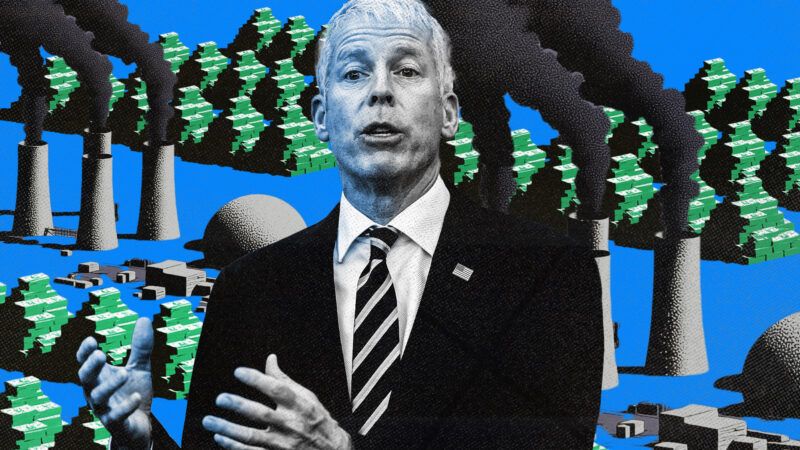
Energy Secretary Chris Wright declared Thursday, during an interview with CNBC at Idaho National Laboratory, that America had entered the "golden era" of nuclear energy. Wright's bold proclamation coincides with the Energy Department's launch this week of a $17.5 billion loan program, through its Office of Energy Dominance Financing, to "rebuild" America's nuclear supply chain.
The loan program will finance five projects "sponsored by utilities and energy companies nationwide" that will begin construction on 10 large-scale commercial nuclear reactors across the United States by 2030. It's a lofty goal, and there's certainly a demand nationwide for new energy generation capacity, but a federal loan program cuts against Wright's argument that "private capital, private innovators" are steering the nuclear renaissance.
All 10 reactors will be AP1000s built by Westinghouse Electric Corporation, the same company the Trump administration signed a golden shares agreement with last October. It's no surprise then that the Energy Department's $17.5 billion loan program—exclusively for Westinghouse's product—matches the terms of that agreement, in which the government receives a 20 percent share of any dividends "paid out by Westinghouse above a $17.5 billion threshold," according to Bloomberg's Liam Denning.
Projects will be "jointly owned" by Westinghouse and a utility or energy company, each of which will be required to commit $500 million to the venture before any loan is approved. Westinghouse has already signed letters of intent with seven potential partners, according to the Energy Department, though details of the partnerships have yet to be released.
Despite renewed private sector interest in nuclear power, it's still expensive to build new reactors and power plants. The department's loan program is intended to alleviate the upfront costs of building new reactors, which have an average cost overrun of $1.56 billion per project, according to one estimate from Boston University's Institute for Global Sustainability.
The Westinghouse loan program is a step backward for an administration that has mostly recognized that the largest roadblock to deploying nuclear power is often the government itself.
Last June, to meet the president's goal of tripling the nation's nuclear energy capacity by 2050, the Energy Department launched its Reactor Pilot Program. The program aims to have three new self-sustaining, advanced, and smaller reactors by July 4 and fast-track viable projects through a new commercial licensing process.
The program is off to a successful start. This month, advanced nuclear reactors built by Antares Nuclear and Valar Atomics, respectively, reached the criticality milestone, with AALO Atomics set to join them "in the next few days," according to Wright.
Yet there's an important distinction between the reactors approved through the pilot program and the prospective reactors backed by federal loans. The three projects were able to cut through regulatory red tape thanks to the pilot program, but the private sector financed them entirely.
Since launching a few years ago, Valar Atomics has raised over $489 million in private capital, and Antares Nuclear has raised over $140 million. AALO Atomics raised $100 million in its last funding round alone. It appears all they needed was for the government to get out of their way.
In contrast, even though the AP1000 is the only large advanced reactor commercially operating in the United States, it's difficult to believe the Trump administration didn't choose Westinghouse because the government has a vested interest in its success.
Competition breeds innovation. The Trump administration could seemingly achieve its goal of energy dominance by streamlining the licensing process—which it has started to do—to allow other firms to compete with Westinghouse's approved design, rather than picking winners and losers and putting taxpayers on the hook for the project's success.
Bringing large-scale advanced reactors online by the "early to mid 2030s" is an ambitious timeline, given that the only other AP1000s to be completed—Vogtle Units 3 and 4 in Georgia—took nearly 17 years from initial permits to completion, with a cost overrun of nearly $21 billion.
Increasing nuclear power generation in the U.S. is a worthy goal. With the private sector already eyeing investments in the nuclear industry, there's simply no need for the government to put its thumb on the scale to usher in a true "golden era" for the industry.