
Trump, Scalia, and the Unitary Executive
How a four-decade-old dissent may now help the president fire independent federal agency heads at will
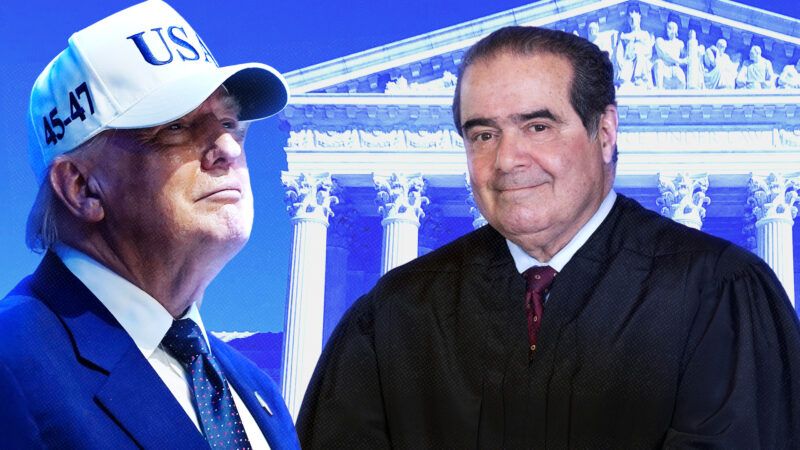
Sometime in the next two or three weeks, the U.S. Supreme Court will decide a case about the president's authority to fire independent federal agency heads "at will," rather than "for cause," as federal law currently requires. If President Donald Trump wins the case, as many legal observers think he probably will, a 1988 dissenting opinion by a famous conservative justice is likely to play a key supporting role.
You’re reading Injustice System from Damon Root and Reason. Get more of Damon’s commentary on constitutional law and American history.
The pending case is Trump v. Slaughter. It centers on Trump's purported firing of Rebecca Slaughter from her position as a commissioner of the Federal Trade Commission (FTC). According to the Federal Trade Commission Act, FTC commissioners may only "be removed by the President for inefficiency, neglect of duty, or malfeasance in office." Trump, however, purported to fire Slaughter for purely political reasons, which the statute, as written, does not allow. The question now before the Supreme Court is whether that statutory requirement amounts to an unlawful restriction on executive power.
A majority of the Supreme Court seems inclined to view the law in that unforgiving light and rule in Trump's favor. If the Court does so, among the legal authorities it is likely to cite is a solo dissent written by the late Justice Antonin Scalia in a case called Morrison v. Olson (1988). Because of the outsized role that Morrison may well play in Slaughter, it's worth revisiting that earlier case as we wait for the Slaughter decision to come down.
The story starts in 1978 with the passage of the Ethics in Government Act, a post-Watergate law designed to rein in the executive branch in the wake of the many misdeeds committed by the Richard Nixon administration. Among other measures, that law created the new office of the independent counsel, a special kind of federal prosecutor who would be tasked with investigating and prosecuting alleged crimes committed by executive branch officials.
At issue in Morrison v. Olson was whether the existence of the independent counsel violated the constitutional separation of powers because it placed certain executive authorities beyond the immediate reach of the chief executive. Writing for the majority, Chief Justice William Rehnquist, a judicial conservative who was first appointed to SCOTUS by none other than Nixon, readily affirmed the independent counsel law. "Although the [independent] counsel exercises no small amount of discretion and judgment in deciding how to carry out his or her duties under the Act," Rehnquist wrote, "we simply do not see how the President's need to control the exercise of that discretion is so central to the functioning of the Executive Branch as to require as a matter of constitutional law that the counsel be terminable at will by the President."
Writing alone in dissent, Scalia offered a very different view of the matter. The Constitution placed the executive power in the hands of the president alone, Scalia argued, and "this does not mean some of the executive power, but all of the executive power."
This view, sometimes known as the unitary executive theory, has only grown in stature and influence on the legal right in the years since. In 2018, for example, the Supreme Court declared the single-director structure of the Consumer Financial Protection Bureau unconstitutional. "Such an agency," Chief Justice John Roberts wrote for the majority in Seila Law v. Consumer Financial Protection Bureau, "lacks a foundation in historical practice and clashes with constitutional structure by concentrating power in a unilateral actor insulated from Presidential control."
Writing in concurrence, Justice Clarence Thomas, joined by Justice Neil Gorsuch, agreed with Roberts about that outcome but also argued that the majority should have gone even further in its policing of legislative restrictions on the executive branch. That concurrence repeatedly cited Scalia's Morrison dissent. More recently, the Trump administration did the same thing in its principal brief in the Slaughter case, which also repeatedly cites to Scalia in Morrison.
If Trump does prevail in his efforts to fire Slaughter from the FTC, don't be surprised when the long shadow cast by Scalia's nearly 40-year-old dissent is visible in the Court's decision.