
Does Reporting Bad News About the Iran War Make You a Foreign Agent?
The Trump administration invokes the notoriously vague FARA to threaten a critic.
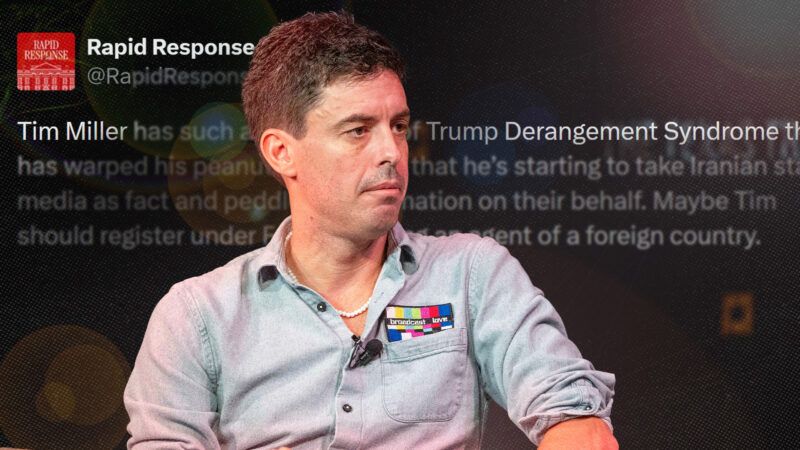
The Trump administration has made no secret of its desire to censor bad news about the Iran war. President Donald Trump even accused journalists of treason during the war. Now the administration has found a specific (if extremely tenuous) legal justification for his claims: the Foreign Agents Registration Act (FARA).
After The Bulwark journalist Tim Miller shared someone else's paraphrase of an Iranian TV news report about the ceasefire negotiations, the official White House Rapid Response account on X commented that Miller is "starting to take Iranian state media as fact and peddle disinformation on their behalf. Maybe Tim should register under FARA for being an agent of a foreign country."
On its face, Miller's criticism falls far outside of FARA. All he did was comment on a public report. But it wouldn't be the first time the federal government tried to weaponize FARA against domestic critics.
Passed in 1938 to root out Nazi agents, the law requires anyone conducting political activities "at the order, request, or under the direction or control" of a foreign power to register publicly or face jail time or fines.
In 1951, the Department of Justice tried to prosecute civil rights activist W.E.B. Du Bois under FARA for republishing an international communist-led petition against nuclear weapons. A judge threw out the case after prosecutors failed to present evidence of any concrete Soviet ties. Since then, the government has mostly used FARA to prosecute foreign spies short of the Espionage Act, to add another layer of red tape to foreign lobbying, and to throw the book at corruption schemes involving foreigners.
Still, the law is "strikingly sweeping, capturing much other conduct that most people would not think should be registrable," according to a 2022 article in Just Security, which recommended narrowing the foreign-agent law to avoid abuse. The Department of Justice once required an American church to register as a foreign agent for bringing foreign congregants to the March for Life rally in Washington, D.C. Until 2024, the department also considered paid tourism promoters foreign agents.
The first Trump administration pushed Russian, Chinese, and Qatari news outlets to register as foreign agents. The nonprofit Committee to Protect Journalists accused the Department of Justice of using FARA as a political cudgel and undermining freedom of the press.
The threat against Miller seems to confirm critics' worst fears about FARA. And it is also the latest attempt by the Trump administration to browbeat journalists out of reporting on the Iran war. Miller struck a nerve by pointing out that the reported U.S. peace offer falls far short of Trump's war goals, and might have put the U.S. in a worse position than it was before Trump attacked. The White House lashed out at Miller without actually saying what was false about the report.
During the war, Federal Communications Commission Chairman Brendan Carr threatened to yank TV stations' licenses for spreading "fake news." That threat was directed at a Wall Street Journal article about damage to U.S. aircraft that turned out to be true. And it was ultimately an empty threat.
But even raising the possibility of legal punishment—and directing it at individual citizens—is a heavy cudgel for the government to wield. Last year, the official U.S. Immigration and Customs Enforcement (ICE) account accused CATO Institute Director of Immigration Studies David Bier of inciting "DAILY assaults" on federal agents for sharing an NBC News report about an ICE shooting. The Department of Homeland Security told Reason that filming ICE agents "sure sounds like obstruction of justice."
The point is not to have an airtight legal case that can be used to prosecute critics. The point is to exploit the vagueness of the law to terrorize people out of speaking up in the first place.