
The James Comey Indictment Looks Like Vindictive Prosecution
Such claims are hard for most defendants to prove. But most defendants haven't drawn the public ire of the president.
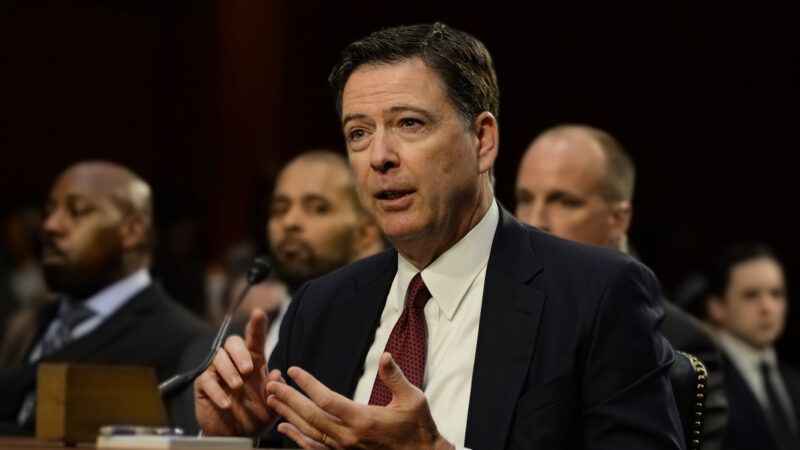
The U.S. Department of Justice (DOJ) this week indicted former FBI Director James Comey on two felony counts of threatening the president. The case stems from a May 2025 Instagram post, in which Comey shared a photo of seashells arranged to spell "86 47"—86 being a slang term for getting rid of someone or something, and 47 a reference to Donald Trump, the 47th president of the United States.
The case is meritless. It appears to be a vehicle for settling a personal grudge—Comey has been a target of Trump's ire for nearly a decade—and is so deficient that the former FBI director has an unusually strong argument for vindictive prosecution.
The indictment alleges Comey violated two federal statutes: one against threatening the president and the other against transmitting such a threat "in interstate or foreign commerce." Comey "did knowingly and willfully make a threat to take the life of, and to inflict bodily harm upon, the President of the United States," according to the federal government. He did so, it says, by posting the seashell photo, "which a reasonable recipient who is familiar with the circumstances would interpret as a serious expression of an intent to do harm to the President of the United States."
That is, to put it mildly, up for debate. The term 86, according to Merriam-Webster, broadly means "to eject, dismiss, or remove (someone)," originating from 1930s soda-counter culture. And while the dictionary acknowledges the term can imply violence, it says it does not include that connotation in its definition "due to its relative recency and sparseness of use." Which perhaps explains, as Reason's Billy Binion noted last year, why several Trump allies—from former Rep. Matt Gaetz (R–Fla.) to MAGA influencer Jack Posobiec—have used the term about their political opponents without eliciting similar outrage, much less investigation or prosecution.
Comey deleted the post. "I didn't realize some folks associate those numbers with violence," he said in an apology, and he agreed to an interview with Secret Service. It later emerged that after Comey posted the photo from the North Carolina beach where he and his wife were on vacation, law enforcement reportedly followed and surveilled him as he returned home, as if suspecting he might make good on the perceived threat. In announcing the indictment, FBI Director Kash Patel said the government had worked on the seashell investigation "over the past 9, 10, 11 months."
"I think this prosecution is unjustified, and will get thrown out," writes UCLA School of Law professor Eugene Volokh, who notes the case is likely doomed on First Amendment grounds. The Supreme Court's ruling in Counterman v. Colorado (2023) established that to punish someone over a threatening statement, the government "must show that the defendant consciously disregarded a substantial risk that his communications would be viewed as threatening violence."
It is difficult to argue this meets that bar. "The idea that Comey's picture of seashells conveyed a serious intent to harm the president is ridiculous," adds the Foundation for Individual Rights and Expression. "The administration should abandon this transparent and unconstitutional attempt to punish a critic."
Yet apart from the speech implications, Comey also has a stronger-than-average argument that he is being vindictively prosecuted.
As far back as 1886, the Supreme Court recognized a right against selective prosecution, when laws are applied only against certain groups or individuals. It later established a similar doctrine against vindictive prosecution, forbidding prosecutorial decisions based on personal animus. It is a high bar to clear. But because of the way Trump and his administration have behaved during his second term, Comey may have a good shot.
Consider, first, that this was the Trump administration's second prosecution of Comey in less than a year. In September 2025, prosecutors brought an indictment in the Eastern District of Virginia charging Comey with lying to Congress; the case came less than a week before the statute of limitations expired. More importantly, it also followed closely on the heels of a Trump Truth Social missive addressed to then–Attorney General Pam Bondi—which, sources say, was intended to be a private message. "Nothing is being done," Trump complained, singling out Comey as well as Sen. Adam Schiff (D–Calif.) and New York Attorney General Letitia James. "They impeached me twice, and indicted me (5 times!), OVER NOTHING. JUSTICE MUST BE SERVED, NOW!!!" Was this about justice, or was this about getting revenge? (A federal judge later dismissed the case not because of vindictive prosecution, but because the prosecutor who brought the indictment was improperly appointed.)
Under current Supreme Court precedent, a defendant must prove the government's motivations to succeed on a vindictive prosecution claim. Obtaining such evidence usually requires getting to discovery. But to be permitted to go to discovery, defendants usually need some evidence. "How are you supposed to be able to win your motion if you aren't allowed to get the government to answer your questions and give you documents?" Carissa Byrne Hessick, a professor at the University of North Carolina at Chapel Hill School of Law, tells Reason. "Basically they're saying you have to have the evidence before you can ask for the evidence."
This is not your typical case, however, particularly when considering the president of the United States has taken to social media demanding prosecutions of his personal enemies, including Comey. (The post is still up.)
The former FBI director is not guaranteed to defeat the indictment on such grounds. "He has a very strong case for discovery—that is, a very strong case to be able to ask DOJ questions and get documents for them," Hessick says. That's "a separate question," she notes, "from whether he'll win the motion [or] whether he'll get the charges dismissed." But even just getting to that point, she adds, and getting to scrutinize prosecutors' decision-making process, would be "terribly embarrassing" for the administration.