
Trump's Tariffs Are Not Going To Eliminate the Income Tax
And that's especially true if the tariffs are illegal.
It's been a chaotic few days for President Donald Trump's tariff policies, but one thing remains very true: Tariffs are not going to offset the federal income tax anytime soon.
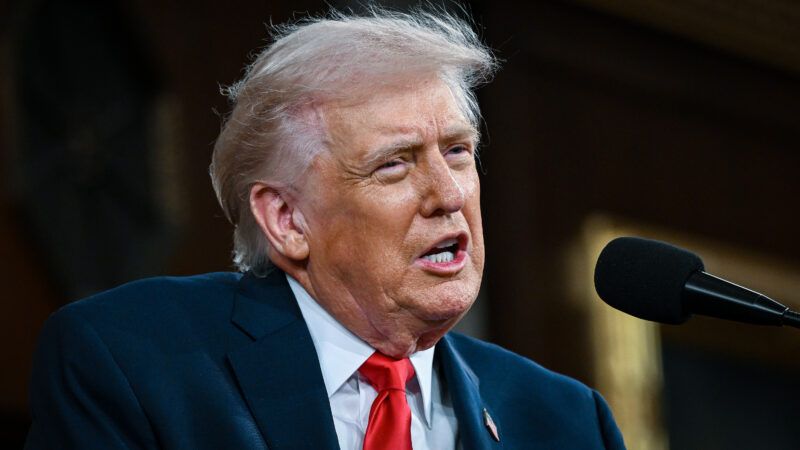
"As time goes by, I believe the tariffs paid for by foreign countries will, like in the past, substantially replace the modern-day system of income tax," Trump said during Tuesday night's State of the Union address.
The president has been making versions of this claim since his 2024 campaign. Like his similar claim that tariffs will allow the federal government to pay off the national debt—a promise so outlandish that Trump seems to have abandoned it, though some of his fans keep repeating it—the math simply does not work.
Individual income tax collections have totalled $924 billion over the first four months of this fiscal year, while tariffs have brought in about $118 billion, even after Trump hiked tariffs to levels not seen in decades.
And as the Tax Foundation noted last year, the biggest problem here isn't the gap in revenue totals. It's the gap in the size of the tax base.
In recent years, the U.S. has imported around $3 trillion worth of goods annually. To achieve anything like income tax levels of annual revenue from tariffs, you'd need astronomically high tariff rates.
"And raising tariff rates astronomically high would significantly depress imports, making it impossible to generate enough revenue to fully replace the income tax," the Tax Foundation concludes.
Of course, if the tariffs are illegal, as the Supreme Court recently ruled, they will generate significantly less revenue.
The alternative would be to dramatically reduce the size and cost of the federal government so that it could be funded with tariffs. Sign me up for that.
Unfortunately, the Trump administration has shown little desire to actually reduce the cost of government, despite some rhetoric to the contrary. Total federal spending increased during Trump's first term and then did it again during the first year of his second term.